
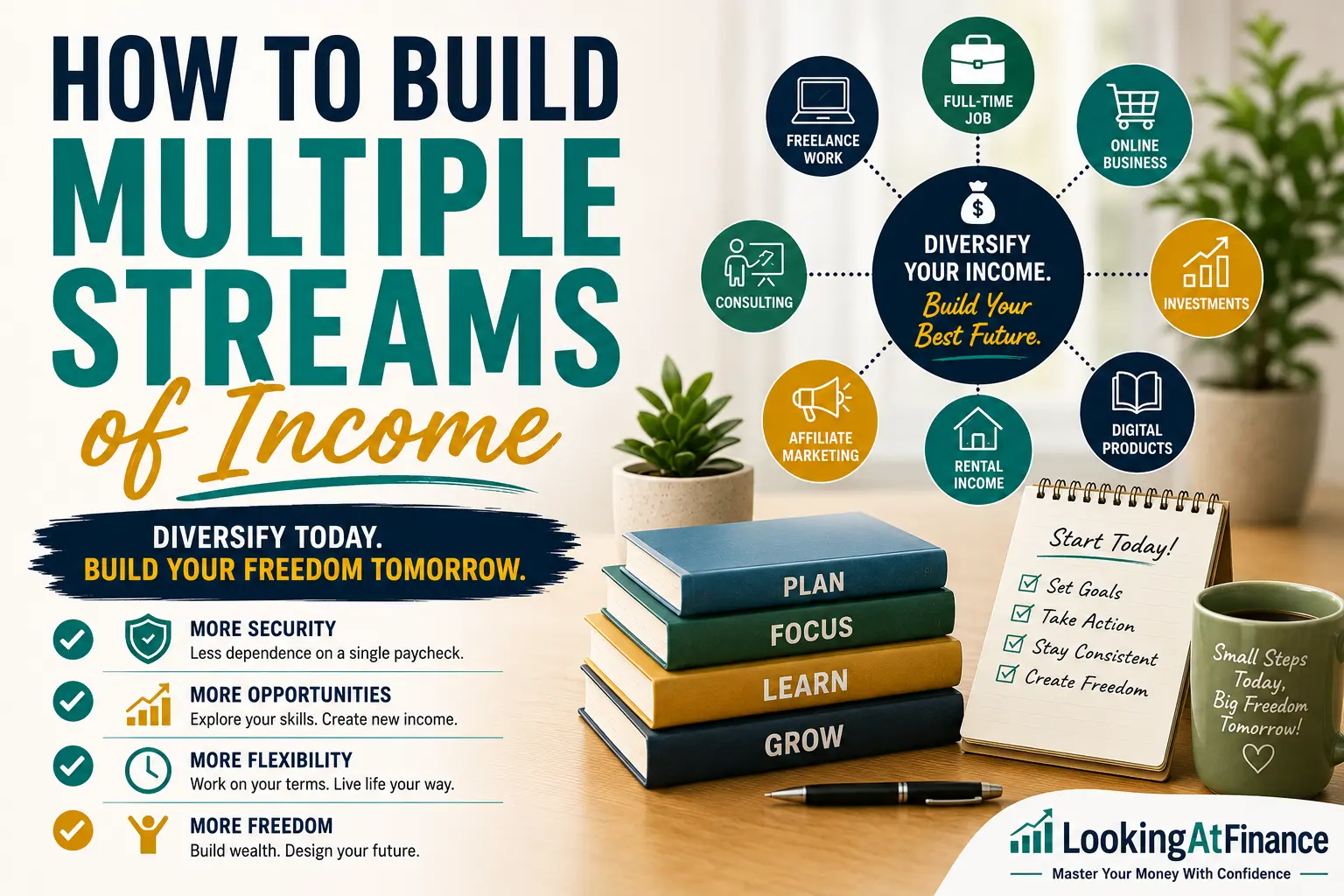
Why Multiple Streams of Income Matter
Imagine waking up one morning to discover that your primary source of income has suddenly disappeared.
Perhaps your employer announces company-wide layoffs.
Maybe your business experiences a slow season.
Or an unexpected illness temporarily prevents you from working.
For many people, losing a single paycheck can create immediate financial stress because nearly all of their income comes from one source.
Now imagine a different situation.
Instead of relying entirely on one paycheck, you earn money from several different sources.
You still have your primary job, but you also receive income from freelance work, a small online business, investments, or another side venture.
If one income source decreases, the others continue helping support your financial goals.
This is the idea behind multiple streams of income.
Building additional income streams isn’t about becoming wealthy overnight.
It’s about creating greater financial stability, flexibility, and opportunities over time.
Some additional income may help you:
- Pay off debt faster.
- Build an emergency fund.
- Save for a home.
- Invest for retirement.
- Reduce financial stress.
- Achieve greater financial independence.
The important thing to remember is that most people don’t build several income streams all at once.
They usually begin with one.
As that source becomes more stable, they gradually add another.
Over time, those small steps can create meaningful financial progress.
In this guide, you’ll learn:
- What multiple streams of income are.
- Why relying on one paycheck can be risky.
- The difference between active and passive income.
- Common myths about earning additional income.
- Practical types of income streams beginners can explore.
- How to build additional income one step at a time.
- Mistakes to avoid along the way.
By the end of this guide, you’ll understand how diversifying your income can become part of a broader plan to build long-term financial confidence.
💡 Action Moment: Understand Your Current Financial Picture First
Before looking for new ways to earn money, it’s important to understand your current financial situation.
Many people immediately begin searching for side hustles without first asking questions like:
- How much money do I currently earn?
- Where does my income go each month?
- Which expenses are essential?
- How much additional income do I actually need?
- What financial goal am I trying to achieve?
Without these answers, it’s easy to work harder without making meaningful financial progress.
That’s why 7 Days to Financial Clarity™ is the ideal place to begin.
The guide helps you organize your:
- Income.
- Knowing every source of income helps you identify opportunities to grow it.
- Monthly expenses.
- Understanding where your money goes makes it easier to decide how much additional income you truly need.
- Savings.
- Reviewing your savings helps you determine whether your next priority should be building an emergency fund, investing, or another goal.
- Debt.
- Organizing your debt may help you decide whether extra income should first be directed toward reducing high-interest balances.
- Financial priorities.
- Clear priorities allow every new income stream to support meaningful long-term goals.
Financial clarity ensures you’re building additional income with purpose—not simply staying busier.
What Is a Stream of Income?
A stream of income is simply a source from which you regularly earn money.
For many people, their primary paycheck is their only income stream.
Others may receive income from several different sources throughout the month.
For example, someone might earn money through:
- Full-time employment.
- A regular salary or hourly wage provides predictable income.
- Freelance work.
- Skills such as writing, graphic design, programming, or consulting may generate additional earnings.
- Investments.
- Certain investments may produce dividend payments or interest income, although returns are not guaranteed.
- Rental property.
- Property owners may receive rental income after accounting for expenses and vacancies.
- Online businesses.
- Blogs, digital products, affiliate marketing, or e-commerce businesses can create additional revenue opportunities.
Each income source contributes to the person’s overall financial picture.
The more diversified those sources become, the less dependent someone may be on any single paycheck.
Why Relying on One Paycheck Can Be Risky
Having one reliable job is valuable.
However, relying exclusively on one source of income can create financial vulnerability.
Unexpected events happen.
Companies restructure.
Industries change.
Economic conditions fluctuate.
Health issues arise.
Even the most dependable career can experience periods of uncertainty.
Imagine a table supported by only one leg.
If that leg weakens, the entire table becomes unstable.
Now imagine a table supported by several sturdy legs.
If one leg becomes damaged, the table is often better able to remain standing.
Multiple income streams work in much the same way.
Each additional source of income may increase financial resilience by reducing dependence on a single source.
That doesn’t eliminate financial risk, but it can improve flexibility during challenging periods.
Benefits of Building Multiple Income Streams
Creating additional income isn’t only about earning more money.
It can also strengthen your overall financial position.
Some potential benefits include:
Greater Financial Stability
When income comes from several sources, a decline in one source may have less impact on your overall finances.
Diversifying income can help reduce dependence on a single employer or business.
Faster Financial Goals
Additional income may allow you to:
- Build savings more quickly.
- Extra earnings can accelerate progress toward an emergency fund or other savings goals.
- Pay off debt sooner.
- Directing side income toward high-interest debt may reduce interest costs over time.
- Increase investments.
- Investing part of your additional income may support long-term wealth building, while recognizing that investment returns are never guaranteed.
More Career Flexibility
Additional income streams can provide options.
Some people use side income to:
- Reduce overtime hours.
- Transition into self-employment.
- Change careers.
- Work fewer hours later in life.
- Pursue personal interests while maintaining financial stability.
Building multiple income streams doesn’t guarantee these outcomes, but it may increase flexibility over time.
Increased Financial Confidence
Knowing that you have more than one source of income can reduce financial stress for many people.
Rather than feeling completely dependent on a single paycheck, you may feel better prepared to adapt if your circumstances change.
Confidence often comes not from earning the most money—but from having a thoughtful financial plan.
Active Income vs. Passive Income
When discussing multiple income streams, you’ll often hear two important terms:
Active income and passive income.
Understanding the difference helps set realistic expectations.
Active Income
Active income generally requires your ongoing time and effort.
If you stop working, the income typically stops as well.
Examples include:
- Employment income.
- Wages or salaries earned through your job.
- Freelancing.
- Income earned by providing services to clients.
- Consulting.
- Sharing professional expertise in exchange for payment.
- Driving for delivery or rideshare services.
- Earnings depend on the time you spend working.
Active income is often the easiest type of income to begin because it usually relies on skills you already have.
However, it’s also limited by the amount of time available.
There are only so many hours in a day.
Passive Income
Passive income is often misunderstood.
Many people believe it means earning money without doing any work.
In reality, passive income usually requires significant effort, money, or both before it begins generating ongoing income.
Examples include:
- Dividend-paying investments.
- Some investments may distribute dividends, although payments and investment performance are not guaranteed.
- Rental property.
- Rental income requires purchasing, maintaining, and managing property or hiring others to do so.
- Digital products.
- E-books, templates, online courses, or printable resources may continue generating sales after they’re created.
- Affiliate marketing.
- Content published today may continue generating commissions in the future if it remains valuable to readers.
Most passive income begins as active work.
The difference is that the work may continue producing income long after the initial effort has been completed.
Common Myths About Multiple Streams of Income
Many misconceptions discourage people from getting started.
Let’s look at some of the most common myths.
Myth: You Need to Be Wealthy First
Many successful income streams begin with existing skills rather than large amounts of money.
Writing, teaching, designing, consulting, or offering services often require more knowledge and consistency than major upfront investments.
Myth: You Need Five or Six Income Streams Immediately
One additional income stream is enough to begin.
Trying to build several businesses simultaneously often leads to burnout and slower progress.
Many successful entrepreneurs build one reliable income stream before adding another.
Myth: Passive Income Requires No Work
Almost every passive income stream begins with active effort.
Whether you’re writing articles, creating digital products, building a website, or purchasing investments, meaningful preparation is usually required before ongoing income becomes possible.
Myth: More Income Automatically Solves Financial Problems
Higher earnings certainly create opportunities, but they don’t automatically improve financial health.
Without budgeting, saving, and thoughtful spending, additional income can disappear just as quickly as a regular paycheck.
That’s why building multiple income streams works best when combined with strong money management habits.
Building Income Is About Building Options
One of the greatest advantages of multiple income streams isn’t simply earning more money.
It’s creating more choices.
Additional income may allow you to:
- Handle unexpected expenses with greater confidence.
- Pursue career opportunities that interest you.
- Save and invest more consistently.
- Reduce financial stress.
- Work toward long-term financial independence.
Every additional income stream doesn’t have to replace your full-time income.
Even modest, reliable sources of additional income can contribute meaningfully to your overall financial picture when managed wisely.
You’re already investing time in improving your finances, and that’s something to be proud of. Before you continue, download our free 7 Days To Financial Clarity™ workbook and start putting these ideas into action.

Seven Practical Types of Income Streams
One of the biggest misconceptions about building multiple income streams is believing that everyone should pursue the same opportunities.
In reality, the best income stream for one person may not be the best choice for someone else.
For example:
A college student may have plenty of time but very little money to invest.
A full-time employee may have limited free time but valuable professional skills.
A retiree may prioritize investments that generate income rather than starting a new business.
Your personal circumstances matter.
Instead of asking,
“What’s the best income stream?”
A better question is,
“Which income stream fits my skills, available resources, and financial goals?”
Let’s explore several common types of income streams and how they work.
Income Stream #1: Employment Income
For most people, employment income is their primary source of earnings.
Whether you’re paid an hourly wage or receive a salary, your job often provides the financial foundation that supports your household.
Employment income offers several advantages.
Predictable Income
Many employees receive regular paychecks on a consistent schedule.
This predictability makes budgeting and financial planning easier.
Employee Benefits
Depending on your employer, your compensation may include benefits such as:
- Health insurance.
- Employer-sponsored coverage may reduce healthcare costs.
- Retirement plans.
- Some employers match employee retirement contributions, helping workers save for the future.
- Paid vacation.
- Paid time off allows employees to maintain income while taking leave.
These benefits can add significant value beyond your salary alone.
Limitations
Employment income is valuable, but it also has limitations.
Your earnings are generally tied to:
- Your available working hours.
- Your employer’s financial health.
- The stability of your industry.
- Your employment status.
For many people, employment income serves as the starting point—not the ending point—for building financial security.
Income Stream #2: Freelance or Consulting Income
One of the fastest ways many people begin earning additional income is by offering skills they already possess.
Freelancing involves providing services to clients on a project or contract basis.
Examples include:
- Writing.
- Businesses often hire freelance writers to create articles, website content, or marketing materials.
- Graphic design.
- Designers create logos, advertisements, presentations, and digital content.
- Programming.
- Software developers and web designers frequently work with clients on individual projects.
- Bookkeeping.
- Small businesses often outsource financial recordkeeping.
- Marketing.
- Social media management, email marketing, and advertising services remain in demand.
Consulting is similar but typically involves providing professional advice based on specialized knowledge or experience.
Freelancing often allows you to begin earning additional income without making large financial investments.
Your expertise becomes your primary asset.
Income Stream #3: Online Business Income
The internet has created opportunities for people to build businesses that reach customers around the world.
Examples include:
- Blogging.
- Educational websites can generate revenue through advertising, affiliate marketing, and digital products.
- E-commerce.
- Online stores sell physical or digital products directly to customers.
- Membership websites.
- Subscribers pay for exclusive educational content or community access.
- Educational platforms.
- Experts create online courses, workshops, or coaching programs.
Online businesses often require patience.
Unlike traditional employment, they usually take time to grow.
However, once established, they may provide income that is less directly tied to hours worked.
Income Stream #4: Affiliate Marketing
Affiliate marketing allows individuals to earn commissions by recommending products or services they genuinely believe may be helpful to others.
Here’s a simple example.
Imagine you write a detailed article reviewing budgeting software.
If readers purchase the software through your affiliate link, the company may pay you a commission.
Successful affiliate marketing is generally built on:
- Trust.
- Honest recommendations help build long-term relationships with readers.
- Valuable content.
- Educational articles often perform better than overly promotional content.
- Relevant products.
- Products should solve real problems for your audience.
It’s important to disclose affiliate relationships where required by law or platform policies.
Readers appreciate transparency, and trust is one of the most valuable assets an online business can build.
Income Stream #5: Dividend Investing
Some investors build additional income through dividend-paying investments.
Certain companies distribute a portion of their profits to shareholders in the form of dividends.
These payments may provide ongoing income if dividends are declared.
However, dividend investing should be viewed realistically.
Dividends are not guaranteed.
Companies may increase, reduce, suspend, or eliminate dividend payments depending on business conditions.
Many long-term investors choose to reinvest dividends to purchase additional investments, potentially supporting future growth through compounding.
Dividend investing generally requires capital to begin and should fit within an individual’s overall investment strategy and risk tolerance.
Income Stream #6: Rental Income
Owning rental property is another way some people generate additional income.
Rental income may come from:
- Residential properties.
- Houses, apartments, or condominiums rented to tenants.
- Vacation rentals.
- Short-term rentals in areas with tourism demand.
- Commercial property.
- Office, retail, or industrial space leased to businesses.
Although rental income can be rewarding, it also involves responsibilities.
Property owners may need to manage:
- Maintenance and repairs.
- Property taxes.
- Insurance.
- Vacancies between tenants.
- Local laws and regulations.
Rental property should be viewed as both an investment and an ongoing business responsibility.
Income Stream #7: Digital Products and Royalties
One of the most scalable income streams involves creating something once that may continue generating sales over time.
Examples include:
- E-books.
- Educational books can continue selling long after publication.
- Printable planners.
- Budget planners, journals, and worksheets remain popular digital products.
- Online courses.
- Educational courses allow creators to share specialized knowledge.
- Templates.
- Business, design, and productivity templates solve practical problems for customers.
- Stock photography.
- Photographers may earn royalties when their images are licensed.
Creating digital products often requires significant upfront work.
However, once completed, those products may continue generating income without needing to be recreated for every customer.
That makes them attractive to many entrepreneurs looking for scalable business models.
Choosing the Right Income Stream
With so many possibilities available, it’s easy to become overwhelmed.
Instead of trying everything at once, evaluate opportunities based on several practical factors.
Your Skills
Ask yourself:
- What do I already know how to do?
- What experience do I have that others may value?
- Which problems can I help solve?
Building on existing skills often reduces the learning curve.
Your Available Time
Some income streams require daily attention.
Others involve intensive work at the beginning followed by ongoing maintenance.
Be realistic about how much time you can consistently dedicate without neglecting your health, family, or primary responsibilities.
Your Financial Resources
Some opportunities require very little money to begin.
Others involve larger upfront investments.
Understanding your budget helps you choose opportunities that fit comfortably within your financial situation.
Your Interests
Building an additional income stream usually takes time.
Choosing something you genuinely enjoy or find meaningful may make it easier to remain motivated during the early stages.
Passion alone doesn’t guarantee success, but it often supports consistency.
💡 Action Moment: Match Your Income Strategy to Your Financial Goals
Before starting any new income stream, take a moment to ask yourself an important question:
“Why do I want to earn more money?”
Your answer will influence the types of income opportunities you pursue.
The LookingAtFinance Financial Goal Assessment can help you clarify your priorities.
For example, you may be working toward:
- Paying off debt.
- Additional income may help reduce high-interest balances more quickly.
- Building an emergency fund.
- Extra earnings can strengthen your financial safety net.
- Buying a home.
- Increasing your income may help you save for a down payment.
- Investing for retirement.
- Directing part of your additional income toward long-term investments may support future financial security.
- Achieving greater financial freedom.
- Diversifying your income may provide greater flexibility and reduce dependence on a single paycheck.
When your income strategy supports meaningful financial goals, it’s often easier to stay motivated during periods when progress feels slow.
Remember: You Don’t Need Every Income Stream
Many successful people have multiple income streams.
Very few built them all at once.
Instead, they focused on one opportunity.
They learned.
They improved.
They built systems.
Only after one income stream became stable did they begin developing another.
Trying to do everything at the same time often leads to frustration.
Building one reliable income stream at a time usually creates a stronger foundation for long-term success.
💼 Measure Your Progress
Every extra dollar you earn brings you closer to financial independence. Use our free Financial Freedom Calculator to estimate how your income, savings, and investments can support your long-term goals.

Building Multiple Income Streams Step by Step
Learning about different income streams is exciting.
It’s easy to imagine earning money from a blog, dividend investments, freelance work, digital products, rental property, or an online business.
However, one of the biggest mistakes beginners make is trying to pursue all of these opportunities at the same time.
Instead of making steady progress, they often become overwhelmed.
Successful entrepreneurs and investors usually take a different approach.
They build one income stream at a time.
As each source becomes more stable, they use the experience, confidence, and sometimes the income from that first stream to help build the next one.
Building multiple income streams isn’t a race.
It’s a long-term strategy.
Start With One Additional Income Stream
Imagine trying to learn five new skills simultaneously.
You decide to study a new language, learn to play the guitar, start a business, train for a marathon, and earn a professional certification—all in the same month.
Even though each goal is worthwhile, trying to do everything at once would likely leave you feeling exhausted and making slow progress.
Building additional income works much the same way.
Rather than spreading your time and energy too thin, focus on mastering one opportunity first.
Ask yourself:
- Which income stream best matches my current skills?
- Building on what you already know often shortens the learning curve.
- Which opportunity fits my available time?
- Choosing a realistic commitment increases the likelihood of staying consistent.
- Which income stream supports my financial goals?
- Your additional income should help move you toward meaningful long-term objectives.
Once your first income stream becomes more consistent, you’ll have a stronger foundation for expanding into other opportunities.
Balance Time, Money, and Risk
Every income stream requires a different combination of time, financial investment, and risk.
Understanding these trade-offs helps you choose opportunities that fit your situation.
For example:
Some Income Streams Require More Time Than Money
Examples include:
- Freelance writing.
- Your primary investment is your time and writing ability.
- Virtual assistance.
- Organizational skills may be more important than startup capital.
- Tutoring.
- Existing knowledge can become a valuable service.
These opportunities often allow people to begin earning additional income without making significant financial investments.
Some Require More Money Than Time
Examples include:
- Dividend investing.
- Purchasing investments generally requires available capital.
- Rental property.
- Buying real estate often involves substantial upfront costs and ongoing expenses.
Although these opportunities may require less day-to-day effort after they’re established, they usually involve greater financial commitments and risks at the beginning.
Some Require Both
Building an online business often requires both time and money.
For example, creating a successful blog may involve:
- Purchasing a domain name.
- A professional website begins with its own web address.
- Paying for website hosting.
- Reliable hosting allows your content to remain accessible to readers.
- Creating helpful content.
- Publishing educational, high-quality articles requires consistent effort.
- Learning search engine optimization (SEO).
- Understanding how search engines work may help people discover your content over time.
Although building an online business often takes patience, it also creates opportunities for multiple future income sources such as advertising, affiliate marketing, sponsored partnerships, and digital products.
Build Systems Instead of Working More Hours
One challenge with active income is that it’s directly connected to your time.
If you stop working, the income often stops as well.
As your financial goals grow, simply working longer hours isn’t always sustainable.
Instead, many successful entrepreneurs focus on creating systems.
A system is something that continues working even when you’re not actively involved every minute.
For example:
A freelance writer may eventually hire an editor.
An online store owner may automate order processing.
A blogger may publish evergreen articles that continue attracting readers months or even years after publication.
An author may continue earning royalties from books that were written long ago.
These systems don’t eliminate work.
Instead, they help create more efficient ways to generate income over time.
Reinvest Part of Your Additional Income
One of the smartest habits many successful entrepreneurs develop is resisting the temptation to spend every dollar they earn.
Instead, they reinvest part of their additional income back into their financial future.
For example, someone earning extra money from freelance work might choose to:
- Build an emergency fund.
- A stronger financial cushion can reduce stress during slower months.
- Invest for long-term growth.
- Investing part of additional income may support future wealth building while recognizing that investment returns are never guaranteed.
- Improve their business.
- Better tools, training, or equipment may help increase future earning potential.
- Reduce high-interest debt.
- Lower debt can free up more monthly cash flow for future goals.
Reinvesting doesn’t necessarily mean putting every dollar into investments.
It means using today’s additional income to create greater opportunities tomorrow.
Create Habits Instead of Chasing Motivation
Motivation is powerful.
Unfortunately, it’s also temporary.
Some days you’ll feel excited about your side business.
Other days you’ll be tired after work and tempted to skip it.
That’s perfectly normal.
This is why successful people often rely on habits rather than motivation alone.
Instead of asking:
“Do I feel motivated today?”
Ask:
“What’s the next small step I committed to taking?”
Perhaps that’s:
- Writing one article.
- Small, consistent publishing efforts often produce stronger long-term results than occasional bursts of activity.
- Contacting one potential client.
- Regular outreach may gradually expand your business opportunities.
- Designing one digital product.
- Every completed product becomes another potential source of future income.
- Learning one new skill.
- Continuous learning strengthens your ability to adapt and grow.
Small actions repeated consistently often produce greater results than occasional periods of intense effort.
Be Patient With Your Progress
One reason many people abandon additional income streams is because results take longer than expected.
For example:
A new blog may receive very few visitors during its first several months.
A freelance business may require time to build a client base.
A digital product may sell slowly before gaining momentum.
A dividend investment portfolio may begin with relatively modest income.
This doesn’t necessarily mean you’re failing.
Many worthwhile financial goals require patience.
Think about planting a fruit tree.
You wouldn’t expect fruit the day after planting the seed.
You water it.
Protect it.
Allow it time to grow.
Building income streams follows a similar pattern.
Consistent effort today often creates opportunities months or years later.
Avoid Common Mistakes
Building additional income becomes easier when you recognize common obstacles early.
Trying Too Many Opportunities
Focusing on five different businesses at once often leads to scattered attention and slower progress.
Choose one opportunity, learn it well, and build from there.
Expecting Overnight Success
Many online success stories highlight impressive outcomes without showing the years of work that came before them.
Sustainable income streams usually take time to develop.
Setting realistic expectations helps you stay committed during the early stages.
Ignoring Personal Finances
Earning more money doesn’t automatically improve financial health.
Without budgeting, saving, and thoughtful spending, additional income can disappear just as quickly as a paycheck.
Managing your money well remains just as important as earning it.
Forgetting to Continue Learning
Markets evolve.
Technology changes.
Customer needs shift.
Continuing to develop your skills allows your income opportunities to grow alongside changing circumstances.
Learning isn’t an obstacle to success.
It’s part of success.
💡 Action Moment: Explore How Extra Income Could Support Your Financial Freedom
Imagine earning an additional $250, $500, or even $1,000 each month.
Rather than spending all of it, what might happen if you consistently directed part of that income toward your long-term goals?
The LookingAtFinance Financial Freedom Calculator helps you explore different hypothetical scenarios.
You can estimate how factors such as:
- Additional monthly income
- Explore how consistently earning and setting aside extra money could affect your long-term financial progress.
- Regular savings and investing
- Compare different contribution amounts while remembering that actual investment performance and future returns cannot be guaranteed.
- Long-term time horizons
- See how maintaining consistent financial habits over 10, 20, or 30 years may influence projected outcomes.
- Different growth assumptions
- Experiment with hypothetical scenarios to better understand the potential value of time and consistency.
The calculator isn’t intended to predict your future income or investment results.
Instead, it demonstrates an important principle:
Consistently putting part of your additional income to work may have a meaningful impact on your long-term financial goals.
Multiple Income Streams Are Built One Step at a Time
It’s easy to look at someone with several successful businesses and assume they built everything at once.
In reality, most people start much smaller.
One client.
One product.
One website.
One investment.
One side hustle.
Over time, those individual efforts can grow into multiple, complementary income streams.
The goal isn’t to become busy with countless projects.
The goal is to create a collection of reliable income sources that strengthen your financial security, provide greater flexibility, and support your long-term financial aspirations.
Every financial journey is different. Take our free
Financial Goal Assessment to discover which area deserves your attention first
and receive a clear direction for your next financial milestone.

A Real-Life Example: Two Different Approaches to Building Income
Building multiple streams of income doesn’t happen overnight.
It usually begins with one small decision, followed by another.
To illustrate this, consider two fictional individuals, Daniel and Olivia.
Both are 38 years old.
Both earn similar full-time salaries.
Both want greater financial freedom.
However, they take very different approaches to achieving it.
Daniel’s Story
Daniel has often talked about earning more money.
He reads articles about side hustles and watches videos about passive income.
Every few months, he becomes excited about a new opportunity.
One month he researches dropshipping.
The next month he wants to become a freelance designer.
Later he considers buying rental property.
Eventually he starts looking into stock investing.
The problem isn’t that these are bad ideas.
The problem is that Daniel never commits to one long enough to build momentum.
He jumps from opportunity to opportunity before developing the skills, systems, or consistency needed for success.
Whenever he earns a little extra money, he spends it immediately on lifestyle upgrades instead of using it to strengthen his financial position.
At the end of the year, Daniel is just as busy as before.
Unfortunately, his income hasn’t changed very much.
Olivia’s Story
Olivia decides to take a different approach.
Instead of trying to build five income streams immediately, she focuses on one.
She starts freelancing a few evenings each week using skills she already has.
The income isn’t huge at first, but it’s consistent.
Rather than spending every extra dollar, she follows a plan.
She:
- Builds her emergency fund.
- Having savings helps her feel more secure if unexpected expenses arise.
- Pays down high-interest debt.
- Lower debt reduces the amount of interest she pays each month.
- Invests part of her additional income.
- She begins building long-term wealth while recognizing that investment returns can vary.
After a year, her freelance business becomes more established.
She then creates a digital product based on the knowledge she has gained.
Months later, that product begins generating additional sales.
Eventually, she starts a small educational website where she shares helpful content and earns income through affiliate marketing.
None of these income streams made her wealthy overnight.
Instead, each one built upon the last.
Over time, Olivia became less dependent on her primary paycheck because she created several complementary sources of income.
The Difference Was Focus
Daniel spent most of his time searching for the “perfect” opportunity.
Olivia spent her time improving one opportunity until it became reliable.
Daniel chased new ideas.
Olivia built systems.
Daniel focused on quick results.
Olivia focused on long-term progress.
By the end of several years, Olivia had something much more valuable than a collection of unfinished projects.
She had a diversified financial foundation.
That’s one of the biggest lessons about building multiple streams of income.
Success usually comes from consistency—not constant change.
Multiple Income Streams Checklist
Use this checklist to evaluate your progress as you begin building additional income.
Build a Strong Foundation
☐ I understand my current financial situation.
☐ I know why I want additional income.
☐ I have specific financial goals.
☐ I maintain a realistic monthly budget.
☐ I track my progress regularly.
Choose the Right Opportunity
☐ I selected one income stream that fits my skills.
☐ I understand the time commitment required.
☐ I understand the financial risks involved.
☐ I have realistic expectations.
☐ I focus on long-term growth rather than quick profits.
Grow Your Income Wisely
☐ I continue learning new skills.
☐ I reinvest part of my additional income.
☐ I avoid chasing every new opportunity.
☐ I build systems that improve efficiency.
☐ I review my progress and make thoughtful adjustments when necessary.
Frequently Asked Questions
How many income streams should I have?
There isn’t a single number that’s right for everyone.
Some people are comfortable relying on one primary income source, while others choose to gradually build several. The important consideration is whether your income strategy supports your financial goals, lifestyle, and ability to manage each source effectively.
Which income stream is easiest for beginners?
The answer depends on your existing skills, experience, available time, and financial resources.
Many beginners start with service-based work such as freelancing or consulting because these opportunities often require little upfront investment. Others may prefer creating digital products or building an online business if they enjoy creating content and are comfortable waiting longer for results.
Is passive income really passive?
Not usually.
Most passive income streams require considerable effort, money, or both before they begin producing ongoing income.
For example, writing an e-book, creating an online course, building a website, or purchasing investments all involve work before they have the potential to generate future income.
Even after they begin producing income, many passive income sources still require ongoing maintenance.
Do I need a lot of money to build multiple income streams?
Not necessarily.
Some opportunities, such as freelance work or consulting, may require more skill than capital.
Others, such as dividend investing or rental property, often require larger financial investments.
The best choice depends on your current situation and long-term goals.
Should I quit my full-time job to build another income stream?
For many people, keeping a stable primary income while gradually building additional income streams reduces financial risk.
As additional income becomes more reliable, some individuals choose to adjust their work arrangements. The right decision depends on your financial circumstances, risk tolerance, and personal goals.
What should I do with the extra money I earn?
Many people use additional income to strengthen their financial foundation.
Common priorities include:
- Building an emergency fund.
- Savings can provide a buffer for unexpected expenses.
- Paying down high-interest debt.
- Reducing expensive debt may improve monthly cash flow.
- Investing for long-term goals.
- Consistent investing may help build wealth over time, although returns are never guaranteed.
- Reinvesting in a business.
- Better tools, education, or marketing may increase future earning potential.
Choosing where to direct your additional income should reflect your personal financial priorities.
How long does it take to build meaningful additional income?
There isn’t a universal timeline.
Some service-based opportunities may generate income relatively quickly, while businesses, investments, and digital products often require months or years to develop.
Patience, consistency, and continuous improvement are usually more important than trying to achieve rapid growth.
Final Thoughts
Building multiple streams of income isn’t about trying every side hustle or chasing every new business idea.
It’s about creating a financial foundation that doesn’t rely entirely on one source of earnings.
Every additional income stream has the potential to strengthen your financial resilience.
One may help you reduce debt.
Another may allow you to build savings.
A third may support long-term investing.
Together, they can create greater flexibility and reduce the pressure of depending on a single paycheck.
Remember, most successful people didn’t build several income streams overnight.
They started with one opportunity.
They learned from experience.
They improved their skills.
They reinvested their earnings.
Most importantly, they remained consistent.
Financial freedom is rarely built through one extraordinary decision.
More often, it’s the result of many thoughtful decisions made consistently over time.
Wherever you are today, your first additional income stream could become the beginning of something much bigger.
Your Next Steps
If you’re ready to begin building multiple streams of income, here’s a practical roadmap to help you move forward.
Step 1: Gain Financial Clarity
Download 7 Days to Financial Clarity™ and organize your finances before pursuing additional income.
The guide will help you:
- Understand your income.
- Knowing exactly how much you earn—and from where—helps you identify opportunities to diversify.
- Review your expenses.
- Understanding your spending can reveal how much additional income you truly need to reach your goals.
- Evaluate your savings.
- Assessing your current savings helps determine whether your priority should be building an emergency fund or investing.
- Organize your debt.
- Understanding your debt obligations makes it easier to decide how extra income should be allocated.
- Clarify your priorities.
- Clear financial priorities help ensure every new income stream supports a meaningful objective.
Step 2: Complete the Financial Goal Assessment
Use the LookingAtFinance Financial Goal Assessment to identify why you’re building additional income.
Your goal might be to:
- Pay off debt.
- Save for a home.
- Build an emergency fund.
- Invest for retirement.
- Replace part of your employment income.
- Work toward financial freedom.
When your additional income serves a clear purpose, staying motivated becomes much easier.
Step 3: Explore Your Long-Term Potential
Use the LookingAtFinance Financial Freedom Calculator to explore how consistently earning and setting aside additional income could influence your long-term financial goals.
Experiment with different scenarios by adjusting:
- Additional monthly income.
- Compare how different amounts of extra income might affect your financial progress.
- Savings or investment contributions.
- Explore hypothetical outcomes while remembering that actual investment performance will vary.
- Time horizons.
- See how maintaining consistent habits over many years can influence long-term projections.
The calculator is designed to educate and motivate by showing the potential value of consistency rather than predicting future financial outcomes.
Key Takeaway
Multiple streams of income aren’t about getting rich quickly—they’re about building financial stability one step at a time. By choosing opportunities that match your skills, staying focused, reinvesting wisely, and consistently working toward meaningful goals, you can gradually reduce dependence on a single paycheck and create a stronger foundation for long-term financial confidence and freedom.
🚀 Ready To Keep Going?
You have invested time learning today. Now take the next step by downloading our free 7 Days To Financial Clarity™ workbook and begin building a stronger financial future.
