
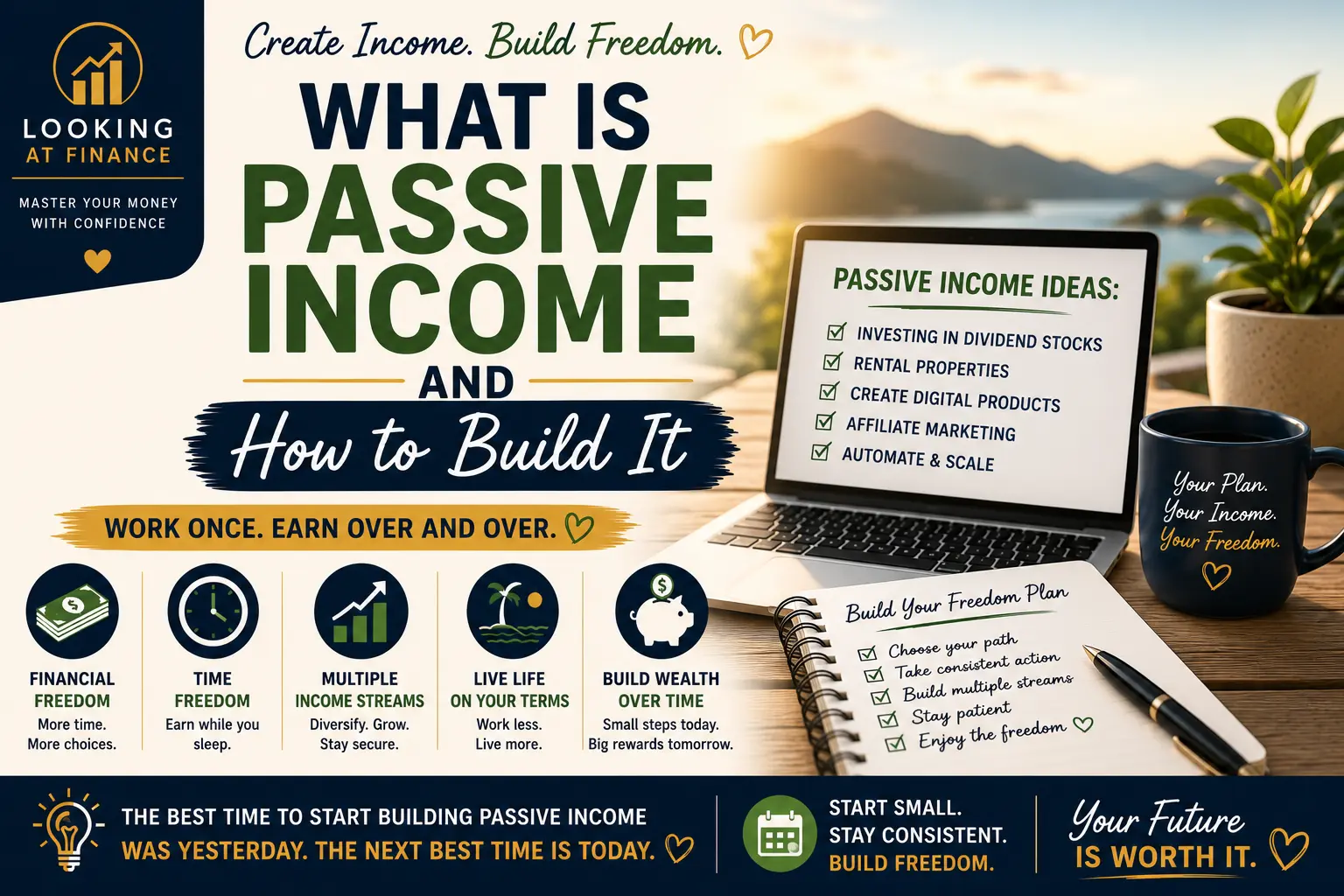
Imagine earning money while you’re on vacation, spending time with your family, or even sleeping.
It’s an appealing idea, and it’s one of the reasons passive income has become one of the most talked-about topics in personal finance.
A quick search online reveals countless videos, articles, and advertisements promising that anyone can generate thousands of dollars each month with little effort. Some even suggest you can quit your job within a few months by creating multiple passive income streams.
While these claims can be tempting, they often leave out an important part of the story.
Most passive income opportunities require some combination of:
- Time
- Money
- Skills
- Planning
- Consistent effort
before they begin producing reliable income.
For example:
- An investor may spend years building a portfolio that generates dividend income.
- A blogger may write dozens of articles before earning meaningful advertising or affiliate income.
- An author may spend months writing a book before it begins generating royalties.
- A landlord may invest significant savings before receiving rental income.
In other words, passive income is rarely effortless.
Instead, it’s income that continues to generate revenue after much of the initial work has been completed.
Understanding this distinction is important because it helps set realistic expectations.
Rather than looking for shortcuts, successful passive income builders focus on creating assets that continue working for them over time.
Whether your goal is earning a little extra each month, building long-term wealth, preparing for retirement, or creating greater financial flexibility, passive income can become an important part of your overall financial strategy.
In this guide, you’ll learn:
- What passive income really is.
- How passive income differs from active income.
- Why passive income matters.
- Common myths to avoid.
- Popular passive income ideas for beginners.
- How to choose the right passive income strategy.
- Practical steps to begin building passive income responsibly.
By the end of this article, you’ll understand that passive income isn’t about getting rich overnight—it’s about building financial assets that can support your long-term goals.
💡 Action Moment: Build a Strong Financial Foundation First
Before focusing on passive income, it’s important to understand your current financial situation.
Questions such as these can help shape your decisions:
- How much money do you currently earn?
- How much do you spend each month?
- Do you have an emergency fund?
- Are you carrying high-interest debt?
- How much can you realistically invest?
Having clear answers makes it much easier to choose passive income opportunities that fit your budget and long-term goals.
That’s exactly why 7 Days to Financial Clarity™ was created.
This free guide helps you organize your finances, understand your cash flow, and identify opportunities to strengthen your financial foundation before investing time or money into passive income strategies.
When your financial foundation is solid, every passive income decision becomes more intentional.
What Is Passive Income?
Passive income is money earned from an asset or activity that continues generating income after much of the initial work or investment has already been completed.
Unlike a traditional job, passive income doesn’t always require you to trade your time directly for every dollar you earn.
Instead, you build or purchase something that has the potential to continue producing income over time.
Examples include:
- Dividend-paying investments.
- Rental properties.
- Interest earned on savings.
- Royalties from books or music.
- Digital products.
- Online courses.
- Affiliate marketing.
- Advertising revenue from websites or videos.
Although these income sources can continue generating revenue, they usually require occasional maintenance, updates, or oversight.
For example:
A rental property may require repairs.
A blog may need fresh content.
An online course may need updates.
An investment portfolio may need periodic review.
Passive income is better understood as income that requires less day-to-day involvement than traditional employment, not income that requires no work at all.
Active Income vs. Passive Income
To better understand passive income, it’s helpful to compare it with active income.
What Is Active Income?
Active income is money you earn by performing work.
If you stop working, the income usually stops as well.
Examples include:
- Salaries.
- Hourly wages.
- Freelance work.
- Consulting.
- Contract work.
- Overtime pay.
- Commissions based primarily on personal effort.
For most people, active income is the primary source of financial support.
It pays for everyday expenses such as housing, food, transportation, utilities, and savings.
What Is Passive Income?
Passive income is different because it’s generated by assets or systems that continue producing income over time.
Although some ongoing effort is often required, the income isn’t tied directly to every hour you work.
Examples include:
- Dividend payments from investments.
- Rental income.
- Royalties from books or music.
- Interest earned on savings or certificates of deposit.
- Revenue from digital products.
- Affiliate commissions from existing online content.
- Advertising income from established websites or YouTube channels.
The key difference is that passive income has the potential to continue generating revenue even when you’re not actively working every day.
Why Many People Build Both
Rather than choosing one or the other, many financially successful people rely on a combination of active and passive income.
For example:
Your full-time job may provide the steady income needed to pay monthly bills and support your family.
At the same time, you might gradually build passive income through:
- Investing.
- A blog.
- Dividend-paying stocks.
- Rental properties.
- Digital products.
- Other long-term assets.
Over time, these additional income sources may provide greater financial flexibility and reduce dependence on a single paycheck.
It’s not about replacing your active income overnight.
It’s about creating additional streams of income that can strengthen your overall financial position.
Why Passive Income Matters
Passive income isn’t simply about earning extra money.
It can play an important role in helping you build financial resilience and pursue long-term financial goals.
Here are some of the reasons many people choose to develop passive income streams.
Diversifies Your Income
Relying on a single paycheck can leave you vulnerable if your employment situation changes unexpectedly.
Adding additional income sources can help reduce that dependence.
If one source of income decreases, another may continue providing financial support.
Diversification doesn’t eliminate risk, but it can improve financial stability over time.
Supports Long-Term Wealth Building
Many passive income strategies involve building assets that may grow over time.
Examples include:
- Dividend-paying investments.
- Real estate.
- Businesses.
- Intellectual property.
These assets can potentially provide ongoing income while also increasing in value, although returns are never guaranteed and values can fluctuate.
Building wealth often involves consistent contributions and patience rather than quick results.
Creates Greater Financial Flexibility
Additional income can provide more options.
Depending on your circumstances, passive income might help you:
- Increase savings.
- Pay down debt faster.
- Invest more consistently.
- Reduce financial stress.
- Pursue career changes.
- Fund education.
- Save for retirement.
Even modest amounts of recurring income can make a meaningful difference over time.
Can Help During Retirement
Many retirees rely on more than one source of income.
Along with pensions or government benefits (where applicable), passive income from investments or other assets may help support ongoing living expenses.
Planning for retirement often involves developing multiple income sources rather than depending on just one.
Encourages Long-Term Thinking
Perhaps one of the greatest benefits of building passive income is the mindset it encourages.
Instead of asking:
“How can I earn more money this week?”
you begin asking:
“What can I build today that may continue generating value for years to come?”
That shift in perspective often leads to stronger financial habits and more intentional long-term planning.
Common Passive Income Myths
Because passive income is discussed so frequently online, it’s easy to develop unrealistic expectations.
Let’s look at some of the most common misconceptions.
Myth #1: Passive Income Requires No Work
This is probably the biggest misconception.
Nearly every passive income stream requires effort at some stage.
For example:
- Writing a book takes time.
- Building a website takes work.
- Investing requires research and planning.
- Purchasing rental property requires management.
- Creating an online course involves planning, recording, and updates.
The work may become less intensive over time, but it’s rarely nonexistent.
Myth #2: You Need to Be Wealthy to Start
Some passive income strategies require significant capital, such as purchasing rental property.
Others can often be started with much smaller amounts.
For example:
- Investing small amounts regularly.
- Creating digital products.
- Starting a blog.
- Writing an eBook.
- Building educational content online.
The important factor isn’t necessarily how much money you begin with—it’s developing consistent habits over time.
Myth #3: Passive Income Will Make You Rich Quickly
Most successful passive income streams grow gradually.
Building meaningful income often requires:
- Learning new skills.
- Creating valuable assets.
- Improving over time.
- Remaining patient during periods of slow growth.
Quick wealth is the exception—not the expectation.
The people who achieve long-term success usually focus on steady progress rather than overnight results.
You’re already investing time in improving your finances, and that’s something to be proud of. Before you continue, download our free 7 Days To Financial Clarity™ workbook and start putting these ideas into action.

Different Types of Passive Income
One of the greatest advantages of passive income is that there isn’t just one way to build it.
Some income streams require significant upfront money but very little ongoing work.
Others require little financial investment but more time and effort at the beginning.
The right passive income strategy depends on your:
- Financial situation
- Available time
- Skills and experience
- Risk tolerance
- Long-term goals
Let’s explore some of the most common passive income opportunities for beginners.
Dividend-Paying Stocks
Dividend-paying stocks are shares of companies that distribute a portion of their profits to shareholders.
If you own these stocks, you may receive regular dividend payments, often quarterly, while continuing to own the shares.
For many investors, dividend income becomes an additional source of cash flow that can be:
- Reinvested to purchase more shares.
- Used to supplement other income.
- Saved toward future financial goals.
Keep in mind that dividends are not guaranteed. Companies can increase, reduce, or suspend dividend payments based on business performance and other factors.
Advantages
- Potential for regular income.
- Opportunity for long-term growth.
- Can benefit from compounding when dividends are reinvested.
Considerations
- Investment values can rise or fall.
- Dividend payments may change.
- Requires patience and a long-term perspective.
Index Funds and Exchange-Traded Funds (ETFs)
Rather than investing in individual companies, many beginners choose index funds or ETFs.
These investments typically hold a collection of stocks or bonds, providing diversification within a single investment.
Some index funds and ETFs distribute dividends, while others focus primarily on long-term growth.
Because they spread investments across many companies, they can reduce the impact of any single company’s performance, though they still carry market risk.
For long-term investors, these funds are often considered a straightforward way to build wealth gradually.
Real Estate Investment Trusts (REITs)
Not everyone wants to purchase and manage rental property.
A Real Estate Investment Trust (REIT) allows investors to gain exposure to certain types of real estate through shares rather than directly owning buildings.
Depending on the REIT and market conditions, investors may receive income from properties such as:
- Apartment communities.
- Office buildings.
- Shopping centers.
- Warehouses.
- Healthcare facilities.
REITs can provide access to real estate investing without the day-to-day responsibilities of being a landlord, although they still involve investment risk and their value can fluctuate.
High-Yield Savings Accounts
While they typically don’t produce large amounts of passive income, high-yield savings accounts can generate interest while keeping your money relatively accessible.
They are often used for:
- Emergency funds.
- Short-term savings goals.
- Money set aside for future purchases.
Interest rates can change over time, so earnings will vary.
Although the returns may be modest compared with some investments, many people value the stability and liquidity these accounts can offer.
Certificates of Deposit (CDs)
Certificates of Deposit, commonly called CDs, are savings products offered by many banks and credit unions.
With a CD, you generally agree to leave your money deposited for a specific period in exchange for a fixed interest rate.
CDs may appeal to people who:
- Want predictable returns.
- Don’t need immediate access to their money.
- Prefer lower-risk savings options.
However, withdrawing funds before the maturity date may result in penalties, depending on the terms of the account.
Bonds
When you purchase a bond, you’re essentially lending money to a government, municipality, or corporation for a specified period.
In return, the issuer generally agrees to make interest payments and repay the principal at maturity, subject to the bond’s terms.
Many investors use bonds to help diversify their portfolios.
While bonds are often considered less volatile than stocks, they still carry risks, including interest rate risk, inflation risk, and the possibility that the issuer may not meet its obligations.
Rental Property
Rental real estate is one of the most recognized forms of passive income.
Property owners may earn rental income from tenants while potentially benefiting from long-term property appreciation.
However, rental property isn’t entirely passive.
Owners may be responsible for:
- Property maintenance.
- Repairs.
- Finding tenants.
- Insurance.
- Property taxes.
- Legal and regulatory responsibilities.
Some landlords hire property management companies to handle many of these tasks, although this adds additional costs.
Rental property can be rewarding, but it’s important to understand both the opportunities and the responsibilities involved.
Digital Products
Digital products are items that can be sold repeatedly without manufacturing or shipping physical inventory.
Examples include:
- Printable planners.
- Budget templates.
- Spreadsheets.
- Financial trackers.
- Digital journals.
- Educational guides.
- Stock photography.
Once created, digital products can often be sold multiple times with relatively low ongoing costs.
Success typically depends on creating products that solve real problems for customers and updating them as needed.
Online Courses
If you have expertise in a particular subject, creating an online course can become another source of passive income.
Course topics might include:
- Personal finance.
- Photography.
- Graphic design.
- Programming.
- Cooking.
- Music.
- Business skills.
Although creating a high-quality course requires considerable planning, recording, and editing, it may continue generating revenue after publication if it remains relevant and valuable to learners.
Writing Books or eBooks
Authors can earn royalties from books long after they’re published.
Whether you write:
- Traditional books.
- eBooks.
- Educational workbooks.
- Children’s books.
each sale may generate royalty income according to the publishing agreement or platform used.
Successful books often require:
- Careful research.
- Professional editing.
- Effective marketing.
- Ongoing visibility.
Writing is rarely a quick path to passive income, but well-crafted content can continue providing value to readers for years.
Blogging
A blog can become a long-term passive income asset when it consistently attracts readers.
Bloggers may earn income through:
- Display advertising.
- Affiliate marketing.
- Digital products.
- Sponsored content.
- Memberships.
- Email marketing.
Building a successful blog usually requires patience.
Creating helpful, trustworthy content consistently over time often plays a much bigger role than publishing large amounts of content quickly.
Affiliate Marketing
Affiliate marketing allows you to earn commissions by recommending products or services through special tracking links.
If someone purchases through your link, you may receive a commission at no additional cost to the customer.
Successful affiliate marketing is generally built on:
- Trust.
- Honest recommendations.
- Helpful educational content.
- Transparency.
Rather than promoting every available product, many successful creators focus on recommending products they genuinely believe may provide value to their audience.
YouTube and Educational Content
Creating educational videos can become another passive income opportunity.
Established creators may generate income through:
- Advertising revenue.
- Affiliate marketing.
- Sponsorships.
- Digital products.
- Memberships.
Like blogging, success often depends on consistently producing valuable content that continues attracting viewers over time.
Licensing Creative Work
Creative professionals sometimes earn passive income by licensing their work.
Examples include:
- Photography.
- Music.
- Artwork.
- Graphic designs.
- Software.
- Mobile applications.
Each time someone purchases or licenses the work under the applicable terms, the creator may receive royalty or licensing income.
The amount and frequency of income vary depending on demand and the licensing agreement.
💡 Action Moment: Match Your Passive Income Strategy to Your Financial Goals
Not every passive income opportunity is right for every person.
Someone who is paying off high-interest debt may have different priorities than someone saving for retirement or building an investment portfolio.
Before deciding where to focus your time or money, complete the LookingAtFinance Financial Goal Assessment.
It can help you identify your current financial priorities and choose passive income opportunities that support those goals.
For example:
- If your goal is financial stability, you may decide to strengthen your emergency fund before pursuing higher-risk investments.
- If you’re focused on building long-term wealth, regularly investing in diversified investments may align with your objectives.
- If you’re interested in creating additional income, developing a blog, digital products, or educational content may complement your existing skills.
- If you’re preparing for retirement, building multiple long-term income sources may become an important part of your overall strategy.
The best passive income plan isn’t necessarily the one generating the highest returns today—it’s the one that fits your financial goals, your available resources, and your willingness to stay consistent over time.
There Is No “Perfect” Passive Income Strategy
It’s easy to become overwhelmed by the number of opportunities available.
Some people thrive by investing.
Others enjoy creating digital products.
Some prefer rental properties, while others focus on building online businesses.
Rather than chasing every new trend, start with one strategy that fits your current situation.
Learn how it works.
Build confidence.
Then expand gradually as your experience grows.
Successful passive income is often built through consistency—not by trying everything at once.
📈 Watch Your Money Grow
Successful investing isn’t about guessing—it’s about understanding long-term growth. Use our free Investment Growth Calculator to see how regular investing can build wealth over time.

How to Choose the Right Passive Income Stream
One of the biggest mistakes beginners make is assuming there’s a single “best” passive income strategy.
In reality, the right approach depends on your unique circumstances.
Someone with significant savings may be comfortable investing in rental property, while someone just beginning their financial journey might prefer building a blog or investing small amounts consistently in a diversified portfolio.
Rather than following what someone else is doing, start by evaluating your own situation honestly.
Ask yourself:
- How much time can I realistically dedicate each week?
- How much money can I afford to invest?
- Am I comfortable with investment risk?
- What skills or knowledge do I already have?
- What are my long-term financial goals?
Your answers will help you identify passive income opportunities that fit your lifestyle instead of creating unnecessary financial pressure.
Consider Your Available Time
Not every passive income stream requires the same level of effort.
Some opportunities demand significant work at the beginning before becoming easier to maintain.
Examples include:
- Writing a book.
- Creating an online course.
- Building a blog.
- Designing digital products.
Other strategies require less time initially but more financial capital, such as purchasing dividend-paying investments or real estate.
Understanding the trade-off between time and money can help you choose an approach that fits your current circumstances.
Consider Your Available Money
Some passive income ideas can be started with relatively little money.
Examples include:
- Blogging.
- Writing eBooks.
- Creating printable products.
- Affiliate marketing.
- Educational content.
Others often require more capital, such as:
- Dividend investing.
- Rental property.
- Real Estate Investment Trusts (REITs).
- Bond investing.
If your budget is limited, don’t assume passive income is out of reach.
Many successful income streams began with small, consistent investments of either time or money.
The important thing is starting with what you have rather than waiting for the “perfect” moment.
Understand Your Risk Tolerance
Every passive income opportunity involves some level of risk.
For example:
Investment-based income may fluctuate because financial markets rise and fall.
Rental property can involve vacancies, unexpected repairs, or changes in property values.
Online businesses may experience changes in search engine rankings, advertising rates, or consumer demand.
Before pursuing any opportunity, ask yourself:
- How comfortable am I with uncertainty?
- Could I handle temporary income fluctuations?
- Would short-term losses prevent me from reaching my long-term goals?
Choosing strategies that match your comfort level can help you remain consistent even during challenging periods.
Build Around Your Existing Skills
One of the easiest ways to begin building passive income is by leveraging knowledge you already possess.
Think about:
- Professional experience.
- Hobbies.
- Certifications.
- Technical skills.
- Teaching ability.
- Creative talents.
For example:
A graphic designer might create digital templates.
A teacher could develop educational courses.
A photographer might license stock images.
A personal finance enthusiast could build a blog that helps others manage their money.
Building on existing strengths often reduces the learning curve and makes it easier to create valuable resources for others.
Start With One Income Stream
It’s easy to become excited about passive income and try several strategies at once.
However, spreading yourself too thin often slows progress.
Instead, choose one opportunity that matches your goals and commit to learning it well.
Once you’ve developed confidence and established a consistent system, you can gradually expand into additional income streams.
Many successful entrepreneurs and investors didn’t build multiple passive income sources overnight.
They built one successful asset at a time.
A Step-by-Step Plan to Build Passive Income
Understanding passive income is one thing.
Building it is another.
The following roadmap can help you create a stronger financial foundation before expanding into additional income streams.
Step 1: Strengthen Your Financial Foundation
Before investing heavily in passive income opportunities, make sure your everyday finances are under control.
This often includes:
- Creating a monthly budget.
- Tracking your spending.
- Paying bills on time.
- Building healthy saving habits.
When your financial foundation is stable, you’ll be in a stronger position to make thoughtful long-term decisions.
Step 2: Pay Down High-Interest Debt
If you’re carrying high-interest debt, such as certain credit card balances, reducing that debt may provide a more immediate financial benefit than pursuing some passive income strategies.
That’s because high interest costs can offset the returns generated by new investments.
Every financial situation is different, so consider how debt repayment fits into your overall goals and cash flow.
Reducing expensive debt can improve financial flexibility and free up more money for future investing.
Step 3: Build an Emergency Fund
Life is unpredictable.
Unexpected expenses can arise at any time, including:
- Medical bills.
- Vehicle repairs.
- Home maintenance.
- Temporary income loss.
- Family emergencies.
Having emergency savings can reduce the likelihood that you’ll need to interrupt long-term investments or take on additional debt when unexpected costs occur.
A strong financial foundation supports long-term passive income success.
Step 4: Invest Consistently
Many people believe they need thousands of dollars before they can begin investing.
In reality, many investment accounts allow individuals to start with relatively small contributions.
Consistency often matters more than trying to invest large amounts all at once.
Regular investing can help you develop disciplined financial habits while gradually increasing your investment portfolio over time.
💡 Action Moment: See How Consistent Investing Can Grow Over Time
One of the most powerful principles behind many passive income strategies is compound growth.
When investment earnings remain invested, they may generate additional earnings over time. While future returns are never guaranteed, this compounding effect is one reason many long-term investors focus on consistent contributions rather than trying to time the market.
Use the LookingAtFinance Investment Growth Calculator to explore different scenarios.
You can estimate how factors such as:
- Your starting investment.
- Monthly contributions.
- Expected rate of return.
- Investment time horizon.
may influence your portfolio’s growth over the long term.
Seeing the potential impact of steady investing can help reinforce the value of patience and consistency.
Step 5: Diversify Your Income
As your financial confidence grows, consider gradually expanding your income sources.
Diversification simply means avoiding dependence on a single investment or income stream.
For example, someone might combine:
- Dividend-paying investments.
- A blog.
- Affiliate marketing.
- Digital products.
- High-yield savings for short-term goals.
Diversification doesn’t eliminate risk, but it can reduce the impact if one income source performs differently than expected.
Building multiple complementary income streams often creates greater financial resilience over time.
Step 6: Continue Learning and Improving
Passive income isn’t something you build once and never revisit.
Markets change.
Technology evolves.
Consumer preferences shift.
Successful passive income builders often review their strategies regularly by:
- Learning new skills.
- Updating digital products.
- Reviewing investment allocations.
- Monitoring business performance.
- Looking for opportunities to improve efficiency.
Continuous learning helps you adapt while keeping your long-term goals in focus.
Be Patient With the Process
One of the biggest reasons people abandon passive income plans is unrealistic expectations.
It’s natural to want quick results, but meaningful passive income usually develops gradually.
For example:
A blog may take months—or even longer—to attract a steady audience.
An investment portfolio grows through consistent contributions and time.
A digital product may require revisions before it gains traction.
Rental properties may involve periods of maintenance or vacancy.
Instead of focusing on overnight success, measure progress by the habits you’re building.
Each article you publish, each investment you make, each product you create, and each dollar you save contributes to a stronger financial future.
Passive Income Is a Marathon, Not a Sprint
Financial independence rarely comes from one extraordinary decision.
More often, it results from hundreds of ordinary decisions repeated consistently over many years.
That means:
- Saving regularly.
- Investing consistently.
- Creating valuable assets.
- Learning continuously.
- Reinvesting when appropriate.
- Remaining patient during periods of slow growth.
The goal isn’t simply to earn more money.
The goal is to build financial systems that continue creating value long after the initial work has been completed.
Every financial journey is different. Take our free
Financial Goal Assessment to discover which area deserves your attention first
and receive a clear direction for your next financial milestone.

Common Passive Income Mistakes to Avoid
Building passive income can be an exciting goal, but it’s also an area where unrealistic expectations often lead to disappointment.
Many people become discouraged because they believe passive income should be quick, easy, or completely effortless.
Understanding the most common mistakes can help you build income streams more confidently and avoid costly setbacks.
Expecting Instant Results
One of the biggest misconceptions about passive income is that it produces immediate wealth.
In reality, most successful passive income streams take time to develop.
For example:
- A blog may require months of publishing valuable content before attracting consistent visitors.
- An investment portfolio grows gradually through regular contributions and time in the market.
- A digital product may need revisions, customer feedback, and ongoing marketing before generating steady sales.
If you expect immediate success, you may give up before your efforts have had a chance to grow.
Passive income is usually the result of long-term consistency rather than short-term excitement.
Chasing Every New Opportunity
Every year, new passive income trends emerge.
One month it’s cryptocurrency.
The next month it’s artificial intelligence tools.
Then it’s online courses, print-on-demand products, or another fast-growing opportunity.
While it’s good to stay informed, constantly switching from one idea to another often prevents meaningful progress.
Instead of chasing every trend, choose one strategy that aligns with your skills and goals, then commit to learning and improving over time.
Ignoring Risk
No passive income strategy is completely risk-free.
For example:
- Investments can lose value.
- Rental properties can experience vacancies or unexpected repairs.
- Digital products may stop selling if customer needs change.
- Online businesses can be affected by search engine updates or changing technology.
Understanding potential risks doesn’t mean avoiding passive income—it means making informed decisions and preparing for uncertainty.
Neglecting Diversification
Relying on a single source of passive income can create unnecessary risk.
Imagine if your only passive income came from one website and its traffic suddenly declined.
Or suppose all your investments were concentrated in one company that experienced financial difficulties.
Diversifying across different assets or income streams can reduce your reliance on any one source.
Diversification doesn’t guarantee success, but it can improve financial resilience over time.
Overlooking Taxes and Expenses
Passive income is rarely “pure profit.”
Many income streams involve expenses that should be considered when evaluating potential returns.
Examples include:
- Website hosting fees.
- Property maintenance.
- Investment account fees.
- Business software subscriptions.
- Marketing expenses.
- Insurance.
- Taxes.
Understanding the full financial picture helps you make better decisions and avoid unpleasant surprises.
If you’re unsure how taxes may apply to your situation, consider consulting a qualified tax professional in your jurisdiction.
Spending Instead of Reinvesting
When passive income begins to grow, it can be tempting to spend every dollar you earn.
However, many successful investors and entrepreneurs choose to reinvest at least part of their earnings.
For example, they might:
- Purchase additional investments.
- Improve their website.
- Create another digital product.
- Upgrade business tools.
- Expand marketing efforts.
Reinvesting can help strengthen your income-generating assets and potentially increase future earning opportunities.
A Real-Life Example: Two Different Paths to Passive Income
Let’s compare two fictional individuals who both want to build passive income.
Olivia’s Approach
Olivia begins by reviewing her finances.
She creates a budget, pays down high-interest debt, and builds a modest emergency fund.
Next, she starts investing a small amount every month into a diversified portfolio.
At the same time, she launches a personal finance blog where she shares practical budgeting tips.
She understands that results won’t happen overnight, so she focuses on publishing helpful content consistently.
As her knowledge grows, she creates a downloadable budgeting template and later writes a beginner’s guide to saving money.
Over several years, Olivia gradually develops multiple income sources, including investment income, affiliate commissions, and digital product sales.
No single decision makes her wealthy.
Instead, steady progress over time strengthens her financial position.
Daniel’s Approach
Daniel watches several online videos promising fast passive income.
Excited by the possibility of making money quickly, he purchases expensive courses and jumps from one opportunity to another.
He starts several projects but abandons each one before it has time to develop.
He invests money he can’t comfortably afford to lose and doesn’t build an emergency fund first.
When one investment performs poorly, he becomes discouraged and stops pursuing passive income altogether.
Although Daniel worked hard, the lack of planning, patience, and consistency prevented him from building lasting results.
The Lesson
Olivia and Daniel both wanted greater financial freedom.
The difference wasn’t intelligence or luck.
It was their approach.
Olivia focused on:
- Building a strong financial foundation.
- Learning continuously.
- Staying consistent.
- Diversifying her income.
- Thinking long term.
Daniel focused on:
- Quick results.
- Constantly changing strategies.
- Taking unnecessary risks.
- Expecting immediate success.
Building passive income is less about finding the “perfect” opportunity and more about consistently making sound financial decisions over time.
Passive Income Checklist
Use this checklist as you begin building your own passive income strategy.
Build Your Financial Foundation
☐ Create a monthly budget.
☐ Track your spending.
☐ Build an emergency fund.
☐ Reduce high-interest debt where appropriate.
☐ Understand your financial goals.
Choose the Right Strategy
☐ Consider your available time.
☐ Evaluate how much money you can invest.
☐ Think about your existing skills.
☐ Understand the risks involved.
☐ Start with one passive income stream.
Grow Consistently
☐ Invest regularly if it aligns with your goals.
☐ Continue learning.
☐ Reinvest part of your earnings when appropriate.
☐ Diversify over time.
☐ Review your progress each year.
Frequently Asked Questions
Is passive income really passive?
Passive income usually requires some level of initial work, investment, or ongoing maintenance.
The key difference is that it isn’t directly tied to every hour you work, unlike most traditional employment.
How much money do I need to start building passive income?
The amount varies depending on the strategy.
Some approaches, such as dividend investing or purchasing rental property, often require more capital.
Others, including blogging, writing eBooks, or creating digital products, can often be started with relatively modest financial investment but may require more time and effort.
Can beginners build passive income?
Yes.
Many beginners start by investing small amounts consistently, creating educational content, writing digital products, or developing online businesses.
The most important factors are learning, patience, and consistency rather than starting with large amounts of money.
Which passive income strategy is safest?
There is no single strategy that’s universally safest or best for everyone.
Each opportunity carries different levels of risk, potential return, and effort.
The most suitable choice depends on your financial situation, goals, and comfort with risk.
Can passive income replace a full-time job?
For some people, passive income eventually becomes a significant source of financial support.
However, this usually takes years of planning, consistent effort, and disciplined investing or business development.
For most beginners, passive income is best viewed as a way to supplement—not immediately replace—active income.
Should I build more than one passive income stream?
Many people eventually diversify across multiple income sources.
However, trying to build several streams at once can become overwhelming.
It’s often more effective to develop one successful income stream before expanding into others.
Final Thoughts
Passive income is one of the most powerful concepts in personal finance—not because it offers effortless wealth, but because it encourages you to think differently about earning money.
Instead of relying solely on the hours you work today, passive income challenges you to build assets that may continue creating value well into the future.
Whether those assets are investments, rental properties, digital products, educational content, or online businesses, they all have one thing in common: they require intention, patience, and consistency.
It’s important to remember that there is no universal blueprint for success.
The best passive income strategy is the one that aligns with your financial goals, available resources, personal interests, and willingness to stay committed over time.
You don’t need to master every passive income opportunity.
You simply need to choose a thoughtful starting point and improve consistently.
Every investment you make, every skill you develop, and every asset you create has the potential to move you one step closer to greater financial security and flexibility.
The journey may not always be quick, but steady progress often produces meaningful results over the long term.
Your Next Steps
Now that you understand what passive income is and how it can support your financial future, here are three practical steps you can take today.
1. Build a Strong Financial Foundation
Download 7 Days to Financial Clarity™ to organize your finances, understand your spending habits, and identify opportunities to strengthen your financial position before pursuing new income streams.
A clear financial picture makes it easier to make informed decisions with confidence.
2. Clarify Your Financial Priorities
Complete the LookingAtFinance Financial Goal Assessment to identify what matters most right now.
Whether your priority is:
- Becoming debt-free
- Growing your investments
- Saving for retirement
- Creating additional income
- Building long-term wealth
understanding your goals will help you choose passive income strategies that fit your unique circumstances.
3. Explore the Power of Consistent Investing
Use the LookingAtFinance Investment Growth Calculator to see how regular contributions and long-term investing may help grow your portfolio over time.
Experiment with different contribution amounts and time horizons to better understand how consistency can support your financial goals.
While investment returns are never guaranteed, seeing the potential impact of disciplined investing can be a powerful motivator to stay committed.
Key Takeaway
Passive income isn’t about finding a shortcut to wealth—it’s about building valuable assets that can generate income over time while supporting your broader financial goals.
By strengthening your financial foundation, choosing strategies that fit your circumstances, and remaining patient through the ups and downs, you can gradually create additional income streams that contribute to greater financial stability, flexibility, and long-term confidence.
🚀 Ready To Keep Going?
You have invested time learning today. Now take the next step by downloading our free 7 Days To Financial Clarity™ workbook and begin building a stronger financial future.
