
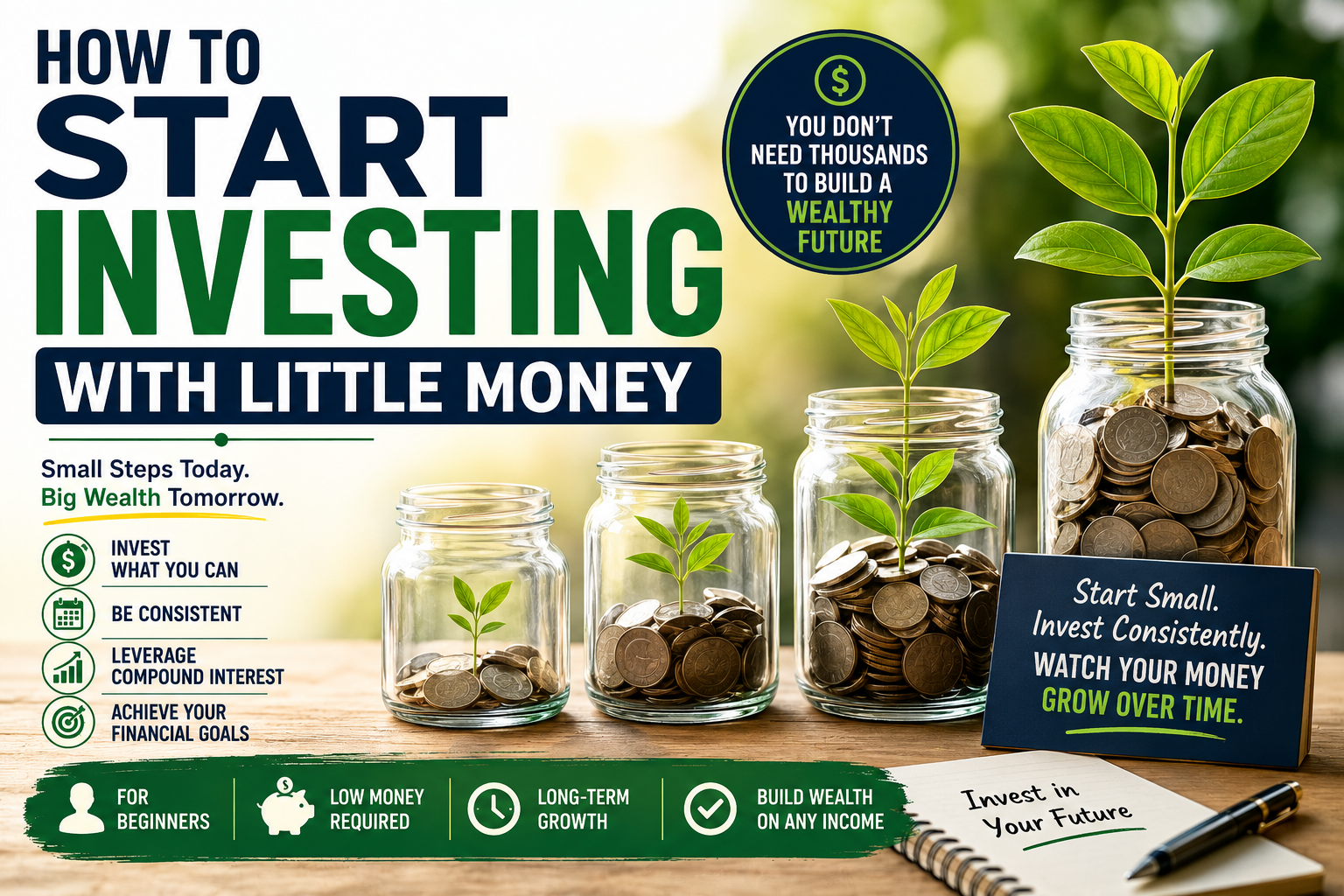
One of the biggest misconceptions about investing is that you need a lot of money to get started.
Many people assume investing is something reserved for wealthy individuals with thousands of dollars available to put into the stock market.
As a result, they postpone investing for years while waiting for the “right time” or a larger bank balance.
Unfortunately, that delay can become expensive.
The truth is that investing has become far more accessible than it was in the past.
Today, many people can begin investing with relatively small amounts of money.
In many cases, the most important factor isn’t how much money you start with.
It’s simply getting started.
This idea may seem surprising.
After all, how can investing small amounts of money possibly make a meaningful difference?
The answer lies in two powerful concepts:
- Consistency
- Time
When combined with compound growth, even modest contributions can grow significantly over the long term.
This is why financial experts frequently encourage beginners to start investing as soon as they reasonably can.
Waiting for the perfect amount of money often means losing valuable years that could have been spent building wealth.
Whether your goal is:
- Retirement planning
- Financial independence
- Wealth building
- Creating passive income
- Growing side hustle earnings
investing can help move you toward those objectives.
In this article, you’ll learn:
- Whether you can really invest with little money
- Why starting small matters
- Beginner-friendly investment options
- How to create an investing plan
- Common mistakes to avoid
- Practical ways to find money to invest
Most importantly, you’ll discover that investing is not about starting big.
It’s about starting.
Can You Really Start Investing with Little Money?
One of the first questions beginners ask is:
“Can I actually invest if I only have a small amount of money?”
The answer is yes.
In fact, many successful investors began with far less money than most people imagine.
The challenge isn’t usually a lack of money.
The challenge is overcoming the belief that investing requires large sums of money.
Let’s examine that myth.
The Biggest Investing Myth
Many people believe they need:
- $5,000
- $10,000
- $20,000
before investing becomes worthwhile.
This belief causes countless individuals to delay investing for years.
Unfortunately, those lost years can be far more costly than starting with a small amount.
Why This Myth Exists
Historically, investing was less accessible.
Some brokerage firms required large account minimums.
Certain investments required substantial capital.
Today, many of those barriers have disappeared.
Modern investing platforms allow beginners to start with relatively modest amounts.
This makes investing accessible to far more people.
Why Many People Never Start
Even when investing is available, many people remain on the sidelines.
Common reasons include:
- Fear of losing money
- Lack of confidence
- Information overload
- Believing they need more money first
The final reason is especially common.
Many people tell themselves:
“I’ll start investing when I have more money.”
The problem is that “more money” often never feels like enough.
Years pass.
Opportunities are missed.
Compounding is delayed.
A Better Mindset
Instead of asking:
How much money do I need?
Ask:
How can I start with what I have?
That simple shift in thinking can make a significant difference.
How Investing Has Changed
The investing world looks very different today than it did decades ago.
Technology has reduced many traditional barriers.
Modern investors can often:
- Open accounts online
- Invest automatically
- Purchase fractional shares
- Access diversified investment products
This has made investing more accessible than ever before.
Why This Matters
You no longer need to wait until you have thousands of dollars.
You can begin learning, investing, and building good habits with much smaller amounts.
The earlier those habits begin, the more valuable they can become.
Small Amounts Can Still Grow
One of the most powerful lessons in personal finance is that growth is not determined solely by starting balance.
Growth is also influenced by:
- Time
- Consistency
- Compound interest
- Investment returns
This means a modest amount invested today may have greater long-term value than a larger amount invested years later.
Example
Imagine two people.
Person A
Invests:
$50 per month
starting today.
Person B
Waits five years and then begins investing:
$200 per month.
Although Person B invests more money each month, Person A has a valuable advantage:
Time.
Those additional years allow compound growth to begin earlier.
This demonstrates why starting matters.
Real-Life Example
Consider Marcus.
Marcus wants to invest but believes he needs several thousand dollars before getting started.
Instead of waiting, he decides to invest:
$100 per month.
At first, the amount seems small.
However, Marcus develops:
- Investing experience
- Financial discipline
- Consistency
Most importantly, his money begins participating in compound growth.
Several years later, Marcus is glad he started rather than waited.
The lesson is simple:
You don’t need a large amount of money to begin building wealth.
You simply need to begin.
You’re already investing time in improving your finances, and that’s something to be proud of. Before you continue, download our free 7 Days To Financial Clarity™ workbook and start putting these ideas into action.

Why Starting Small Is Better Than Waiting
Many beginners assume waiting is harmless.
After all, what’s the difference between starting today and starting later?
The answer can be significant.
Because investing relies heavily on time and compounding, delays often carry hidden costs.
Let’s examine why.
The Cost of Delaying
Every year spent waiting is a year that compound growth cannot work on your behalf.
This cost is easy to overlook because it isn’t visible.
You don’t receive a bill.
You don’t see an immediate penalty.
However, opportunities are still being lost.
Quick Reality Check
Waiting five years to start investing often costs far more than starting today with a small amount. Time is one of the most valuable investing assets you can never recover.
Why This Matters
Compound growth depends on time.
Less time generally means less opportunity for growth.
This is why delaying investing can be surprisingly expensive.
Time vs Amount Invested
Many people focus entirely on how much they invest.
While contribution size matters, time can be equally important.
Sometimes more important.
Example
Imagine two investors.
Investor A starts early and contributes smaller amounts.
Investor B starts later but contributes larger amounts.
Investor A may still accumulate substantial wealth because compounding had more years to work.
The Key Lesson
You can always invest more money later.
You cannot recover lost time.
The Power of Getting Started
Beginning creates momentum.
Once someone becomes an investor, they often begin:
- Learning more
- Saving more
- Increasing contributions
- Improving financial habits
The first investment is frequently the hardest one.
After that, investing often becomes part of a routine.
Why Action Matters
Many people spend years researching investing.
Far fewer actually start.
Knowledge is valuable.
Action is what produces results.
Building the Investing Habit
One of the greatest benefits of starting small is habit formation.
Successful investing is often less about large investments and more about consistent behavior.
Example
Investing:
$50 per month
for years creates a habit.
That habit can eventually become:
$100 per month
then:
$250 per month
and perhaps more.
The important thing is establishing the routine.
Why Habits Matter
Wealth building often occurs through repeated actions rather than dramatic events.
Small investments made consistently can become surprisingly powerful over time.
A Key Lesson Before Moving Forward
Many people believe investing success begins with a large amount of money.
In reality, investing success often begins with a decision.
The decision to start.
The decision to stay consistent.
The decision to allow time and compounding to work.
In the next section, we’ll answer one of the most common beginner questions:
How much money do you actually need to start investing?
We’ll look at realistic examples using $25, $50, $100, and $500 to show how even modest amounts can begin a wealth-building journey.
How Much Money Do You Actually Need?
Many beginners use an investment calculator to estimate how regular monthly contributions may grow over time.
One of the most common questions beginner investors ask is:
“How much money do I need to start investing?”
The answer surprises many people.
You may need far less than you think.
While larger investments can accelerate wealth building, the amount you start with is often less important than developing the habit of investing consistently.
Modern investing platforms have made it possible for people to begin with relatively small amounts of money.
This means the conversation is no longer:
“Can I afford to invest?”
Instead, it becomes:
“How can I start investing with the money I have available today?”
Let’s examine what different starting amounts can look like.
Starting with $25
Many people spend more than $25 each month without realizing it.
Examples might include:
- Coffee shop visits
- Streaming subscriptions
- Impulse purchases
- Convenience spending
Redirecting even a small amount toward investing can begin your wealth-building journey.
Why $25 Still Matters
At first glance, $25 may seem insignificant.
However, investing is about more than the amount.
It’s about establishing a habit.
Benefits of Starting with $25
- Builds investing confidence
- Creates consistency
- Develops financial discipline
- Introduces compound growth
Most importantly, it gets you started.
A Helpful Perspective
Many successful investors didn’t begin with large portfolios.
They began with small contributions that grew over time.
Starting with $50
For many beginners, $50 per month feels achievable.
This amount may come from:
- Reducing discretionary spending
- Budget improvements
- Small income increases
Although $50 won’t create overnight wealth, it can create something far more important:
Momentum.
Why Momentum Matters
Investing becomes easier once it becomes part of your routine.
Regular contributions create:
- Confidence
- Familiarity
- Experience
Over time, many investors naturally increase contributions as their financial situation improves.
Real-Life Example
Suppose someone invests:
$50 per month
for several years.
As income increases, contributions may rise to:
- $75 per month
- $100 per month
- $200 per month
The initial habit becomes the foundation for future growth.
Starting with $100
A monthly investment of $100 can have a meaningful long-term impact.
Many investors begin at this level.
The key advantage is consistency.
Why $100 Can Be Powerful
Combined with:
- Time
- Compound growth
- Regular contributions
$100 per month can become a substantial portfolio over the long term.
Where the Money Might Come From
Examples include:
- Budget adjustments
- Overtime income
- Freelancing
- Side hustles
- Online income opportunities
This is one reason investing often works well alongside efforts to increase income.
Extra earnings can become investment capital.
Starting with $500
Investors who can contribute larger amounts may experience faster growth.
However, the principles remain identical.
Success still depends on:
- Consistency
- Patience
- Time
- Sound investment choices
Bigger Contributions Don’t Replace Good Habits
Some people mistakenly believe larger contributions guarantee success.
In reality, poor investing habits can affect portfolios of any size.
The Real Advantage
The true advantage comes from combining:
- Larger contributions
- Long time horizons
- Compound growth
When those factors work together, wealth-building potential increases significantly.
What Matters Most
After reviewing these examples, a clear pattern emerges.
The amount matters.
But it isn’t the most important factor.
Successful investing is usually built on:
✓ Starting
✓ Staying consistent
✓ Remaining patient
✓ Increasing contributions over time
Many investors spend years worrying about whether they have enough money.
Meanwhile, they miss valuable time that could have been used for compounding.
The Bottom Line
The best amount to start investing with is often:
Whatever amount allows you to begin today.
Step 1: Build a Financial Foundation First
Before investing aggressively, it’s important to create a stable financial foundation.
Investing is a powerful wealth-building tool.
However, it works best when combined with strong financial habits.
Think of investing like building a house.
A strong foundation makes everything else more secure.
Without that foundation, financial setbacks can create unnecessary stress.
Let’s look at the key components.
📈 Watch Your Money Grow
Successful investing isn’t about guessing—it’s about understanding long-term growth. Use our free Investment Growth Calculator to see how regular investing can build wealth over time.

Create an Emergency Fund
One of the first financial priorities should be building an emergency fund.
An emergency fund is money set aside specifically for unexpected expenses.
Examples include:
- Medical emergencies
- Car repairs
- Home repairs
- Job loss
- Emergency travel
Why Emergency Funds Matter
Without emergency savings, many people are forced to:
- Use credit cards
- Take loans
- Sell investments
during difficult situations.
This can disrupt long-term investing plans.
Example
Imagine investing regularly for several years.
Suddenly, a major expense occurs.
Without emergency savings, you may need to sell investments to cover the cost.
If markets are down at that time, the situation becomes even more challenging.
An emergency fund helps prevent this.
How Much Should You Save?
A common recommendation is to maintain:
- Three to six months of essential expenses
in an emergency fund.
The ideal amount depends on:
- Job stability
- Family responsibilities
- Income consistency
- Personal comfort level
The goal is financial resilience.
Pay Off High-Interest Debt
High-interest debt can create obstacles to wealth building.
This is especially true for:
- Credit card debt
- Payday loans
- Certain personal loans
Why High-Interest Debt Matters
Suppose your credit card charges:
22% interest
while your investments earn:
8%
Your debt is growing much faster than your investments.
Example
An investor contributes money to the market while simultaneously carrying large credit card balances.
Although investing is valuable, eliminating high-interest debt may provide a stronger financial return in many situations.
The Key Lesson
High-interest debt often deserves attention before aggressive investing begins.
Create a Basic Budget
A budget provides clarity.
Without one, it can be difficult to determine:
- How much money you earn
- How much you spend
- How much you can invest
Why Budgeting Helps Investors
Successful investing is usually a long-term process.
Consistency matters.
A budget helps identify how much money can realistically be invested each month.
Example
Suppose your monthly finances look like this:
Income:
$3,500
Expenses:
$3,000
Remaining:
$500
You now have a clearer understanding of what may be available for:
- Investing
- Saving
- Debt reduction
This creates structure.
Why This Matters Before Investing
Many beginners focus exclusively on investments.
However, investing is only one part of a larger financial picture.
A strong foundation typically includes:
✓ Emergency savings
✓ Budgeting
✓ Debt management
✓ Consistent cash flow
When these areas are in place, investing often becomes easier and more sustainable.
A Key Lesson Before Moving Forward
Investing with little money is absolutely possible.
However, successful investing isn’t only about choosing investments.
It’s also about creating financial stability.
A strong foundation helps ensure your investments have time to grow without being interrupted by avoidable financial emergencies.
In the next section, we’ll explore how to set realistic investing goals and choose the right type of investment account for your situation.
Step 2: Set Realistic Investing Goals
One of the biggest mistakes beginner investors make is starting without a clear goal.
They know they want to invest, but they aren’t sure why.
Without a goal, it becomes difficult to determine:
- How much to invest
- Which investments to choose
- How much risk to take
- How long to remain invested
Clear goals provide direction.
They help transform investing from a vague idea into a practical financial plan.
Fortunately, setting investing goals doesn’t need to be complicated.
The important thing is understanding what you’re trying to achieve.
Short-Term Goals
Short-term goals generally involve money that may be needed within the next few years.
Examples include:
- Buying a car
- Taking a vacation
- Building a home down payment
- Funding a major purchase
Why Short-Term Goals Require Caution
Investments can fluctuate in value.
A market decline that occurs shortly before you need the money could affect your plans.
Example
Suppose you plan to purchase a vehicle within:
Two years.
Investing all of that money in aggressive stock investments may expose you to unnecessary risk.
The Key Lesson
The shorter your timeline, the more important stability often becomes.
Long-Term Goals
Long-term goals are where investing typically shines.
These goals often involve:
- 10 years
- 20 years
- 30 years
- Or more
Examples include:
- Building wealth
- Financial independence
- Future passive income
- Long-term financial security
Why Long-Term Goals Benefit from Investing
Longer timelines provide more opportunities for:
- Compound growth
- Market recovery
- Wealth accumulation
Temporary market declines become less significant when viewed across decades rather than months.
Example
Someone investing for a goal 25 years away may have more flexibility than someone who needs the money next year.
Time can become a powerful ally.
Retirement Goals
Retirement is one of the most common reasons people invest.
Rather than relying solely on future employment income, investors build assets that may help support them later in life.
Why Retirement Investing Matters
Retirement can last:
- 20 years
- 30 years
- Or longer
This means many people need investments that can continue supporting them throughout retirement.
The Advantage of Starting Early
A person who begins investing for retirement in their twenties benefits from decades of compound growth.
Even modest contributions can become meaningful over long periods.
A Powerful Reminder
Retirement planning isn’t necessarily about investing large amounts immediately.
It’s often about investing consistently for many years.
Wealth-Building Goals
Many people invest because they want to increase their net worth over time.
This is often referred to as wealth building.
What Wealth Building Means
Wealth building involves gradually increasing financial assets through:
- Saving
- Investing
- Compound growth
- Income generation
The goal is not merely earning money.
The goal is accumulating assets that can continue growing.
Why Investing Plays a Key Role
Investing allows money to participate in growth opportunities that may outpace inflation over long periods.
This makes investing an important tool for many wealth-building strategies.
Matching Goals to Investments
Different goals often require different approaches.
Short-Term Goal Example
May emphasize:
- Stability
- Lower volatility
- Capital preservation
Long-Term Goal Example
May emphasize:
- Growth
- Compounding
- Long-term wealth accumulation
Why This Matters
Choosing investments without considering goals can create unnecessary risk.
Successful investors often begin with the goal and then choose investments that support it.
Step 3: Choose the Right Investment Account
Once your goals are clear, the next step is selecting an investment account.
Many beginners focus entirely on investments and overlook the importance of the account itself.
However, where you invest can be nearly as important as what you invest in.
Different account types offer different benefits.
Let’s review the most common options.
Brokerage Accounts
A brokerage account is one of the most flexible ways to invest.
It allows investors to purchase a wide range of investments.
Examples include:
- Stocks
- ETFs
- Mutual funds
- Bonds
Why Beginners Like Brokerage Accounts
Brokerage accounts are often straightforward and easy to understand.
They provide:
- Flexibility
- Broad investment choices
- Easy access to funds
Advantages
- Simple to open
- Flexible withdrawals
- Suitable for many financial goals
Considerations
Depending on your location and tax situation, investment gains may be taxable.
Retirement Accounts
Retirement accounts are specifically designed to encourage long-term investing.
Many countries offer retirement-focused accounts with special tax advantages.
Why They Matter
Retirement accounts often reward long-term investing behavior.
Because retirement is typically decades away, these accounts provide an environment where compounding can work over long periods.
Potential Benefits
Depending on the account type, benefits may include:
- Tax-deferred growth
- Tax-free growth
- Tax deductions
Long-Term Focus
These accounts generally work best when used for retirement planning rather than short-term financial goals.
Tax-Advantaged Accounts
Many governments encourage investing by offering tax benefits through specific account types.
The details vary by country, but the underlying principle is similar.
Why Taxes Matter
Taxes can reduce investment returns.
Over decades, the effect can become significant.
Example
Two investors earn identical returns.
One uses a tax-efficient account.
The other does not.
Over many years, the tax-efficient investor may retain more of their growth.
The Lesson
Understanding account options can improve long-term investing results.
Which Option Is Best for Beginners?
The answer depends on your goals.
General Wealth Building
A brokerage account may provide flexibility.
Retirement Planning
A retirement-focused account may be appropriate.
Multiple Goals
Many investors use a combination of account types.
Questions to Ask Yourself
- What am I investing for?
- When will I need the money?
- Do tax benefits matter?
- How much flexibility do I need?
The answers help determine which account structure may be most suitable.
A Key Lesson Before Moving Forward
Many people assume successful investing begins with choosing stocks.
In reality, successful investing often begins with:
✓ Clear goals
✓ Appropriate accounts
✓ Long-term thinking
✓ Consistent contributions
Once these pieces are in place, selecting investments becomes much easier.
In the next section, we’ll explore beginner-friendly investments, including ETFs, index funds, dividend investments, and fractional shares—some of the most accessible ways to start investing with little money.
Step 4: Understand Beginner-Friendly Investments
Once you’ve decided to start investing, a new question usually appears:
“What should I actually invest in?”
This is where many beginners become overwhelmed.
A quick internet search may expose you to:
- Stocks
- ETFs
- Index funds
- Mutual funds
- Bonds
- Real estate
- Cryptocurrency
The list can feel endless.
The good news is that you do not need to understand every investment option immediately.
In fact, many successful investors build wealth using only a few simple investment types.
When you’re starting with little money, simplicity can be a major advantage.
Let’s examine some beginner-friendly investment options.
ETFs
Exchange-Traded Funds, commonly known as ETFs, have become one of the most popular investment choices for beginners.
Many financial educators recommend ETFs because they combine diversification, simplicity, and accessibility.
What Is an ETF?
An ETF is a collection of investments packaged together into a single fund.
Instead of purchasing shares in just one company, an ETF may contain:
- Dozens of companies
- Hundreds of companies
- Sometimes even thousands of companies
This provides instant diversification.
Example
Rather than investing all your money into one business, you can invest in an ETF that owns shares of many businesses.
This spreads risk across multiple companies.
Why ETFs Are Popular
ETFs offer several advantages for beginners.
Diversification
A single ETF can provide exposure to numerous companies.
This reduces the risk associated with relying on one investment.
Simplicity
Many ETFs allow investors to gain broad market exposure without researching hundreds of individual stocks.
Accessibility
Most brokerage platforms make ETFs easy to purchase.
Many investors can begin with relatively small amounts.
Lower Costs
Many ETFs have lower fees compared to actively managed investment products.
Lower fees leave more money available for long-term growth.
Index Funds
Index funds are another beginner-friendly investment option.
In many ways, they share similarities with ETFs.
Both are designed to provide diversification and long-term growth potential.
What Is an Index Fund?
An index fund seeks to track the performance of a specific market index.
Examples may include:
- Broad stock market indexes
- Large-company indexes
- International indexes
Rather than trying to outperform the market, index funds aim to follow it.
How Index Funds Work
Imagine an index that contains hundreds of companies.
An index fund attempts to mirror that collection of companies.
When those companies grow, the fund may grow as well.
Why Many Investors Like Index Funds
Index funds offer:
- Diversification
- Simplicity
- Long-term focus
Many investors appreciate the “set it and forget it” approach often associated with index investing.
ETF vs Index Fund
Beginners often ask:
Which is better?
The answer depends on individual circumstances.
Both can be excellent tools for long-term investing.
The important takeaway is that both provide diversified exposure that may be more suitable for beginners than attempting to select individual stocks.
Dividend Investments
Some investors enjoy receiving income from their investments.
This is where dividend investments become attractive.
What Are Dividends?
Dividends are payments some companies make to shareholders.
These payments usually come from company profits.
Example
Suppose you own shares in a company that pays dividends.
Instead of earning returns solely from price increases, you may also receive periodic dividend payments.
Income and Growth Potential
Dividend investing offers two potential benefits.
Income
Investors may receive cash payments.
Growth
The underlying investment may increase in value over time.
This combination makes dividend investing attractive to many long-term investors.
Reinvesting Dividends
Many investors choose to reinvest dividends rather than spend them.
This allows dividends to purchase additional shares.
Those new shares may then generate additional dividends.
This creates a compounding effect.
Why This Matters
Dividend reinvestment is one of the clearest examples of compound growth in action.
Over long periods, reinvested dividends can contribute significantly to portfolio growth.
Fractional Shares
One of the biggest changes in modern investing is the rise of fractional shares.
This innovation has made investing far more accessible.
What Are Fractional Shares?
Traditionally, investors needed enough money to purchase an entire share of a company.
Some companies have share prices that can be expensive.
Fractional shares allow investors to purchase a portion of a share instead.
Example
Suppose a stock costs:
$500
per share.
A fractional share platform may allow you to invest:
$25
or:
$50
without purchasing the entire share.
Investing Without Buying Whole Shares
Fractional shares remove a major barrier for small investors.
Instead of waiting until you have hundreds or thousands of dollars, you can begin investing immediately.
Why This Is Helpful
Fractional shares allow investors to:
- Start earlier
- Invest consistently
- Participate in market growth
- Build portfolios gradually
This flexibility is especially valuable for beginners.
Why Fractional Shares Matter
Many people delay investing because they believe they need large sums of money.
Fractional shares prove otherwise.
They demonstrate that investing can begin with modest amounts.
This aligns perfectly with one of the most important themes of this article:
Starting matters more than starting big.
Which Investment Is Best for Beginners?
There is no single investment that is perfect for everyone.
However, many beginner investors prioritize:
✓ Diversification
✓ Simplicity
✓ Low costs
✓ Long-term growth
This is one reason ETFs and index funds are frequently recommended as starting points.
A Practical Approach
Rather than searching for the perfect investment, many beginners focus on:
- Learning continuously
- Investing consistently
- Remaining patient
- Building diversified portfolios
Over time, knowledge and confidence often grow alongside investments.
Step 5: Use Dollar-Cost Averaging
Once you’ve selected investments, another important question arises:
When should you invest?
Many beginners worry about investing at the wrong time.
They fear buying just before the market declines.
This concern often leads to delays.
Fortunately, there is a simple strategy that can help reduce this anxiety.
It’s called Dollar-Cost Averaging.
What Dollar-Cost Averaging Means
Dollar-Cost Averaging (DCA) is the practice of investing a fixed amount of money at regular intervals regardless of market conditions.
Examples include:
- $25 per week
- $50 per month
- $100 every paycheck
The amount remains consistent.
Whether markets are rising or falling, you continue investing according to your plan.
Why It Works for Small Investors
Dollar-Cost Averaging is especially helpful for people investing with limited amounts of money.
Removes Timing Pressure
You no longer need to predict:
- Market tops
- Market bottoms
- Economic events
The schedule handles the decision-making.
Encourages Consistency
Regular investing becomes a habit.
Consistency is one of the most important ingredients of long-term success.
Supports Compound Growth
Every contribution begins participating in the compounding process.
This allows small investments to gradually build momentum.
Example of Monthly Investing
Imagine Sarah decides to invest:
$100 per month.
Rather than waiting for the perfect opportunity, she contributes consistently.
During Strong Markets
Her money buys fewer shares.
During Weak Markets
Her money buys more shares.
Over Time
She develops:
- Investing discipline
- Consistency
- Long-term perspective
Most importantly, she stays invested.
Consistency Beats Perfection
Many investors spend years searching for the perfect entry point.
Meanwhile, they remain uninvested.
Dollar-Cost Averaging shifts the focus away from prediction and toward participation.
The Key Lesson
You do not need perfect timing.
You need a reasonable plan that you can follow consistently.
For many beginner investors, that approach is far more effective than trying to predict short-term market movements.
A Key Lesson Before Moving Forward
Investing with little money does not require complicated strategies.
Many beginners succeed by focusing on:
✓ Diversified investments
✓ Low-cost investment options
✓ Fractional shares
✓ Consistent contributions
✓ Dollar-Cost Averaging
These principles create a solid foundation for long-term wealth building.
In the next section, we’ll explore how automation can make investing even easier and review some of the most common mistakes that small investors should avoid.
Step 6: Automate Your Investing
One of the biggest challenges beginner investors face is consistency.
Most people understand that investing regularly is important.
The difficulty is remembering to do it month after month, year after year.
Life gets busy.
Unexpected expenses occur.
Motivation comes and goes.
This is why many successful investors rely on automation.
Automation helps remove human emotion and inconsistency from the investing process.
Instead of deciding every month whether to invest, the decision is made once and then repeated automatically.
For people investing with little money, automation can be one of the most powerful tools available.
Why Automation Works
Automation turns investing into a habit rather than a monthly decision.
Once contributions are scheduled, investing becomes part of your financial routine.
The Power of Consistency
Many investors fail not because they choose poor investments.
They fail because they stop investing.
Automation helps solve this problem.
Benefits of Automated Investing
- Reduces procrastination
- Encourages consistency
- Removes emotional decision-making
- Supports long-term growth
- Makes investing easier
These benefits can be especially valuable for beginners.
Investing with Every Paycheck
Many investors choose to invest whenever they receive income.
Examples include:
- Weekly
- Biweekly
- Monthly
contributions.
This approach aligns investing with cash flow.
Why This Works
When investing occurs immediately after receiving income, there is less temptation to spend the money elsewhere.
The investment becomes a priority rather than an afterthought.
Example
Suppose someone receives a paycheck every two weeks.
They automatically invest:
$50
from each paycheck.
By the end of the month, they have invested approximately:
$100
without needing to make repeated decisions.
Removing Emotion from Investing
Emotions can be expensive.
Many investors feel confident during rising markets and fearful during declining markets.
Unfortunately, these emotional reactions often lead to poor decisions.
Common Emotional Mistakes
Investors may:
- Buy when excitement is high
- Sell when fear is high
- Delay investing during uncertainty
Automation helps reduce these tendencies.
Why It Matters
An automated investment plan continues operating regardless of:
- Market headlines
- Economic concerns
- Short-term volatility
This consistency supports long-term investing success.
The Set-It-and-Forget-It Approach
Automation doesn’t mean ignoring your finances.
However, it does mean reducing unnecessary decisions.
Example
An investor may:
- Open an investment account.
- Select investments.
- Schedule automatic contributions.
- Periodically review progress.
The system does most of the work.
Why Beginners Like This Approach
It simplifies investing.
Rather than constantly wondering whether now is the right time to invest, the plan continues automatically.
For many people, simplicity improves consistency.
Common Mistakes Small Investors Make
Investing with little money is absolutely possible.
However, beginners often make mistakes that slow progress.
The good news is that most of these mistakes are avoidable.
Let’s examine the most common ones.
Waiting for More Money
This is perhaps the biggest mistake of all.
Many people postpone investing because they believe they need a larger amount of money.
Why This Happens
They think:
- $25 isn’t enough
- $50 isn’t enough
- $100 isn’t enough
As a result, they wait.
Sometimes for years.
The Problem
While they wait for more money, they lose valuable compounding time.
Better Approach
Start with what you have.
You can always increase contributions later.
Trying to Get Rich Quickly
Many beginner investors are attracted to stories of rapid wealth.
Social media often promotes:
- Massive gains
- Overnight success stories
- Speculative investments
These stories create unrealistic expectations.
The Reality
Most long-term wealth is built through:
- Consistency
- Patience
- Compound growth
rather than quick wins.
The Lesson
Focus on sustainable investing habits rather than shortcuts.
Chasing Hot Stocks
Many investors become interested in stocks only after hearing success stories.
By that point, excitement is often already high.
Why This Can Be Dangerous
Popular investments can become overhyped.
Investors sometimes buy based on emotion rather than strategy.
Better Approach
Focus on:
- Diversification
- Long-term goals
- Consistent investing
rather than market trends.
Ignoring Fees
Fees may seem small.
However, over decades they can have a meaningful impact.
Why Fees Matter
Every dollar spent on fees is a dollar that cannot continue growing.
Example
Two investors achieve identical returns.
One pays significantly higher fees.
Over time, the lower-fee investor may retain more wealth.
The Lesson
Understand the costs associated with your investments.
Investing Without a Plan
Some people begin investing without clear goals.
This often leads to:
- Frequent strategy changes
- Emotional decisions
- Inconsistent contributions
Why Planning Matters
A simple plan provides direction.
It helps answer:
- Why am I investing?
- How much should I invest?
- What am I trying to achieve?
Investors with plans often remain more disciplined during market fluctuations.
Real-Life Examples
Let’s look at a few examples of how small investments can begin a wealth-building journey.
Example 1: Investing $25 Per Month
Meet Emma.
Emma believes she doesn’t have enough money to invest.
After reviewing her spending, she identifies:
$25 per month
that can be redirected toward investing.
What Happens?
Initially, the amount seems small.
However, Emma develops:
- Consistency
- Investing experience
- Financial confidence
Over time, the habit becomes more valuable than the amount itself.
Lesson
Small beginnings can create powerful habits.
Example 2: Investing $100 Per Month
Meet Jason.
Jason decides to invest:
$100 each month.
He automates the process and continues regardless of market conditions.
What Happens?
Jason gradually builds:
- A growing portfolio
- Compound growth
- Long-term discipline
As his income increases, he raises his contributions.
Lesson
Consistency often matters more than starting amount.
Example 3: Using Side Hustle Income to Invest
Meet Olivia.
Olivia earns additional money through freelance work.
Instead of spending every extra dollar, she invests a portion of her side income.
What Happens?
Her side hustle income begins contributing to:
- Portfolio growth
- Compound interest
- Long-term wealth building
Lesson
Additional income can accelerate investing progress.
This is one reason investing and make-money-online strategies work so well together.
Every financial journey is different. Take our free
Financial Goal Assessment to discover which area deserves your attention first
and receive a clear direction for your next financial milestone.

How Compound Interest Helps Small Investors
Many people assume compound interest only benefits those with large portfolios.
The reality is quite different.
Compound interest can benefit investors regardless of account size.
What matters most is giving it enough time to work.
Why Time Matters More Than Size
A common misconception is that investment success depends entirely on how much money you start with.
In reality, time often plays an equally important role.
Example
Someone investing:
$50 per month
for decades may accumulate more wealth than someone who delays investing while waiting for a larger amount.
Why?
Because compound growth begins earlier.
Time becomes a force multiplier.
Small Contributions Over Decades
Small contributions can seem insignificant during the first few years.
However, as contributions accumulate and earnings begin generating additional earnings, growth can accelerate.
The Important Lesson
The first years may appear slow.
The later years often demonstrate the true power of compounding.
This is why patience matters.
The Snowball Effect of Compounding
Imagine a snowball rolling downhill.
At first, growth is modest.
As the snowball becomes larger, it gathers more snow.
Growth accelerates.
Compound interest works similarly.
Small investments may eventually become meaningful because earnings continue building upon previous earnings.
Connecting to Long-Term Wealth
Wealth building is rarely about one large investment.
More often, it is the result of:
- Consistent investing
- Long-term thinking
- Compound growth
- Financial discipline
These habits work together to create lasting financial progress.
A Key Lesson Before Moving Forward
Investing with little money is not a disadvantage if it allows you to start early.
Many successful investors began with modest contributions.
What separated them from others was not necessarily the amount invested.
It was their willingness to:
✓ Start
✓ Stay consistent
✓ Automate contributions
✓ Avoid common mistakes
✓ Allow compound growth time to work
In the final section, we’ll explore practical ways to find money to invest, connect investing with retirement planning, debunk common myths, and provide a complete beginner checklist before wrapping up the article.
How to Find Money to Invest
One of the most common challenges beginner investors face is finding money to invest.
Many people assume they must dramatically change their lifestyle before investing becomes possible.
In reality, small adjustments can often create opportunities to begin investing.
The goal isn’t necessarily finding thousands of dollars.
The goal is identifying consistent amounts that can be directed toward long-term financial growth.
Reviewing Your Budget
The first place to look is your existing budget.
Many people are surprised to discover spending patterns they were not fully aware of.
Why Budget Reviews Matter
A budget helps answer important questions:
- Where is my money going?
- Which expenses are essential?
- Which expenses could be reduced?
Even small adjustments may create room for investing.
Example
Reducing discretionary spending by:
$25 to $50 per month
could provide the starting capital needed to begin investing.
The amount may seem small, but consistency matters more than perfection.
Cutting Small Expenses
Not every financial improvement requires a major lifestyle change.
Small expenses often accumulate over time.
Examples might include:
- Unused subscriptions
- Frequent convenience purchases
- Impulse spending
- Excessive dining out
Why Small Changes Matter
The objective is not eliminating enjoyment from your life.
The objective is creating opportunities for future wealth building.
Example
Saving:
$10 per week
creates approximately:
$40 per month
that could be invested instead.
Over time, those investments may benefit from compound growth.
Using Pay Raises
Income increases provide an excellent opportunity to boost investing contributions.
Unfortunately, many people increase spending immediately after receiving a raise.
This is often called lifestyle inflation.
A Better Approach
When income increases:
- Increase savings
- Increase investing
- Increase financial security
before increasing discretionary spending.
Example
Suppose you receive a raise worth:
$200 per month
Allocating even half of that increase toward investing can significantly improve long-term results.
Side Hustles and Freelancing
Additional income can accelerate investing progress.
Many investors use side income specifically to fund investments.
Examples include:
- Freelancing
- Consulting
- Tutoring
- Delivery services
- Creative work
Why Side Income Helps
Side income creates investment capital without affecting your primary budget.
This can make investing feel more achievable.
Example
An extra:
$100 to $300 per month
from freelance work may provide meaningful investing opportunities.
Make Money Online Opportunities
The internet has created numerous ways to generate additional income.
This is one reason the Investing and Make Money Online categories naturally complement each other.
Examples include:
- Blogging
- Affiliate marketing
- Content creation
- Virtual assistance
- Selling digital products
- Freelance services
Turning Extra Income into Investments
Many people focus entirely on earning additional income.
The next step is deciding what to do with that income.
Investing a portion of online earnings can transform temporary income into long-term wealth-building opportunities.
The Wealth Formula
A simple formula to remember is:
Earn More → Invest More → Compound More → Build More Wealth
This is one of the most effective ways to accelerate financial progress.
Investing with Little Money and Retirement Planning
Retirement planning often feels intimidating because the goal can seem so large.
Many people assume they need significant amounts of money before retirement investing becomes worthwhile.
The reality is that retirement investing often begins with small contributions.
Why Early Investing Matters
Retirement investing benefits enormously from time.
The earlier contributions begin, the longer compound growth has to work.
The Advantage of Time
Someone investing in their twenties may have:
- 30 years
- 40 years
- Or more
before retirement.
Those decades create opportunities for substantial compound growth.
Why This Matters
A modest monthly contribution made consistently over decades can potentially become much larger than many people expect.
Starting in Your 20s vs 40s
This comparison appears frequently in personal finance because it highlights the value of time.
Investor A
Starts investing at:
Age 25
Investor B
Starts investing at:
Age 45
Both invest consistently.
Both make reasonable investment decisions.
The Difference
Investor A benefits from twenty additional years of compounding.
That time advantage can dramatically affect long-term outcomes.
The Lesson
Starting early is one of the most powerful investing advantages available.
Building Retirement Wealth Gradually
Many people believe retirement investing requires large monthly contributions.
While larger contributions can certainly help, consistency remains critical.
A Practical Perspective
Retirement wealth is often built through:
- Regular contributions
- Long time horizons
- Compound growth
- Patience
rather than dramatic one-time investments.
This is encouraging because it means many people can begin with manageable amounts.
Investing Myths Debunked
Several myths continue preventing people from investing.
Let’s address some of the most common misconceptions.
You Need Thousands of Dollars
This is perhaps the biggest investing myth.
Reality
Modern investing platforms have made investing accessible to people with relatively small amounts of money.
The most important step is often simply getting started.
Investing Is Only for Rich People
Many people assume investing is reserved for wealthy individuals.
Reality
Investing is a tool available to people across a wide range of income levels.
Wealthy investors may invest larger amounts, but they do not have exclusive access to investing opportunities.
Small Investments Don’t Matter
This myth discourages countless potential investors.
Reality
Small investments may appear insignificant initially.
However, when combined with:
- Time
- Consistency
- Compound growth
their impact can become meaningful.
Important Reminder
Every large investment portfolio once started at zero.
It’s Too Late for Me to Start
Many people regret not starting sooner.
As a result, they convince themselves that investing is no longer worthwhile.
Reality
Starting earlier is generally better.
However, starting today is usually better than waiting another year.
The Lesson
Focus on what you can do now rather than what you wish you had done previously.
Beginner Investing Checklist
Before wrapping up, let’s summarize the key actions discussed throughout this article.
Before You Start
✓ Build an emergency fund
✓ Create a basic budget
✓ Address high-interest debt
✓ Define your investing goals
✓ Choose an investment account
✓ Commit to long-term thinking
During Your First Year
✓ Begin investing consistently
✓ Automate contributions
✓ Learn about diversified investments
✓ Focus on progress rather than perfection
✓ Continue learning
✓ Avoid emotional decisions
Long-Term Habits
✓ Stay invested
✓ Increase contributions when possible
✓ Reinvest earnings
✓ Review goals annually
✓ Remain diversified
✓ Stay patient
✓ Allow compounding to work
Final Thoughts
Many people delay investing because they believe they don’t have enough money.
Fortunately, investing doesn’t require a large starting balance.
What it often requires is a willingness to begin.
The most successful investors are not necessarily the ones who start with the most money.
They are often the ones who:
- Start early
- Stay consistent
- Continue learning
- Remain patient
Investing with little money may not seem exciting at first.
However, small investments combined with time and compound growth can become surprisingly powerful.
Remember:
You do not need thousands of dollars.
You do not need perfect timing.
You do not need expert-level knowledge.
You simply need a plan and the discipline to follow it.
Whether your goal is:
- Retirement
- Wealth building
- Financial independence
- Growing side hustle income
- Creating future passive income
starting today may be one of the most valuable financial decisions you ever make.
The amount you begin with matters far less than your willingness to begin.
Frequently Asked Questions
Can I start investing with $25?
Yes. Many modern investment platforms allow investors to begin with relatively small amounts of money.
Is $100 enough to start investing?
Absolutely. Consistent contributions of $100 per month can help build investing habits and create opportunities for compound growth.
What is the best investment for beginners?
Many beginners prefer diversified investments such as ETFs or index funds because they offer broad market exposure and simplicity.
Are ETFs good for small investors?
Yes. ETFs are often considered beginner-friendly because they provide diversification, accessibility, and relatively low costs.
Should I pay off debt before investing?
High-interest debt is often a priority because the interest costs may outweigh potential investment gains.
What if I lose money?
All investments involve risk. Diversification, long-term thinking, and consistent investing can help manage that risk.
How often should I invest?
Many investors contribute monthly or with each paycheck. Consistency is often more important than frequency.
Is it too late to start?
No. Starting today is generally better than continuing to wait.
Can side hustles help me invest more?
Yes. Many people use additional income from freelancing, side hustles, and online businesses to increase investment contributions.
What is the biggest mistake beginners make?
One of the most common mistakes is waiting too long to start because they believe they need more money.
🚀 Ready To Keep Going?
You have invested time learning today. Now take the next step by downloading our free 7 Days To Financial Clarity™ workbook and begin building a stronger financial future.
