
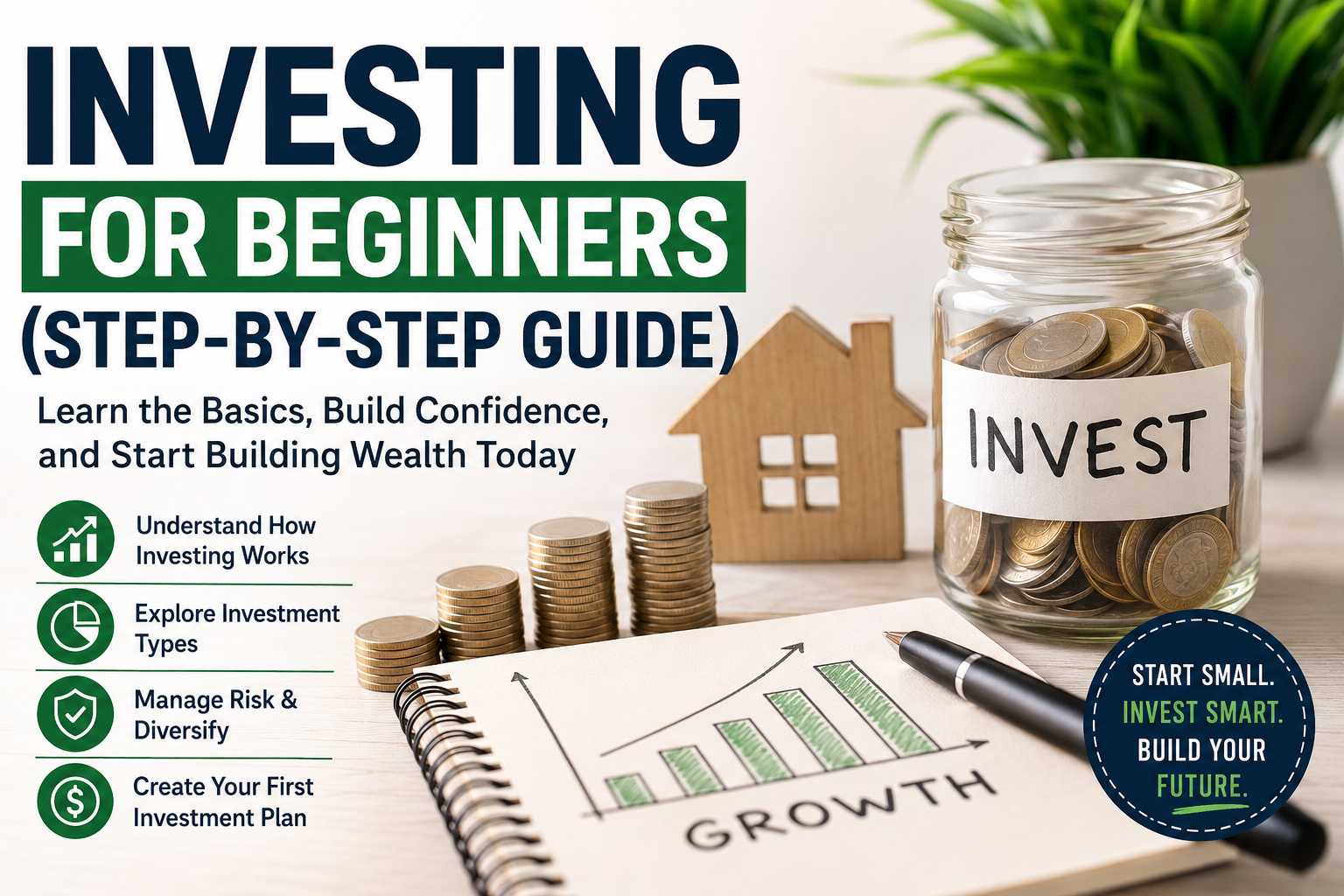
For many people, investing feels intimidating.
The word itself often brings images of stock market experts, financial news channels, complicated charts, and people making large amounts of money—or losing it.
As a result, countless beginners assume investing is something they will learn “someday.”
Unfortunately, that someday often becomes years later.
While they wait, valuable time passes.
Money remains sitting in low-interest savings accounts, and opportunities for long-term growth are missed.
One of the biggest misconceptions about investing is that you need to be wealthy before you can start.
In reality, many successful investors began with relatively small amounts of money.
The difference wasn’t how much they started with.
The difference was that they started.
Another common misconception is that investing is only for financial experts.
This couldn’t be further from the truth.
Modern investing has become more accessible than ever before.
Today, someone can begin investing with relatively small amounts of money using simple investment products designed specifically for beginners.
Understanding investing is important because saving money alone may not be enough to achieve long-term financial goals.
Savings accounts play an important role in financial planning.
They help provide:
- Emergency funds
- Short-term savings
- Financial stability
However, investing serves a different purpose.
Investing helps your money grow over time.
Instead of simply storing money, investing allows your money to potentially generate additional money through growth, income, and compounding.
This is one reason investing is considered one of the most powerful wealth-building tools available.
Whether your goals include:
- Financial independence
- Retirement
- Buying a home
- Building wealth
- Creating additional income streams
investing can play an important role in helping you reach them.
Throughout this article, you’ll learn:
- What investing is
- How investing works
- Common investment types
- How beginners can start investing
- Common mistakes to avoid
- Practical steps to create your first investment plan
Most importantly, you’ll learn that investing does not have to be complicated.
Small, consistent actions often outperform complex strategies.
Let’s begin by understanding exactly what investing means.
What Is Investing?
At its simplest, investing means putting money into assets that have the potential to increase in value or generate income over time.
Instead of spending money today, you commit that money to something you believe may help improve your financial future.
The goal is simple:
Use money to help create more money.
A Beginner-Friendly Definition
Investing is the process of purchasing assets that have the potential to grow in value or generate income over time.
Examples include:
- Stocks
- Bonds
- Exchange-traded funds (ETFs)
- Mutual funds
- Real estate
- Certain business investments
When people invest, they accept some level of risk in exchange for the possibility of future rewards.
The level of risk varies depending on the investment.
How Investing Differs From Saving
Many beginners confuse saving and investing.
While both are important, they serve different purposes.
Saving
Saving is designed for:
- Emergency funds
- Short-term goals
- Stability
- Accessibility
Money in a savings account is generally protected but typically grows slowly.
Investing
Investing is designed for:
- Long-term growth
- Wealth building
- Retirement planning
- Financial independence
Investments may rise and fall in value, but historically many investments have provided higher long-term growth potential than traditional savings accounts.
A Simple Example
Imagine two people each save $100 per month.
Person A
Keeps the money in a basic savings account.
Person B
Invests the money consistently over many years.
Although investment returns are never guaranteed, the long-term growth potential can be dramatically different because of compounding.
This illustrates why investing plays such an important role in wealth building.
Why Investing Matters
Most people earn money through work.
They exchange time and effort for income.
There is nothing wrong with this approach.
However, investing introduces another concept:
Allowing money to work on your behalf.
Instead of relying entirely on earned income, investments can potentially generate growth and income over time.
This creates opportunities for wealth accumulation that would be difficult to achieve through savings alone.
Connecting Investing and Income Growth
This concept is especially important for readers interested in:
- Side hustles
- Freelancing
- Online businesses
- Make-money-online opportunities
Many people focus exclusively on increasing income.
While increasing income is valuable, long-term wealth often comes from what you do with that income after you earn it.
For example:
A successful freelancer may earn additional income through online work.
If that income is invested consistently, it can potentially create long-term wealth far beyond the original earnings.
Income creates the fuel.
Investing helps put that fuel to work.
The Power of Compound Growth
One of the most important concepts in investing is compound growth.
Compounding occurs when investment earnings begin generating their own earnings.
Over time, growth builds upon previous growth.
The process often starts slowly.
Then, as years pass, growth can accelerate.
Many investors underestimate how powerful compounding can become over long periods.
This is why starting early often matters more than investing large amounts later.
Real-Life Example
Imagine two investors.
Investor A
Begins investing at age 25.
Investor B
Waits until age 35.
Both invest the same monthly amount.
Although Investor B contributes substantial money, Investor A may ultimately accumulate significantly more wealth simply because their money had more time to compound.
Time is one of the most valuable assets an investor can have.
Why Many People Never Start Investing
Despite the benefits of investing, millions of people delay getting started.
Interestingly, the biggest obstacles are often psychological rather than financial.
Understanding these barriers can help you avoid them.
Fear of Losing Money
The most common reason people avoid investing is fear.
Stock market declines receive significant media attention.
Stories about losses often generate more headlines than stories about long-term success.
As a result, beginners sometimes assume investing is extremely dangerous.
The reality is more nuanced.
Investments can fluctuate in value.
Short-term losses are possible.
However, many investors focus on long-term strategies rather than short-term market movements.
Understanding risk is important.
Avoiding investing entirely because of fear can also carry risks, particularly when inflation reduces the purchasing power of savings over time.
Thinking You Need Thousands of Dollars
Many beginners believe investing requires large amounts of money.
This misconception prevents countless people from getting started.
Today, many investment platforms allow investors to begin with relatively small amounts.
In many cases:
- Consistency matters more than size.
- Habits matter more than starting balance.
- Time matters more than perfection.
The most important step is often simply getting started.
Information Overload
Investing information is everywhere.
Unfortunately, much of it can feel overwhelming.
Beginners encounter:
- Stock recommendations
- Market predictions
- Economic forecasts
- Investment jargon
The volume of information can create paralysis.
Many people delay investing because they feel they need to learn everything first.
In reality, successful investing often relies on understanding a handful of key principles and applying them consistently.
Trying to Time the Market
Many new investors believe they must wait for the perfect time to invest.
They tell themselves:
- “I’ll start when the market drops.”
- “I’ll wait until things feel safer.”
- “I’ll invest after the next correction.”
Unfortunately, consistently predicting market movements is extremely difficult.
Even experienced professionals struggle to do it reliably.
Waiting for the perfect moment often results in years of missed opportunities.
Real-Life Example
Consider Michael.
Michael began researching investing at age 28.
He spent years reading articles, watching videos, and waiting for the perfect opportunity.
At age 35, he still hadn’t started.
Meanwhile, his friend Sarah began investing modest amounts every month despite having limited knowledge.
By focusing on consistency rather than perfection, Sarah accumulated years of investing experience and portfolio growth while Michael remained on the sidelines.
The lesson is simple:
Perfect timing rarely matters as much as consistent action
Step 1: Build a Strong Financial Foundation First
One of the biggest mistakes beginners make is rushing into investing before establishing financial stability.
Investing is an important wealth-building tool, but it should not be the first step in a financial plan.
Before putting money into stocks, ETFs, or other investments, it’s important to create a solid financial foundation.
Think of investing like building a house.
A beautiful house built on a weak foundation is vulnerable to problems.
Similarly, an investment portfolio built without financial stability can quickly fall apart when unexpected expenses arise.
A strong foundation allows you to invest with confidence and stay invested when markets become volatile.
Create an Emergency Fund
Before investing, most financial professionals recommend building an emergency fund.
An emergency fund is money set aside specifically for unexpected expenses.
Examples include:
- Medical bills
- Car repairs
- Home repairs
- Job loss
- Emergency travel
Without emergency savings, many people are forced to sell investments at the worst possible time.
Why This Matters
Imagine investing $5,000.
A few months later, your vehicle requires a major repair costing $2,500.
Without emergency savings, you may have no choice but to sell investments to cover the expense.
If the market happens to be down at that time, you could be forced to sell at a loss.
An emergency fund helps prevent this situation.
How Much Should You Save?
A common recommendation is to save:
- Three to six months of essential expenses
before aggressively investing.
The exact amount depends on:
- Job stability
- Household income
- Family responsibilities
- Personal comfort level
The goal is to create a financial cushion that protects your investments from short-term emergencies.
Pay Off High-Interest Debt
Investing while carrying high-interest debt often creates challenges.
This is especially true for:
- Credit card debt
- Payday loans
- Certain personal loans
Why High-Interest Debt Is a Problem
Suppose a credit card charges:
20% interest
If your investments earn:
8%
you are effectively losing ground financially.
The debt is growing faster than the investment.
Real-Life Example
Imagine two people.
Person A
Invests $500 per month while carrying a large credit card balance at 22% interest.
Person B
Uses that same money to eliminate high-interest debt first and then begins investing.
Over time, Person B may be in a stronger financial position because they removed a major financial burden before investing.
A Balanced Approach
This doesn’t necessarily mean all debt must be eliminated before investing.
Lower-interest obligations such as mortgages or certain student loans may require a different analysis.
However, high-interest debt should usually be a priority.
Establish a Basic Budget
Investing works best when it becomes part of an overall financial plan.
This is where budgeting becomes important.
A budget helps you understand:
- Income
- Expenses
- Savings capacity
- Investment potential
Without a budget, investing often becomes inconsistent.
Why Consistency Matters
Successful investing is rarely about making one large investment.
It’s often about investing smaller amounts consistently over many years.
A budget helps identify how much money can realistically be invested each month.
Example
Suppose your budget reveals:
Monthly Income:
$4,000
Monthly Expenses:
$3,400
This leaves:
$600
available for financial goals.
You might decide to allocate:
- $300 toward investing
- $200 toward savings
- $100 toward debt reduction
This creates a sustainable system.
Why Investing Shouldn’t Come Before Financial Stability
Many social media influencers promote investing as the solution to every financial problem.
In reality, investing is only one piece of a larger financial picture.
Before investing heavily, you should generally have:
✓ A workable budget
✓ Emergency savings
✓ A plan for high-interest debt
✓ Stable cash flow
Building this foundation improves the likelihood of long-term investing success.
Step 2: Understand How Investments Grow
Once your financial foundation is in place, the next step is understanding how investments actually generate returns.
Many beginners know that investing can help build wealth.
Fewer understand how that wealth is created.
Understanding the sources of investment growth helps investors make more informed decisions and maintain realistic expectations.
Generally speaking, investments grow in three primary ways:
- Capital appreciation
- Dividend income
- Interest income
Let’s examine each one.
Capital Appreciation Explained
Capital appreciation occurs when an investment increases in value.
This is often what people think of when they imagine investing.
Simple Example
Suppose you purchase an investment for:
$100
Several years later, that investment is worth:
$150
The increase in value represents capital appreciation.
Why Appreciation Happens
Investments may increase in value because of:
- Business growth
- Increased profits
- Economic expansion
- Investor demand
While appreciation is never guaranteed, it has historically been one of the primary drivers of long-term wealth creation.
Real-Life Example
Imagine purchasing shares of a company that continues growing its sales and profits over many years.
As the business becomes more valuable, investors may be willing to pay more for ownership.
This can increase the value of your investment.
Dividend Income Explained
Some investments generate income in the form of dividends.
A dividend is a payment made to investors from company profits.
How Dividends Work
When a company earns profits, it may:
- Reinvest the profits into the business
- Distribute some profits to shareholders
Those distributions are called dividends.
Why Dividends Matter
Dividends provide investors with income without requiring them to sell investments.
This can be particularly attractive for:
- Retirement investors
- Income-focused investors
- Long-term wealth builders
Example
Suppose you own shares in a company that pays annual dividends.
Even if the stock price remains unchanged, you may still receive income through dividend payments.
This creates an additional source of return.
Interest Income Explained
Certain investments generate returns through interest payments.
This is most commonly associated with:
- Bonds
- Savings products
- Fixed-income investments
How Interest Works
When you purchase certain fixed-income investments, you are effectively lending money.
In exchange, you receive interest payments.
Example
Suppose you invest in a bond paying:
5% annual interest.
A $1,000 investment could generate:
$50
per year in interest income.
The exact amount depends on the investment terms.
Why Some Investors Prefer Interest Income
Interest-based investments are often viewed as less volatile than stocks.
However, they may also offer lower long-term growth potential.
This trade-off becomes important when building an investment portfolio.
Reinvestment and Compound Growth
Perhaps the most powerful wealth-building mechanism is reinvestment.
Reinvestment occurs when earnings are used to purchase additional investments rather than being spent.
This allows growth to build upon previous growth.
Why Compounding Matters
Imagine earning:
$100
from an investment.
Instead of spending it, you reinvest it.
Future growth now occurs on:
- The original investment
- The additional $100
Over time, this process can accelerate wealth accumulation.
Small Numbers Can Become Large Numbers
Many people underestimate the impact of consistency.
A relatively modest monthly investment may grow significantly over decades because of compound growth.
This is why experienced investors often emphasize:
- Starting early
- Staying invested
- Remaining consistent
rather than trying to find the perfect investment.
Real-Life Example
Consider two investors.
Investor A
Invests:
$300 per month
beginning at age 25.
Investor B
Invests:
$300 per month
beginning at age 35.
Both invest consistently.
Although Investor B contributes the same monthly amount, Investor A benefits from an additional decade of compounding.
That extra time can create a substantial difference in long-term results.
The lesson is simple:
Time is one of the most valuable assets an investor possesses.
The earlier you start, the more opportunities your money has to grow.
A Key Investing Principle Before Moving Forward
Many beginners believe successful investing requires:
- Finding the perfect stock
- Predicting market movements
- Constantly monitoring investments
In reality, long-term investing success often comes from mastering a few simple principles:
✓ Spend less than you earn
✓ Build emergency savings
✓ Eliminate high-interest debt
✓ Invest consistently
✓ Allow time and compounding to work
In the next section, we’ll explore the major investment types available to beginners and discuss how stocks, bonds, mutual funds, ETFs, and real estate investments fit into a long-term investing strategy.
Step 3: Learn the Major Investment Types
One of the reasons many beginners feel overwhelmed by investing is the number of investment choices available.
A quick search online reveals discussions about:
- Stocks
- Bonds
- ETFs
- Mutual Funds
- Real Estate
- Cryptocurrencies
- Commodities
- Index Funds
For someone just getting started, it can feel like learning a completely new language.
The good news is that you don’t need to understand every investment option immediately.
In fact, many successful investors build substantial wealth using only a handful of investment types.
The key is understanding what each investment is, how it works, and the role it can play in a long-term investment strategy.
Let’s start with the most well-known investment type.
Stocks
When most people think about investing, they think about stocks.
Stocks have helped many investors build wealth over long periods of time, but they can also be misunderstood by beginners.
What Stocks Are
A stock represents partial ownership in a company.
When you buy stock, you become a shareholder.
This means you own a small piece of that business.
As the company grows and becomes more valuable, your investment may increase in value as well.
Example
Imagine a company that develops products people love and continues growing year after year.
As revenue and profits increase, investors may value the company more highly.
This can increase the stock price over time.
As a shareholder, you participate in that growth.
Why This Matters
When you invest in stocks, you’re not simply buying a number on a screen.
You’re investing in businesses.
This mindset helps many investors focus on long-term ownership rather than short-term price movements.
Benefits of Stocks
Stocks offer several advantages.
Growth Potential
Historically, stocks have provided some of the highest long-term returns among traditional investments.
Although past performance never guarantees future results, stocks have played a major role in long-term wealth creation.
Dividend Opportunities
Some companies distribute profits through dividends.
These payments can provide additional income and contribute to overall investment returns.
Accessibility
Modern investing platforms make stock ownership accessible to more people than ever before.
Many investors can begin with relatively small amounts of money.
Risks of Stocks
While stocks offer growth potential, they also involve risk.
Market Volatility
Stock prices move up and down.
Sometimes dramatically.
Short-term declines are a normal part of investing.
Business Risk
Companies can experience:
- Declining sales
- Increased competition
- Poor management decisions
These factors may negatively affect stock performance.
Emotional Risk
Many investors struggle with fear during market declines.
Selling investments during temporary downturns can lock in losses and undermine long-term results.
Understanding these risks helps create realistic expectations.
Bonds
Bonds are often less exciting than stocks, but they play an important role in many investment portfolios.
What Bonds Are
A bond is essentially a loan.
When you purchase a bond, you are lending money to:
- Governments
- Municipalities
- Corporations
In return, the borrower agrees to pay interest and eventually repay the original amount invested.
Simple Example
Suppose you purchase a bond worth:
$1,000
that pays:
5% annual interest.
You may receive interest payments while the bond remains active and eventually receive your original investment back at maturity.
Benefits of Bonds
Bonds offer several potential advantages.
Income Generation
Many bonds provide regular interest payments.
This can create predictable income.
Lower Volatility
Bonds are often less volatile than stocks.
While they are not risk-free, their price movements are typically less dramatic.
Portfolio Diversification
Many investors use bonds to help balance stock market risk.
A diversified portfolio often contains multiple investment types.
Risks of Bonds
Bonds are generally considered less risky than stocks, but they still involve risks.
Inflation Risk
Inflation can reduce the purchasing power of bond income.
Interest Rate Risk
Bond values may decline when interest rates rise.
Credit Risk
Some borrowers may face financial difficulties that affect their ability to repay debt.
Understanding these risks helps investors determine whether bonds fit their financial goals.
Mutual Funds
Mutual funds were created to help investors gain diversified exposure without purchasing numerous individual investments.
They remain a popular investment choice.
How Mutual Funds Work
A mutual fund pools money from many investors.
The fund manager then uses that money to purchase a collection of investments.
These may include:
- Stocks
- Bonds
- Other securities
Rather than buying individual investments yourself, you purchase shares of the fund.
Example
Instead of researching and purchasing dozens of different stocks, you may invest in a mutual fund that already holds a diversified collection of companies.
This simplifies investing.
Advantages for Beginners
Mutual funds offer several benefits.
Diversification
A single fund may provide exposure to dozens or even hundreds of investments.
Professional Management
Investment decisions are handled by professional fund managers.
Convenience
Mutual funds make diversification easier for beginners.
Potential Drawbacks
Some mutual funds charge:
- Management fees
- Administrative expenses
Over long periods, fees can affect overall returns.
This is why comparing costs is important.
ETFs (Exchange-Traded Funds)
ETFs have become extremely popular among beginner investors.
Many financial educators recommend ETFs as a starting point for new investors because they combine simplicity with diversification.
What ETFs Are
An ETF is a collection of investments packaged into a single fund.
Like mutual funds, ETFs may hold:
- Stocks
- Bonds
- Other assets
However, ETFs trade on stock exchanges throughout the day like individual stocks.
Simple Example
Instead of purchasing shares of dozens or hundreds of companies individually, you can buy a single ETF that provides exposure to all of them.
This creates instant diversification.
Why Many Beginners Start Here
ETFs offer several advantages.
Diversification
One ETF may provide exposure to a large number of companies.
Simplicity
Investors can build diversified portfolios without researching hundreds of individual stocks.
Lower Costs
Many ETFs offer relatively low expense ratios compared to actively managed funds.
Accessibility
Most brokerage platforms provide easy access to ETFs.
These features make ETFs particularly attractive for beginner investors.
Potential Risks
ETFs still fluctuate in value.
Because many ETFs contain stocks, they remain subject to market risk.
Investors should understand that diversification helps manage risk but does not eliminate it.
Real Estate Investments
Real estate is another popular investment category.
Many people are familiar with real estate because it involves physical property.
Basic Overview
Real estate investing generally involves purchasing property with the expectation of:
- Income generation
- Appreciation
- Both
Examples include:
- Rental properties
- Commercial buildings
- Real Estate Investment Trusts (REITs)
Why Investors Like Real Estate
Real estate can potentially provide:
- Rental income
- Long-term appreciation
- Diversification
Some investors appreciate owning tangible assets they can physically see and manage.
Pros of Real Estate
Income Potential
Rental properties may generate ongoing cash flow.
Appreciation Potential
Property values may increase over time.
Diversification Benefits
Real estate can add variety to an investment portfolio.
Cons of Real Estate
Higher Capital Requirements
Purchasing property often requires significant funds.
Management Responsibilities
Property ownership may involve:
- Maintenance
- Tenant management
- Repairs
Liquidity Challenges
Real estate is generally less liquid than stocks or ETFs.
Selling property often takes time.
Comparing Major Investment Types
Understanding how these investments differ can make decision-making easier.
| Investment Type | Growth Potential | Income Potential | Complexity |
| Stocks | High | Moderate | Moderate |
| Bonds | Lower | Moderate | Low |
| Mutual Funds | Moderate to High | Moderate | Low |
| ETFs | Moderate to High | Moderate | Low |
| Real Estate | Moderate to High | High | Higher |
No investment is automatically the best choice.
The right option depends on:
- Goals
- Risk tolerance
- Time horizon
- Financial situation
A Key Lesson for Beginners
Many new investors spend months searching for the perfect investment.
In reality, long-term success often comes from:
- Diversification
- Consistency
- Patience
- Time in the market
rather than finding the next hot stock.
For most beginners, understanding investment types is far more important than trying to predict market winners.
In the next section, we’ll discuss one of the most important investing concepts of all:
Risk and Reward.
Understanding how risk works can help you build confidence, avoid emotional decisions, and create an investment strategy that matches your goals.
Step 4: Understand Risk and Reward
One of the most important lessons every investor must learn is that risk and reward are closely connected.
Many beginners focus entirely on potential returns.
They ask questions such as:
- Which investment will make the most money?
- Which stock will double fastest?
- What investment offers the highest return?
While these questions are understandable, they often overlook an equally important consideration:
What level of risk is required to achieve those returns?
Every investment involves some degree of risk.
Understanding that risk—and learning how to manage it—is one of the keys to becoming a successful long-term investor.
The goal is not to eliminate risk completely.
The goal is to take appropriate risks that align with your financial goals and comfort level.
Why Risk Exists
If investing were completely risk-free, everyone would earn high returns with no downside.
Unfortunately, that’s not how investing works.
Higher potential rewards generally come with greater uncertainty.
Investors are compensated for taking risk.
This principle helps explain why some investments offer higher expected returns than others.
A Simple Example
Imagine two investment options:
Option A
A government-backed savings product offering:
3% annual return
Option B
A stock investment that may earn:
8% to 10% annually over the long term
but could experience short-term losses.
The second option offers higher potential rewards because it involves greater uncertainty.
This relationship exists throughout investing.
The Relationship Between Risk and Return
One of the most important investing concepts is known as the risk-return tradeoff.
Simply put:
Higher potential returns generally require accepting higher levels of risk.
Lower-Risk Investments
Examples often include:
- Savings accounts
- Certain government bonds
- Certificates of deposit
These investments tend to offer:
- Greater stability
- Lower volatility
- Lower potential returns
Higher-Risk Investments
Examples often include:
- Individual stocks
- Growth stocks
- Certain real estate investments
These investments may offer:
- Higher growth potential
- Larger price fluctuations
- Greater uncertainty
Neither category is automatically better.
The appropriate choice depends on your goals and circumstances.
Why Beginners Misunderstand Risk
Many new investors view risk as something to avoid entirely.
In reality, risk is not always the enemy.
Some level of risk is often necessary to achieve long-term growth.
The challenge is finding a level of risk you can comfortably tolerate.
Market Volatility Explained
Volatility refers to how much investment prices move up and down.
It is one of the most visible forms of investment risk.
What Volatility Looks Like
Imagine investing:
$10,000
in a diversified stock market investment.
A year later it may be worth:
- $11,000
- $9,000
- $12,000
- $8,500
These fluctuations are normal.
Market prices move constantly.
Why Volatility Feels Scary
Humans naturally dislike losses.
Seeing investments decline in value can create emotional reactions.
Some investors panic and sell during market downturns.
Unfortunately, emotional decisions often harm long-term performance.
Important Perspective
Volatility is not necessarily the same as permanent loss.
Temporary declines are common.
Long-term investors often focus on the overall direction of their investments rather than short-term fluctuations.
Long-Term vs Short-Term Thinking
Time horizon plays a major role in investing success.
The longer your investment timeline, the more opportunity your investments have to recover from temporary declines.
Short-Term Investors
People investing for goals within:
- One year
- Three years
- Five years
may need a more conservative approach.
Short-term market declines could affect their plans.
Long-Term Investors
People investing for:
- Retirement
- Long-term wealth building
- Future financial independence
often have decades available for investments to grow.
This longer timeframe may allow them to tolerate more short-term volatility.
Real-Life Example
Imagine two investors.
Investor A
Needs the money in:
12 months.
Investor B
Needs the money in:
30 years.
The appropriate investment strategy for each person may be very different.
Time horizon matters.
Real-Life Example: Understanding Risk in Practice
Let’s examine how risk affects real investors.
Meet Jennifer
Jennifer is 30 years old.
She plans to retire around age 65.
That gives her approximately:
35 years
before she expects to use most of her investment portfolio.
Initial Reaction
Jennifer reads about stock market declines and becomes concerned.
She worries that investing may be too risky.
As a result, she considers keeping all of her money in savings.
The Hidden Risk
While savings provide stability, they introduce another risk:
Inflation.
Over time, rising prices reduce purchasing power.
Money that remains in low-growth accounts for decades may struggle to keep pace with inflation.
A Balanced Approach
After learning more about investing, Jennifer creates a diversified portfolio aligned with her long-term goals.
She accepts that temporary market declines will occur.
Because she has a long investment horizon, she focuses on long-term growth rather than short-term volatility.
The Lesson
Risk should be viewed within the context of your goals, timeline, and financial situation.
Avoiding all investment risk can sometimes create different financial risks later.
Step 5: Choose the Right Investment Account
Understanding investments is important.
However, before purchasing investments, you’ll need a place to hold them.
This is where investment accounts come into play.
Many beginners focus entirely on what to invest in and overlook where those investments should be held.
Choosing the right account can affect:
- Taxes
- Flexibility
- Retirement planning
- Long-term growth
Let’s review the most common account types.
Brokerage Accounts
A brokerage account is one of the most flexible investment accounts available.
It allows investors to buy and sell:
- Stocks
- ETFs
- Mutual funds
- Bonds
- Other investments
Advantages
Brokerage accounts offer:
- Flexibility
- Easy access to funds
- Broad investment choices
There are generally no restrictions on when money can be withdrawn.
Considerations
Investment gains may be subject to taxes depending on your location and tax circumstances.
This is one reason many investors also consider retirement accounts.
Retirement Accounts
Retirement accounts are specifically designed to help individuals save for retirement.
Various countries offer different retirement account structures.
These accounts often provide tax advantages that encourage long-term investing.
Why Retirement Accounts Matter
Retirement may last decades.
Investing consistently throughout your working years can help create financial security later in life.
Potential Benefits
Depending on the account type, benefits may include:
- Tax-deferred growth
- Tax-free growth
- Tax deductions
These advantages can significantly improve long-term results.
Tax-Advantaged Accounts
Many governments encourage investing through tax-advantaged accounts.
The specific options available depend on your country.
Why Taxes Matter
Taxes can reduce investment returns.
Accounts that offer tax advantages may allow investors to keep more of their earnings.
Over long periods, these differences can become significant.
Example
Two investors earn identical returns.
One uses a tax-efficient account while the other does not.
After many years, the tax-efficient investor may accumulate substantially more wealth because less money was lost to taxes along the way.
Choosing the Right Account for Your Goals
The best account depends on your objectives.
Goal: Long-Term Retirement
Retirement-focused accounts may be appropriate.
Goal: General Wealth Building
A brokerage account may offer greater flexibility.
Goal: Multiple Financial Objectives
Many investors use a combination of account types.
Questions to Consider
Ask yourself:
- What am I investing for?
- When will I need the money?
- Do tax advantages matter?
- How much flexibility do I need?
The answers help determine which account structure may be most suitable.
A Key Investing Principle Before Moving Forward
Many beginners believe success comes from finding the perfect investment.
In reality, long-term success often depends more on:
✓ Choosing appropriate investments
✓ Managing risk wisely
✓ Staying invested
✓ Using suitable account types
✓ Remaining consistent over time
Investing is less about predicting the future and more about building a system that can work across many different market conditions.
In the next section, we’ll move from theory to action by creating your first beginner investment plan, determining asset allocation, assessing risk tolerance, and preparing to make your first investment.
Step 6: Create Your First Beginner Investment Plan
Now that you understand how investing works, the major investment types available, and the relationship between risk and reward, it’s time to create a simple investment plan.
This is where many beginners become stuck.
They spend months reading articles, watching videos, and researching investments but never actually create a plan.
The problem is that knowledge alone doesn’t build wealth.
Action does.
Fortunately, creating a beginner investment plan doesn’t need to be complicated.
In fact, simple plans often outperform complicated ones because they are easier to follow consistently.
The purpose of an investment plan is to provide direction.
It helps answer questions such as:
- What am I investing for?
- How much risk can I handle?
- How much should I invest?
- Which investments should I choose?
- How long should I stay invested?
The clearer your answers become, the easier investing feels.
Define Your Goal
Every investment plan should begin with a goal.
Without a goal, it’s difficult to determine:
- How much risk to take
- Which investments to choose
- How long to stay invested
Common Investing Goals
Examples include:
- Retirement
- Financial independence
- Buying a home
- Building long-term wealth
- Creating future passive income
- Funding a child’s education
Your goal influences every other investment decision.
Why Goals Matter
Imagine two investors.
Investor A
Wants to buy a house in three years.
Investor B
Wants to retire in 30 years.
These investors may require very different strategies because their timelines differ dramatically.
A clear goal creates clarity.
Determine Your Timeline
Your investment timeline refers to how long you expect the money to remain invested.
This is one of the most important factors when building a portfolio.
Short-Term Goals
Generally:
- Less than 5 years
Examples:
- Home down payment
- Vehicle purchase
- Wedding expenses
Shorter timelines often require more conservative investments because there is less time to recover from market declines.
Medium-Term Goals
Generally:
- 5–10 years
Examples:
- Business funding
- Property purchases
- Major financial goals
These goals may allow for a balanced investment approach.
Long-Term Goals
Generally:
- 10+ years
Examples:
- Retirement
- Wealth building
- Financial independence
Longer timelines often allow investors to tolerate greater short-term volatility in pursuit of higher long-term growth.
Why Timeline Matters
Time can be one of an investor’s greatest advantages.
The longer investments remain invested, the greater the opportunity for compound growth.
Assess Your Risk Tolerance
Risk tolerance refers to your ability and willingness to handle investment fluctuations.
Not everyone reacts to market movements the same way.
Some investors remain calm during downturns.
Others become extremely uncomfortable.
Understanding your risk tolerance helps create a portfolio you can stick with during difficult periods.
Conservative Investors
Typically prefer:
- Stability
- Lower volatility
- Lower risk
They may accept lower returns in exchange for greater peace of mind.
Moderate Investors
Typically seek:
- Balanced growth
- Balanced risk
Many beginner investors fall into this category.
Aggressive Investors
Typically seek:
- Maximum growth potential
- Higher risk
- Greater volatility
These investors may be comfortable with larger short-term fluctuations.
An Important Reminder
Risk tolerance isn’t about bravery.
It’s about honesty.
Choosing a strategy that keeps you invested is often better than choosing an aggressive strategy you abandon during the first market decline.
Choose Asset Allocation
Asset allocation refers to how your money is divided among different investment categories.
This decision is often more important than selecting individual investments.
Common Asset Categories
- Stocks
- Bonds
- Cash equivalents
- Real estate investments
Different allocations create different risk profiles.
Example: Conservative Portfolio
May include:
- 40% stocks
- 50% bonds
- 10% cash
Potential characteristics:
- Lower volatility
- Lower growth potential
Example: Moderate Portfolio
May include:
- 60% stocks
- 35% bonds
- 5% cash
Potential characteristics:
- Balanced growth and risk
Example: Growth-Oriented Portfolio
May include:
- 80% stocks
- 15% bonds
- 5% cash
Potential characteristics:
- Higher growth potential
- Greater volatility
These examples are simplified and not personal recommendations.
The purpose is to demonstrate how asset allocation affects risk and return.
Why Asset Allocation Matters
Many studies suggest asset allocation has a larger impact on long-term results than individual investment selection.
This is one reason experienced investors spend significant time thinking about portfolio structure.
Start Small
One of the biggest myths about investing is that you need a large amount of money to begin.
This misconception prevents many people from getting started.
The truth is that investing habits often matter more than initial investment size.
Why Small Amounts Matter
Investing:
$50
per month consistently is usually better than waiting years to invest larger amounts.
Small contributions create:
- Experience
- Confidence
- Momentum
- Consistency
These habits become valuable over time.
Real-Life Example
Suppose two people want to invest.
Person A
Waits until they have:
$10,000
before starting.
Person B
Starts immediately with:
$100 per month.
Several years later, Person B may have significantly more investing experience and accumulated assets simply because they started earlier.
The Lesson
Starting imperfectly is usually better than waiting for perfect circumstances.
Step 7: Make Your First Investment
At some point, preparation must turn into action.
Many people spend years learning about investing but never actually invest.
The first investment often feels intimidating.
Fortunately, the process is usually much simpler than beginners expect.
Opening an Account
The first step is opening an investment account.
This may involve:
- Choosing a brokerage
- Completing identification requirements
- Connecting a bank account
Many platforms guide users through the process step by step.
What to Look For
Consider factors such as:
- Ease of use
- Investment options
- Educational resources
- Fees
- Customer support
A beginner-friendly platform can make the learning process much easier.
Funding the Account
After opening an account, you’ll need to transfer money into it.
Many investors begin with:
- One-time contributions
- Automatic monthly contributions
- A combination of both
Automatic investing can be particularly helpful because it removes the need to make repeated decisions.
Selecting Investments
This is where many beginners become overwhelmed.
Remember:
You do not need dozens of investments to get started.
Many beginner portfolios start with:
- Broad market ETFs
- Diversified mutual funds
- Retirement-focused funds
The goal is not complexity.
The goal is participation.
Avoid Perfectionism
Waiting for the perfect investment often delays progress.
A reasonable long-term investment strategy implemented consistently is generally more effective than endless research without action.
First Investment Example
Imagine Emily.
She decides to begin investing.
Her Process
- Opens a brokerage account.
- Transfers $200.
- Selects a diversified ETF.
- Sets up an automatic monthly contribution.
The process takes less than an hour.
Most importantly:
She begins.
That first step creates momentum.
Avoid Analysis Paralysis
Analysis paralysis occurs when someone becomes so focused on making the perfect decision that they make no decision at all.
This is extremely common among beginner investors.
Common Symptoms
- Constant research
- Endless comparison
- Fear of making mistakes
- Delayed action
The Problem
The market does not reward perfect preparation.
It rewards participation and consistency.
A Better Approach
Focus on:
✓ Learning continuously
✓ Starting small
✓ Investing consistently
✓ Improving gradually
This mindset allows progress without requiring perfection.
A Key Investing Principle Before Moving Forward
The purpose of an investment plan is not to predict the future.
It is to create a framework that helps you remain consistent regardless of market conditions.
Successful investors often succeed because they follow a plan when emotions encourage them to do otherwise.
In the next section, we’ll explore one of the most powerful beginner investing strategies available:
Dollar-Cost Averaging.
This simple approach helps reduce emotional decision-making, removes pressure to time the market, and allows investors to build wealth steadily over time.
Step 8: Use Dollar-Cost Averaging
One of the biggest concerns new investors have is:
“What if I invest at the wrong time?”
It’s a reasonable question.
Nobody wants to invest money only to see the market decline shortly afterward.
Because of this fear, many people spend years waiting for the perfect opportunity.
Unfortunately, perfect timing is nearly impossible.
Even professional investors struggle to consistently predict short-term market movements.
This is where a strategy called Dollar-Cost Averaging can be extremely helpful.
Dollar-Cost Averaging removes much of the guesswork from investing and allows investors to focus on consistency rather than predictions.
What Dollar-Cost Averaging Means
Dollar-Cost Averaging (DCA) is the practice of investing a fixed amount of money at regular intervals regardless of market conditions.
For example:
- $100 every month
- $250 every paycheck
- $500 on the first day of each month
The amount remains the same whether markets are rising, falling, or moving sideways.
Why This Works
When prices are higher, your fixed investment purchases fewer shares.
When prices are lower, your fixed investment purchases more shares.
Over time, this creates an average purchase price.
Rather than trying to perfectly time the market, you participate consistently.
Why It Helps Beginners
Dollar-Cost Averaging solves several common beginner problems.
Reduces Emotional Decisions
Investors often feel pressure to predict the best time to invest.
DCA removes much of that pressure.
Instead of asking:
Should I invest now?
the decision has already been made.
The schedule handles it.
Creates Consistency
Successful investing often depends on consistency.
Automatic investing helps build that habit.
Encourages Long-Term Thinking
Because contributions happen regularly, investors naturally focus less on short-term market fluctuations.
This mindset supports long-term wealth building.
Example of Consistent Investing
Imagine two investors.
Investor A
Has:
$6,000
and waits for the “perfect” time to invest.
Unfortunately, that perfect time never seems to arrive.
Months pass.
Then years.
The money remains on the sidelines.
Investor B
Invests:
$500 per month
using Dollar-Cost Averaging.
Investor B begins immediately and continues regardless of market conditions.
After several years, Investor B has accumulated valuable investing experience and built a growing portfolio while Investor A continues waiting.
The Lesson
Consistency often beats perfection.
The best investment strategy is frequently the one you can maintain over time.
Step 9: Stay Invested for the Long Term
Many investors believe the hard part is choosing investments.
In reality, the hardest part is often staying invested.
Markets do not move upward in a straight line.
They experience:
- Corrections
- Bear markets
- Economic slowdowns
- Unexpected events
These periods can test even experienced investors.
Understanding this reality beforehand helps prepare you for the inevitable ups and downs of investing.
Why Patience Matters
Investing is not a sprint.
It’s a marathon.
The wealth-building power of investing typically unfolds over:
- Decades
- Multiple market cycles
- Numerous economic environments
Many investors become impatient because they expect rapid results.
However, wealth creation generally takes time.
Real-Life Perspective
A tree planted today does not provide shade tomorrow.
Likewise, an investment made today may require years to reach its full potential.
Patience remains one of the most valuable investing skills.
Market Corrections Explained
A market correction is a temporary decline in investment prices.
Corrections are normal.
They occur regularly throughout investing history.
Important Reality
Market declines are not unusual.
They are expected.
Every long-term investor will experience periods when portfolio values decrease.
Why This Matters
Many beginners mistakenly believe declines indicate failure.
In reality, volatility is simply part of the investing process.
Understanding this beforehand can reduce emotional reactions.
Avoiding Panic Selling
Panic selling occurs when investors sell because they are afraid.
This often happens during market declines.
Unfortunately, panic selling can turn temporary losses into permanent losses.
Example
Suppose an investor experiences a:
20% decline.
Fear takes over.
They sell.
Months later, the market recovers and moves higher.
The investor missed the recovery because emotions drove the decision.
A Better Approach
Long-term investors often focus on:
- Goals
- Time horizons
- Diversification
- Consistency
rather than short-term headlines.
The Cost of Missing Market Recoveries
One reason staying invested matters is that market recoveries often occur unexpectedly.
Some of the strongest market gains happen shortly after periods of uncertainty.
Investors who exit the market during downturns may miss those recoveries.
The Challenge
Nobody knows exactly when markets will recover.
This uncertainty is one reason many investors prefer remaining invested according to a long-term plan.
Real-Life Example
Consider Lisa.
Investor Profile
- Age 32
- Retirement goal at age 65
- Long-term investor
During a market downturn, Lisa sees her portfolio decline.
Rather than panic, she continues investing monthly.
Over time, markets recover.
Because she stayed invested, she participates in the recovery.
Lesson
Temporary declines are often the price investors pay for long-term growth potential.
Remaining invested can be one of the most important factors influencing long-term success.
Common Beginner Investing Mistakes
Every investor makes mistakes.
The goal isn’t perfection.
The goal is avoiding the mistakes that cause the most damage.
Let’s review some of the most common beginner investing errors.
Waiting Too Long to Start
This is perhaps the most expensive mistake of all.
Many people spend years preparing to invest.
Meanwhile, valuable compounding time is lost.
Why It Happens
People believe they need:
- More knowledge
- More money
- Better timing
before they can begin.
Better Approach
Start small.
Learn along the way.
Time is often more valuable than perfect preparation.
Chasing Hot Stocks
Every year, certain investments become extremely popular.
Investors hear stories of rapid gains and rush to participate.
Unfortunately, by the time most people hear about these opportunities, much of the growth may already have occurred.
Why It Happens
People fear missing out.
This is often called:
FOMO (Fear of Missing Out)
Better Approach
Focus on long-term investment principles rather than investment trends.
Investing Money You Need Soon
Money needed within the next few years may not belong in volatile investments.
Example
Suppose you’re saving for:
- A house purchase next year
- A wedding next year
- Tuition next year
A significant market decline could affect your plans.
Better Approach
Match investment choices to your timeline.
Trying to Time the Market
Many investors believe they can predict:
- Market tops
- Market bottoms
- Economic events
Unfortunately, this is extremely difficult.
Better Approach
Consistent investing often proves more effective than attempting to predict short-term market movements.
Ignoring Diversification
Putting all your money into a single investment creates unnecessary risk.
Why Diversification Matters
Different investments perform differently under various market conditions.
Diversification helps spread risk.
Better Approach
Build exposure across multiple investments rather than relying on a single opportunity.
Reacting Emotionally
Fear and greed can be expensive.
Emotional investing often leads to:
- Buying high
- Selling low
- Frequent strategy changes
Better Approach
Create a plan and follow it.
A good plan often matters more than perfect predictions.
Real-Life Examples
Sometimes investing concepts become clearer through practical examples.
Example 1: The Early Starter
James begins investing:
$200 per month
at age 25.
He focuses on diversified investments and contributes consistently.
Although the amount seems small initially, decades of compounding help his portfolio grow substantially.
Lesson
Starting early can be incredibly powerful.
Example 2: The Late Starter
David waits until age 40 because he feels he doesn’t know enough about investing.
Eventually, he starts investing consistently.
Although he still benefits from investing, he has fewer years available for compounding.
Lesson
Delaying action can reduce the long-term benefits of investing.
Example 3: The Consistent Investor
Sarah invests:
$300 monthly
through both good markets and bad markets.
She avoids reacting to headlines and focuses on long-term goals.
Over time, consistency becomes one of her greatest advantages.
Lesson
Discipline often outperforms prediction.
A Key Investing Principle Before Moving Forward
The most successful investors are not necessarily the smartest investors.
Often, they are the most consistent.
They:
✓ Invest regularly
✓ Stay diversified
✓ Avoid emotional decisions
✓ Focus on long-term goals
✓ Allow compounding time to work
In the final section, we’ll discuss how much money you actually need to start investing, realistic expectations, investing myths, beginner checklists, FAQs, and the final lessons every new investor should understand before building wealth through investing.
How Much Money Do You Need to Start Investing?
One of the most common questions beginners ask is:
“How much money do I need before I can start investing?”
For decades, many people believed investing was only for wealthy individuals.
This misconception continues to prevent countless people from getting started.
The reality is very different.
Today, many investment platforms allow investors to begin with relatively small amounts of money.
While larger contributions can accelerate wealth building, the habit of investing is often more important than the amount invested initially.
The key is to start where you are.
Starting with $50
Many beginners are surprised to learn that investing can begin with relatively small amounts.
While $50 may not seem like much, it can accomplish something extremely important:
It creates the investing habit.
Why Small Starts Matter
Investing is a skill.
Like any skill, it improves with practice.
Starting with a small amount allows you to:
- Learn how accounts work
- Understand market fluctuations
- Develop confidence
- Build consistency
Without risking large sums of money.
The Bigger Picture
A small start today is often better than a large start years later.
Time remains one of the most valuable factors in investing.
Starting with $100
A monthly investment of $100 can be a realistic goal for many households.
For some people, this amount may come from:
- Budgeting improvements
- Reduced discretionary spending
- Overtime income
- Side hustles
- Make-money-online activities
Connecting Income Growth and Investing
This is where investing naturally connects with the Make Money Online category.
Many people focus on earning extra money online through:
- Freelancing
- Blogging
- Content creation
- Virtual assistance
- Digital products
These activities can generate additional income.
Investing allows that income to potentially create long-term wealth.
Instead of spending every extra dollar earned, a portion can be invested for future growth.
Income generation and investing often work best together.
Starting with $500
Investors with larger starting amounts have additional flexibility.
However, the principles remain the same.
The focus should still be on:
- Diversification
- Long-term thinking
- Consistency
- Risk management
A larger starting balance does not eliminate the need for a sound investment strategy.
A Common Mistake
Some investors wait years to accumulate a large lump sum.
Meanwhile, they miss valuable compounding opportunities.
Starting earlier with smaller amounts may produce better results than waiting indefinitely.
Why Starting Matters More Than Amount
The most successful investors are not always the people who started with the most money.
They are often the people who:
- Started early
- Invested consistently
- Stayed invested
- Continued learning
The amount invested today is important.
The habit of investing regularly is even more important.
A Helpful Perspective
Imagine two investors.
Investor A
Starts with:
$50 per month
today.
Investor B
Plans to invest:
$500 per month
but waits five years before beginning.
Investor A gains five additional years of experience, discipline, and compounding.
Those advantages can be powerful.
Realistic Expectations
One reason some people become disappointed with investing is unrealistic expectations.
Social media often promotes stories about:
- Overnight success
- Massive gains
- Quick wealth
While these stories attract attention, they do not represent typical investing experiences.
Successful investing is usually much less exciting.
And that’s often a good thing.
What Investing Can Do
Investing can:
- Help build wealth
- Support retirement goals
- Increase financial independence
- Generate income
- Combat inflation
- Improve long-term financial security
Over time, investing can become an important part of a comprehensive financial plan.
What Investing Cannot Do
Investing cannot:
- Guarantee profits
- Eliminate risk
- Create instant wealth
- Predict the future
- Replace good financial habits
Investing works best when combined with:
- Budgeting
- Saving
- Debt management
- Income growth
These areas work together.
Why This Matters
Investing is not a shortcut.
It is a long-term wealth-building tool.
Understanding this helps create realistic expectations from the beginning.
Typical Long-Term Returns
Investment returns vary depending on:
- Investment type
- Economic conditions
- Time period
- Risk level
No investment can guarantee future returns.
However, many diversified stock investments have historically produced positive long-term growth over extended periods.
Important Reminder
Past performance does not guarantee future results.
This is one reason diversification and long-term thinking remain so important.
Rather than focusing on short-term results, many successful investors focus on:
- Consistency
- Time horizon
- Asset allocation
Understanding Market Cycles
Markets move through cycles.
Periods of growth are often followed by periods of decline.
Likewise, periods of decline are often followed by recovery.
This pattern has occurred repeatedly throughout investing history.
What This Means for Investors
Market declines are not unusual.
They are part of investing.
Understanding this reality can help investors remain calm during periods of uncertainty.
A Helpful Mindset
Instead of asking:
Why is the market falling?
Long-term investors often ask:
Has my long-term goal changed?
If the answer is no, temporary market movements may be less important than they appear.
Why Wealth Building Takes Time
Many financial goals require decades rather than months.
Examples include:
- Retirement
- Financial independence
- Generational wealth
- Significant portfolio growth
This is why patience matters.
The Snowball Effect
Investing often resembles a snowball rolling downhill.
Initially, progress feels slow.
Over time, growth can accelerate as compounding gains momentum.
Many investors underestimate how dramatic this effect can become over long periods.
Investing Myths Debunked
Many myths discourage people from investing.
Let’s address some of the most common misconceptions.
Investing Is Only for Rich People
This is one of the biggest investing myths.
Modern investing platforms have made investing more accessible than ever.
Many people begin with relatively small amounts.
Wealthy investors may invest more money.
But they don’t have exclusive access to investing opportunities.
Reality
Investing is a tool available to people across a wide range of income levels.
You Need to Be an Expert
Some people avoid investing because they believe they need advanced financial knowledge.
Fortunately, this isn’t true.
While education is valuable, successful investing often relies on:
- Basic principles
- Consistency
- Diversification
- Patience
rather than expert-level market forecasting.
Reality
Many successful investors follow simple strategies.
Investing Is Gambling
This misconception often arises because both investing and gambling involve uncertainty.
However, they are fundamentally different activities.
Gambling
Typically involves:
- Short-term outcomes
- Limited control
- Negative expected value in many situations
Investing
Typically involves:
- Ownership of productive assets
- Long-term growth potential
- Economic participation
The two should not be confused.
You Need Perfect Timing
Many beginners believe they must identify the perfect moment to invest.
Unfortunately, perfect timing is rarely possible.
Reality
Consistent investing often produces better results than waiting for ideal conditions.
This is one reason Dollar-Cost Averaging remains popular.
Stocks Always Go Up
While stocks have historically provided long-term growth potential, they do not move upward continuously.
Markets experience:
- Corrections
- Bear markets
- Volatility
Reality
Long-term investing success requires accepting that declines will occur along the way.
Beginner Investing Checklist
Before we wrap up, let’s create a simple checklist you can use as a starting point.
Before You Start
✓ Build an emergency fund
✓ Create a basic budget
✓ Address high-interest debt
✓ Define your investment goals
✓ Learn the basics of investing
During Your First Year
✓ Open an investment account
✓ Begin investing consistently
✓ Focus on diversification
✓ Ignore short-term noise
✓ Continue learning
✓ Avoid emotional decisions
Long-Term Habits
✓ Invest regularly
✓ Review goals annually
✓ Increase contributions when possible
✓ Stay diversified
✓ Maintain realistic expectations
✓ Remain patient
✓ Let compounding work
Why Investing and Earning More Money Work Together
Increasing your income and investing are two of the most powerful wealth-building strategies available—and they work best together.
Extra income from freelancing, side hustles, online businesses, or other make-money opportunities can provide additional funds to invest. Instead of spending every extra dollar you earn, investing a portion of that income can help it grow over time through compound growth.
Think of income as the fuel and investing as the engine. The more income you generate, the more opportunities you have to invest. The more you invest, the greater your potential for long-term wealth building.
A simple formula to remember is:
Earn More → Invest More → Grow More
For many people, long-term financial success comes not only from increasing income but also from putting that income to work through consistent investing.
Final Thoughts
Investing may seem intimidating at first, but the basic principles are surprisingly simple.
Successful investing rarely depends on predicting market movements, finding the next hot stock, or reacting to every headline.
More often, success comes from doing a few things consistently:
- Starting early
- Investing regularly
- Staying diversified
- Managing risk
- Remaining patient
The most important step is often the first one.
You do not need perfect timing.
You do not need expert-level knowledge.
You do not need a large amount of money.
You simply need a willingness to begin.
Remember that investing works best as part of a larger financial plan.
Budgeting helps you control money.
Saving helps protect money.
Insurance helps protect against financial risks.
Make-money-online opportunities can help increase income.
Investing helps put that income to work.
Together, these financial habits create a foundation for long-term wealth building.
The sooner you start, the more time your money has to grow.
And when it comes to investing, time is often your greatest advantage.
Frequently Asked Questions
What is investing?
Investing is the process of putting money into assets such as stocks, bonds, ETFs, mutual funds, or real estate with the goal of generating long-term growth or income.
How much money do I need to start investing?
Many investors begin with relatively small amounts. The most important factor is developing the habit of investing consistently rather than waiting until you have a large amount of money.
Is investing risky?
Yes. All investments involve some level of risk. However, risk can often be managed through diversification, proper asset allocation, and long-term investing.
What is the safest investment for beginners?
The answer depends on your goals and timeline. Generally, lower-risk investments provide greater stability but lower growth potential. Understanding your risk tolerance is important.
Should I pay off debt before investing?
High-interest debt is often a priority because the interest costs can outweigh potential investment gains. The appropriate strategy depends on your financial situation.
What is an ETF?
An Exchange-Traded Fund (ETF) is a collection of investments packaged into a single fund that trades on an exchange like a stock. Many beginners appreciate ETFs because they provide diversification and simplicity.
What is Dollar-Cost Averaging?
Dollar-Cost Averaging is the practice of investing a fixed amount of money at regular intervals regardless of market conditions.
How often should I invest?
Many investors contribute monthly or with each paycheck. Consistency is often more important than frequency.
Can I lose money investing?
Yes. Investment values can decline, especially in the short term. This is one reason diversification and long-term thinking are important.
How long should I stay invested?
The answer depends on your goals. Many investors maintain long-term investment horizons measured in years or decades rather than months.