
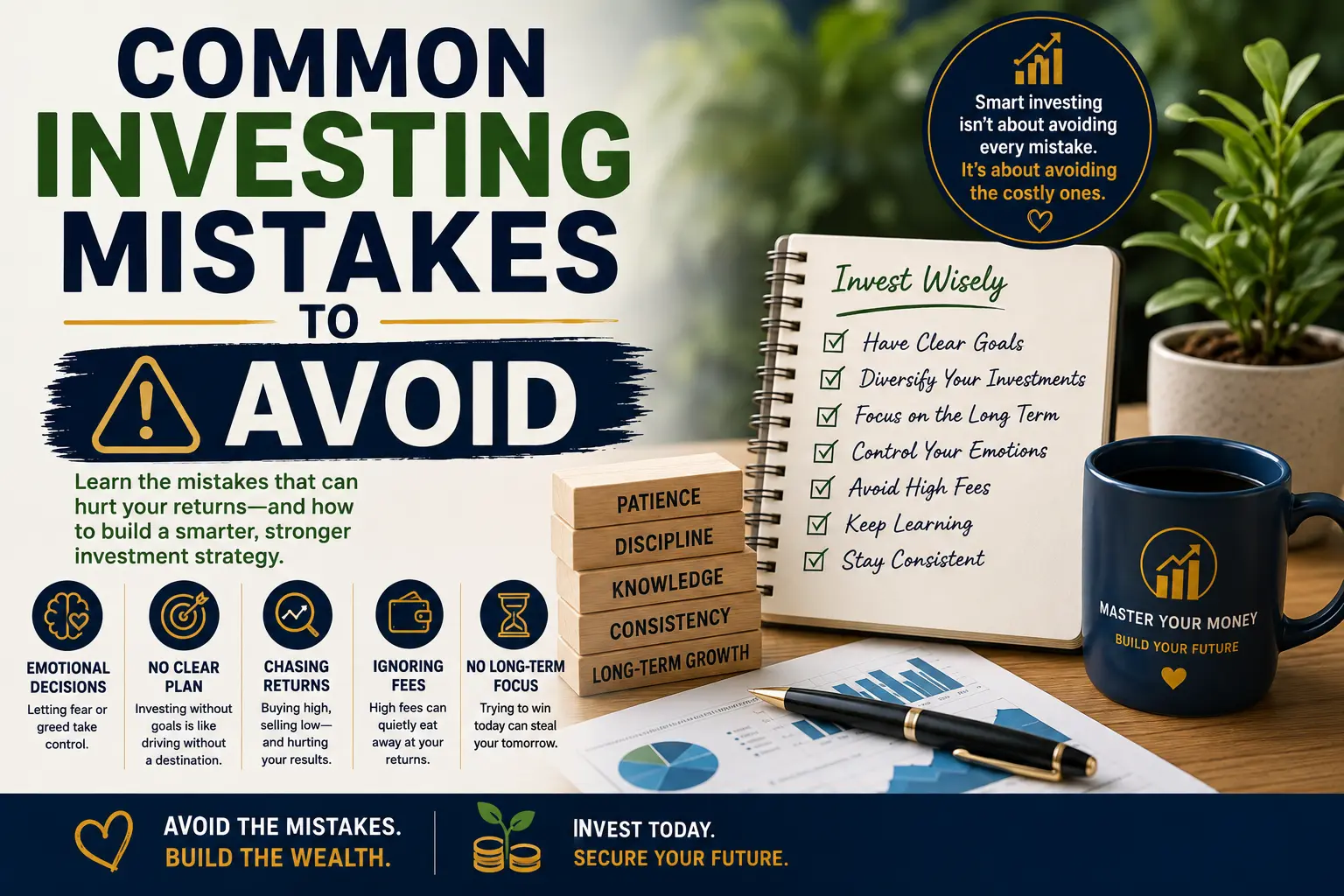
Why Investors Make Costly Mistakes
Investing is one of the most powerful ways to build wealth over the long term.
It has helped millions of people save for retirement, purchase homes, fund their children’s education, and work toward financial independence.
Yet despite its potential, many people hesitate to invest.
Some believe investing is too risky.
Others think they need thousands of dollars before they can begin.
Many simply worry about making an expensive mistake.
These concerns are understandable.
Unlike putting money into a savings account, investing involves uncertainty.
Markets rise and fall.
Individual investments can gain or lose value.
Financial headlines often focus on dramatic market swings that make investing seem unpredictable and intimidating.
The reality is that most successful investors aren’t successful because they avoid every mistake.
They’re successful because they learn to avoid the mistakes that matter most.
In fact, many investing mistakes have very little to do with choosing the “perfect” investment.
Instead, they involve human behavior.
People panic during market declines.
They chase investments after prices have already soared.
They invest without clear goals.
Or they allow emotions to drive financial decisions that should be based on long-term planning.
The encouraging news is that these mistakes can often be reduced through education, preparation, and discipline.
In this guide, you’ll learn:
- Why investors commonly make costly mistakes.
- The habits that can quietly reduce long-term investment returns.
- How emotions influence investing decisions.
- Practical strategies for becoming a more disciplined investor.
- How to create an investment plan that supports your financial goals.
The goal isn’t to eliminate every investment risk.
The goal is to make thoughtful decisions that improve your chances of long-term financial success.
💡 Action Moment: Build a Strong Financial Foundation Before You Invest
Before purchasing your first investment—or adding to an existing portfolio—it’s important to understand your overall financial picture.
Many people become excited about investing without first answering questions such as:
- How much money can I comfortably invest each month?
- Do I have an emergency fund?
- Am I carrying high-interest debt?
- What financial goals am I investing for?
- How long can I leave this money invested?
Without clear answers, investing decisions often become emotional rather than intentional.
That’s why 7 Days to Financial Clarity™ is an excellent place to begin.
The guide helps you organize:
- Monthly income.
- Understanding your cash flow helps determine how much you can realistically invest without affecting essential living expenses.
- Monthly expenses.
- Reviewing your spending helps identify money that may be available for long-term investing.
- Emergency savings.
- Having emergency savings may reduce the likelihood of needing to sell investments unexpectedly to cover unforeseen expenses.
- Outstanding debt.
- Reviewing high-interest debt helps you decide how investing fits within your overall financial priorities.
- Current investments.
- Understanding what you already own helps you make more informed future investment decisions.
Financial clarity doesn’t guarantee investment success.
However, it provides a stronger foundation for making thoughtful, long-term decisions.
Why Investing Feels So Intimidating
Many beginners assume experienced investors always know exactly what the market will do next.
In reality, no one can consistently predict short-term market movements with complete accuracy.
Professional investors, economists, and financial analysts often have different opinions about where markets are heading.
This uncertainty causes many beginners to believe they’re not knowledgeable enough to invest.
Ironically, waiting until you feel like an “expert” may delay years of potential investment growth.
Successful investing isn’t about predicting tomorrow’s market.
It’s about creating a disciplined plan and following it consistently over time.
Common Misconceptions About Investing
Misunderstanding how investing works often leads to poor decisions.
Let’s examine several common myths.
Myth: You Need a Lot of Money to Start Investing
Many people believe investing is only for wealthy individuals.
Years ago, that may have been more common.
Today, many brokerage firms allow investors to begin with relatively small amounts through features such as fractional shares or recurring investments.
The amount you start with is often less important than developing the habit of investing consistently over time.
Myth: Investing Is the Same as Gambling
This misconception discourages many potential investors.
While both investing and gambling involve uncertainty, they’re fundamentally different.
Investing typically involves purchasing ownership in businesses, lending money through bonds, or owning diversified funds with the expectation of long-term growth or income.
Gambling generally relies on games of chance with outcomes determined over a much shorter period.
Investing still carries risk, but thoughtful research, diversification, and patience distinguish it from speculation.
Myth: You Have to Watch the Market Every Day
Many new investors believe successful investing requires constant monitoring.
In reality, checking your portfolio every hour—or even every day—often increases stress without improving long-term results.
Long-term investors typically benefit more from reviewing their portfolios periodically rather than reacting to every market movement.
Myth: The Best Investors Never Lose Money
Even highly experienced investors experience periods when investments decline in value.
Temporary losses are a normal part of investing.
The difference is that disciplined investors generally avoid making emotional decisions during those periods.
Instead of expecting markets to rise continuously, they prepare for both good years and challenging ones.
Why Emotions Are an Investor’s Biggest Challenge
Many investing mistakes occur because emotions temporarily overpower logic.
Two emotions, in particular, influence investor behavior.
Fear
When markets fall sharply, fear can convince investors that selling immediately is the safest decision.
Unfortunately, selling during periods of decline may lock in losses that might otherwise recover over time.
Fear often encourages short-term thinking.
Successful investing usually requires maintaining a long-term perspective even during periods of uncertainty.
Greed
The opposite problem occurs when investments rise rapidly.
Seeing others earn impressive returns can create a fear of missing out (often called FOMO).
Some investors begin purchasing investments simply because everyone else appears to be making money.
By the time widespread excitement reaches its peak, prices may already reflect extremely optimistic expectations.
Making investment decisions based primarily on excitement instead of careful research can increase risk.
Even Experienced Investors Make Mistakes
It’s easy to believe that only beginners make investing errors.
The truth is that investing mistakes affect people at every experience level.
Experienced investors may:
- Become overconfident after several successful investments.
- Confidence is valuable, but assuming every future decision will be correct can lead to unnecessary risk.
- Ignore changing financial goals.
- Investment strategies should evolve as life circumstances change.
- Take excessive risks during strong markets.
- Extended periods of market growth can create a false sense of security.
- Hold losing investments simply because they don’t want to admit they made a mistake.
- Emotional attachment can interfere with objective decision-making.
The goal isn’t to become a perfect investor.
The goal is to remain a thoughtful, adaptable investor.
Build the Right Investing Mindset
Successful investing usually begins long before purchasing your first stock or mutual fund.
It begins with developing realistic expectations.
Healthy investing habits include understanding that:
- Markets naturally rise and fall over time.
- Short-term volatility is a normal characteristic of investing.
- Wealth is typically built gradually.
- Long-term consistency often matters more than short-term performance.
- No investment wins every year.
- Even diversified portfolios experience periods of decline.
- Patience is a valuable investing skill.
- Time allows compound growth more opportunity to work.
- Financial goals should guide investment decisions.
- Your investment strategy should reflect your objectives rather than current headlines.
Thinking this way makes it easier to remain disciplined when markets become unpredictable.
Investing Is a Marathon, Not a Sprint
One of the biggest misunderstandings about investing is believing that success comes from making a few spectacular decisions.
In reality, long-term wealth is more often built through:
- Investing consistently.
- Staying diversified.
- Managing risk thoughtfully.
- Avoiding emotional reactions.
- Remaining patient through changing market conditions.
These habits may seem simple.
Yet they are often much harder to practice than they are to understand.
The encouraging news is that each habit can be developed over time.
You don’t need to predict the future to become a successful investor.
You simply need a clear plan, realistic expectations, and the discipline to stay committed to your long-term goals.
You’re already investing time in improving your finances, and that’s something to be proud of. Before you continue, download our free 7 Days To Financial Clarity™ workbook and start putting these ideas into action.

Part 2: The Most Common Investing Mistakes
Every investor makes mistakes from time to time.
Even experienced professionals occasionally make decisions they later wish they had handled differently.
The difference is that successful investors learn from those mistakes instead of repeating them.
Fortunately, many of the most expensive investing mistakes are also the most preventable.
Understanding these common pitfalls can help you make more thoughtful decisions and stay focused on your long-term financial goals.
Mistake #1: Investing Without Clear Goals
One of the biggest mistakes beginners make is investing simply because they believe they “should.”
They hear that investing is important.
Friends talk about buying stocks.
News headlines celebrate record market highs.
Social media influencers showcase impressive investment gains.
So they invest without first asking an important question:
“What am I investing for?”
Without clear goals, it becomes much harder to choose appropriate investments or remain committed during periods of market volatility.
Your investment strategy should reflect your objectives.
For example, your goal might be:
- Saving for retirement.
- Retirement investing often involves a long time horizon, allowing more time to recover from short-term market fluctuations.
- Buying a home.
- If you plan to use the money within a few years, your investment choices may differ from someone investing for several decades.
- Funding a child’s education.
- Education savings often have specific timelines that influence investment decisions.
- Building long-term wealth.
- Some investors prioritize steadily increasing their net worth over many years.
When your goals are clearly defined, investment decisions become more purposeful and consistent.
Mistake #2: Trying to Time the Market
Many new investors believe they should wait until the “perfect” time to invest.
They hope to buy just before prices rise and sell just before prices fall.
While this sounds appealing, consistently predicting short-term market movements has proven extremely difficult—even for experienced professionals.
Markets respond to countless factors, including:
- Economic conditions.
- Interest rates.
- Corporate earnings.
- Global events.
- Investor sentiment.
These influences are constantly changing, making precise market timing challenging.
Instead of attempting to predict every market movement, many long-term investors focus on investing consistently over time.
This approach reduces the pressure of trying to guess what the market will do next.
Mistake #3: Chasing Hot Stocks and Popular Trends
It’s easy to become excited when a particular stock, industry, or investment is making headlines.
Stories of investors earning large profits in a short period can create the impression that everyone else is getting rich.
This often leads to Fear of Missing Out (FOMO).
People buy investments because:
- Everyone else seems to be buying them.
- Prices have recently increased.
- Social media predicts even larger gains.
- News coverage creates excitement.
The challenge is that investments receiving widespread attention have often already experienced substantial price increases.
Buying solely because something is popular isn’t the same as investing based on careful research and a long-term plan.
Before purchasing any investment, ask yourself:
- Do I understand what I’m buying?
- Does this investment fit my long-term goals?
- Am I making this decision based on research or excitement?
Thoughtful investing usually outperforms impulsive investing over the long run.
Mistake #4: Failing to Diversify
Imagine placing your entire life savings into a single company’s stock.
If that company performs exceptionally well, your investment could grow significantly.
But what happens if that business experiences serious financial problems?
Your entire portfolio could suffer.
Diversification is the practice of spreading investments across different assets rather than relying on a single investment.
Depending on your goals and risk tolerance, diversification may include exposure to:
- Different companies.
- Owning investments in multiple businesses reduces dependence on the success of one company.
- Different industries.
- Economic conditions affect industries differently, so spreading investments across sectors may help reduce concentration risk.
- Different asset classes.
- Some investors hold combinations of stocks, bonds, cash equivalents, or other investments depending on their objectives.
- Different geographic markets.
- Some portfolios include investments from multiple countries or regions.
Diversification doesn’t eliminate investment risk or guarantee profits.
However, it may reduce the impact of poor performance from any single investment.
Mistake #5: Ignoring Investment Fees
Investment returns often receive the most attention.
Fees receive much less.
However, even relatively small fees may reduce long-term investment growth over many years.
Common investment costs may include:
- Expense ratios for mutual funds or exchange-traded funds (ETFs).
- Advisory or management fees.
- Trading commissions, where applicable.
- Account maintenance fees.
A fee that appears insignificant in one year can become much more meaningful over decades because those dollars are no longer available to benefit from potential compound growth.
Before investing, review the fees associated with any investment or account so you understand how they may affect your long-term results.
Mistake #6: Investing Money You’ll Need Soon
Investing is generally most effective when your money has time to grow.
If you’ll need the money in the near future, market fluctuations could create challenges.
For example, imagine you’re planning to purchase a home next year.
If the market experiences a significant decline shortly before your planned purchase, your investment may temporarily be worth less than expected.
This is why many financial professionals suggest matching your investment choices to your time horizon.
Money needed for short-term goals may require a different approach than money being invested for retirement decades away.
Understanding when you’ll need your money is just as important as deciding where to invest it.
Mistake #7: Following Social Media Without Doing Your Own Research
Social media has made investing more accessible than ever.
Educational content can be incredibly helpful.
However, not every recommendation online is based on careful analysis or your personal financial situation.
Some creators may:
- Share opinions rather than research.
- Focus on sensational headlines to attract attention.
- Highlight successful investments while ignoring losses.
- Recommend investments that aren’t appropriate for every investor.
Before acting on investment ideas you encounter online, consider asking:
- Is this information supported by reliable sources?
- Does the recommendation fit my financial goals?
- Do I understand the investment being discussed?
- Have I reviewed information from multiple reputable sources?
Learning from others is valuable.
Blindly copying someone else’s investment decisions is much riskier.
Mistake #8: Letting Emotions Drive Buy and Sell Decisions
Perhaps the most common investing mistake is allowing emotions to dictate decisions.
Markets naturally rise and fall.
During strong markets, investors may become overly confident.
During market declines, fear may encourage people to sell investments simply to stop watching their account balances decrease.
Unfortunately, buying primarily during periods of excitement and selling primarily during periods of fear can make it difficult to achieve long-term investing goals.
A disciplined investment plan provides structure during both positive and negative market conditions.
When emotions increase, having a written strategy can help you focus on your long-term objectives instead of reacting to short-term events.
Mistake #9: Expecting Overnight Success
Many people begin investing after hearing stories of individuals who turned small amounts of money into substantial wealth.
While those stories receive a great deal of attention, they are not representative of most successful investing journeys.
Long-term wealth is more commonly built through:
- Consistent investing.
- Regular contributions can help build a portfolio steadily over time.
- Patience.
- Allowing investments time to grow is often an important part of long-term investing.
- Discipline.
- Continuing to follow your plan during changing market conditions may help reduce emotional decision-making.
- Realistic expectations.
- Markets experience both gains and losses, and returns are never guaranteed.
Successful investing is usually less about finding one extraordinary investment and more about making many good decisions consistently.
💡 Action Moment: Define Your Investment Goals Before You Invest
Avoiding investing mistakes becomes much easier when you know why you’re investing in the first place.
The LookingAtFinance Financial Goal Assessment can help you identify the financial goals that should guide your investment decisions.
As you complete the assessment, consider questions such as:
- Am I investing for retirement?
- A longer time horizon may allow you to take a different approach than someone investing for short-term goals.
- Do I want to buy a home?
- Knowing your timeline helps you determine how much investment risk may be appropriate.
- Am I building wealth for future generations?
- Long-term legacy planning often influences investment choices.
- Do I want passive income in the future?
- Some investors prioritize building portfolios designed to generate future income streams.
- How comfortable am I with market fluctuations?
- Understanding your own risk tolerance helps you choose investments that you can stick with during both good and challenging markets.
When your investments support clearly defined goals, it’s often easier to ignore market noise, avoid emotional decisions, and remain focused on long-term success.
Mistakes Are Opportunities to Learn
Every investor makes mistakes.
The important question isn’t whether you’ll make one.
It’s how you’ll respond when you do.
The most successful investors aren’t perfect.
They continue learning, adjust when necessary, and remain committed to their long-term financial plans.
Each mistake becomes an opportunity to gain experience, strengthen your decision-making, and become a more confident investor.
Successful investing isn’t about guessing—it’s about understanding long-term growth. Use our free Investment Growth Calculator to see how regular investing can build wealth over time.

Part 3: Building Better Investing Habits
Avoiding investing mistakes is only half the equation.
The other half is replacing those mistakes with habits that support long-term financial success.
Many people believe successful investors possess secret knowledge or extraordinary intelligence.
In reality, many experienced investors rely on simple principles practiced consistently over many years.
These habits may not seem exciting.
They rarely generate sensational headlines.
But over time, they can help investors remain disciplined through changing market conditions while working toward their financial goals.
Let’s explore some of the habits that can contribute to becoming a more confident long-term investor.
Invest Consistently
One of the most effective habits an investor can develop is consistency.
Rather than waiting until they have a large amount of money, many long-term investors contribute smaller amounts on a regular schedule.
For example, someone might choose to invest:
- Every paycheck.
- Automatic contributions help build investing into a regular financial routine.
- Every month.
- Monthly investing can make it easier to budget while steadily increasing investments over time.
- Every quarter.
- Some investors prefer making larger contributions less frequently, depending on their income pattern.
The exact schedule matters less than creating a habit you can maintain.
Consistency helps shift your focus away from trying to predict short-term market movements and toward steadily building wealth over time.
Understand Dollar-Cost Averaging
One strategy many investors use is called Dollar-Cost Averaging (DCA).
Dollar-cost averaging involves investing a fixed amount of money at regular intervals, regardless of whether the market is rising or falling.
For example:
Instead of waiting to determine whether today is the “perfect” time to invest, someone might invest $300 every month.
When prices are higher, that fixed amount generally purchases fewer shares.
When prices are lower, it generally purchases more shares.
Over time, this approach averages the purchase price across different market conditions.
Dollar-cost averaging doesn’t eliminate investment risk or guarantee profits.
However, many investors appreciate that it reduces the pressure of trying to predict short-term market movements.
It also encourages consistency, which is often one of the most valuable investing habits.
Stay Diversified
Earlier in this guide, we discussed the importance of diversification.
Successful investors don’t simply diversify once and forget about it.
They continue reviewing whether their investments remain appropriately diversified as their portfolios grow.
Diversification may involve spreading investments across:
- Different companies.
- Reducing reliance on the success of a single business may help lower concentration risk.
- Multiple industries.
- Different sectors of the economy often perform differently over time.
- Various asset classes.
- Depending on their goals and risk tolerance, investors may hold combinations of stocks, bonds, cash equivalents, or other investments.
- International markets.
- Some investors include investments from multiple countries to broaden their exposure.
Diversification cannot prevent market losses.
However, it may reduce the impact of poor performance in one particular investment or sector.
Review Your Portfolio—Don’t Obsess Over It
Technology has made it possible to check investment balances almost instantly.
While this convenience can be helpful, constantly monitoring your portfolio may encourage emotional decision-making.
Daily market movements are normal.
Checking your investments every hour rarely improves long-term results.
Instead, many long-term investors establish a regular review schedule.
Examples include:
- Quarterly reviews.
- Reviewing every few months allows you to monitor progress without reacting to everyday market fluctuations.
- Semiannual reviews.
- This approach balances staying informed with maintaining a long-term perspective.
- Annual reviews.
- Some investors prefer evaluating their portfolio once a year while making adjustments only when necessary.
During these reviews, you might ask:
- Does my portfolio still reflect my goals?
- Has my risk tolerance changed?
- Should I rebalance my investments?
- Have my financial priorities changed?
These thoughtful reviews are often more productive than reacting to daily market headlines.
Manage Risk According to Your Situation
Every investment carries some level of risk.
However, the amount of risk that’s appropriate varies from person to person.
Your investment decisions should reflect factors such as:
Your Time Horizon
Someone investing for retirement in 30 years may approach risk differently than someone planning to use their investment funds to purchase a home within the next two years.
Longer time horizons often provide more opportunity to recover from temporary market declines, although future performance is never guaranteed.
Your Financial Goals
Different goals may require different investment approaches.
For example:
- Retirement.
- Long-term investors often prioritize sustained growth over many years.
- College savings.
- Investment decisions may gradually become more conservative as tuition payment dates approach.
- Financial independence.
- Some investors focus on creating diversified portfolios capable of supporting future income needs.
Understanding your objectives helps ensure your investment strategy supports your broader financial plan.
Your Comfort With Market Volatility
Some investors remain calm during significant market swings.
Others experience considerable stress when account values decline.
Neither response is right or wrong.
The important point is choosing an investment strategy that you can realistically maintain during both positive and negative market conditions.
If your investments cause constant anxiety, your portfolio may not align with your personal comfort level or financial circumstances.
Continue Learning Throughout Your Investing Journey
Financial markets evolve.
New investment products emerge.
Economic conditions change.
Successful investors recognize that learning never truly ends.
You don’t need to become a professional financial analyst.
However, regularly improving your financial knowledge can help you make more informed decisions.
Ways to continue learning include:
- Reading educational books.
- Many timeless investing principles remain relevant regardless of current market conditions.
- Following reputable financial publications.
- Reliable sources often provide balanced perspectives on economic and market developments.
- Exploring educational resources.
- Beginner-friendly guides can strengthen your understanding of investing concepts.
- Asking qualified professionals.
- When appropriate, licensed financial professionals can help explain complex topics and discuss strategies relevant to your circumstances.
The more you understand investing, the easier it becomes to distinguish long-term principles from short-term market noise.
Be Patient With Compound Growth
One of the greatest advantages long-term investors have is time.
Compound growth occurs when investment earnings begin generating additional earnings over time.
During the early years, progress may appear slow.
Your account balance might increase only modestly.
However, as time passes, compound growth has the potential to accelerate because future growth is occurring on a larger balance.
This is why patience is such an important investing habit.
Many people underestimate how meaningful steady investing can become over decades.
While markets fluctuate and returns are never guaranteed, time has historically been one of the most valuable resources available to long-term investors.
Don’t Compare Your Portfolio to Everyone Else’s
It’s natural to wonder how your investments compare with someone else’s.
Social media, financial news, and conversations with friends can make it seem as though everyone else is achieving extraordinary returns.
Remember that you rarely see the complete picture.
People often share successful investments while saying very little about losses, unsuccessful decisions, or the risks they took to achieve those gains.
Your investment strategy should be based on your own:
- Financial goals.
- Your objectives determine what success looks like for you.
- Time horizon.
- Someone investing for retirement has different priorities than someone saving for a short-term purchase.
- Risk tolerance.
- Comfort with volatility varies from person to person.
- Financial responsibilities.
- Income, debt, and family obligations influence investment decisions.
Comparing yourself to others can distract you from building a plan that fits your own life.
Rebalance When Appropriate
As markets change, the mix of investments in your portfolio may gradually shift.
For example, if one type of investment grows much faster than others, it could become a larger percentage of your portfolio than you originally intended.
Rebalancing involves reviewing your portfolio and, when appropriate, adjusting your holdings to better align with your desired asset allocation.
Some investors rebalance:
- On a regular schedule.
- Reviewing once or twice a year can help maintain consistency.
- After significant market movements.
- Large changes in portfolio allocations may prompt a review.
- When financial goals change.
- Major life events may justify adjusting your investment strategy.
Rebalancing doesn’t guarantee improved returns.
Its purpose is to help maintain an investment mix that continues supporting your long-term objectives.
💡 Action Moment: See How Consistency Can Shape Long-Term Growth
Successful investing isn’t usually built through one extraordinary investment.
More often, it’s the result of making consistent contributions over many years.
The LookingAtFinance Investment Growth Calculator allows you to explore how different investing habits might influence long-term results.
You can experiment with scenarios such as:
- Monthly contribution amounts.
- See how increasing or decreasing your regular investments may affect long-term portfolio growth.
- Initial investment amount.
- Explore how starting with different balances changes future projections.
- Investment time horizon.
- Compare the potential impact of investing for 10, 20, or 30 years.
- Estimated annual rate of return.
- Examine how different hypothetical growth assumptions influence projected outcomes.
The calculator is designed for educational purposes and illustrates hypothetical scenarios—not guaranteed results.
Its greatest lesson is often one of patience: even modest, consistent contributions may grow substantially over long periods because of the combined effects of regular investing and compound growth.
Better Habits Create Better Long-Term Decisions
No investor makes perfect decisions every time.
Markets will continue to rise and fall.
Economic conditions will change.
Unexpected events will occur.
The investors who often remain successful over the long term aren’t necessarily those who predict the future most accurately.
They’re the ones who continue practicing sound investing habits regardless of changing market conditions.
By investing consistently, maintaining diversification, reviewing your portfolio thoughtfully, continuing to learn, managing risk appropriately, and giving compound growth time to work, you create a stronger foundation for pursuing your long-term financial goals.
Every financial journey is different. Take our free
Financial Goal Assessment to discover which area deserves your attention first
and receive a clear direction for your next financial milestone.

A Real-Life Example: Two Investors, Two Very Different Outcomes
Investing success rarely comes from luck alone.
More often, it’s the result of consistent decisions repeated over many years.
To illustrate this, let’s compare two fictional investors.
Both begin investing at age 30.
Both earn similar incomes.
Both contribute approximately the same amount of money each year.
Yet their investing experiences turn out very differently.
Jason’s Story
Jason becomes interested in investing after seeing headlines about rapidly rising technology stocks.
He opens a brokerage account and immediately starts buying companies that are popular on social media.
Whenever a stock receives significant attention online, Jason buys it.
If prices begin falling, he quickly sells because he fears losing even more money.
When markets recover, he often waits too long before investing again because he’s worried another decline is coming.
Over the years, Jason repeatedly:
- Buys after prices have already risen significantly.
- Excitement often influences his decisions more than careful research.
- Sells during market declines.
- Fear causes him to lock in temporary losses.
- Frequently changes his strategy.
- Constant adjustments prevent him from following a consistent long-term plan.
- Checks his portfolio several times every day.
- Daily market fluctuations create unnecessary stress and emotional decision-making.
Jason spends a great deal of time thinking about investing.
Unfortunately, much of his energy goes toward reacting to short-term market movements instead of building long-term wealth.
Olivia’s Story
Olivia approaches investing differently.
Before making her first investment, she completes 7 Days to Financial Clarity™ to organize her finances.
She reviews:
- Her monthly income.
- Living expenses.
- Emergency savings.
- Outstanding debt.
- Long-term financial priorities.
Next, she completes the Financial Goal Assessment.
Rather than investing simply because others are doing it, she identifies several clear objectives:
- Saving for retirement.
- Building long-term financial independence.
- Purchasing a future home.
- Creating financial flexibility later in life.
She develops a simple investment strategy that reflects those goals.
Instead of chasing market trends, Olivia:
- Invests consistently every month.
- Automatic contributions help remove emotion from her investing decisions.
- Maintains a diversified portfolio.
- Her investments are spread across different companies, sectors, and asset classes in a way that reflects her goals and risk tolerance.
- Reviews her portfolio periodically.
- She checks her progress several times a year instead of reacting to every market movement.
- Continues learning.
- She regularly reads educational resources and improves her understanding of investing.
When markets decline, Olivia doesn’t panic.
She reminds herself that temporary volatility is a normal part of long-term investing.
Instead of abandoning her plan, she continues investing according to her strategy.
Years later, Olivia’s portfolio has experienced both strong years and difficult ones.
More importantly, she has remained disciplined.
Her success didn’t come from predicting the market.
It came from consistently following a thoughtful plan.
The Difference Wasn’t Intelligence
Jason wasn’t unintelligent.
Olivia wasn’t unusually gifted.
Neither could predict the future.
The biggest difference between them wasn’t investment knowledge.
It was behavior.
Jason reacted to the market.
Olivia responded to a plan.
Jason focused on today’s headlines.
Olivia focused on tomorrow’s goals.
Jason searched for quick wins.
Olivia allowed time and consistency to work in her favor.
This illustrates one of the most valuable lessons in investing:
Your long-term success often depends less on finding extraordinary investments and more on avoiding costly behavioral mistakes.
Smart Investing Checklist
Use this checklist as a guide to help build healthy investing habits.
Build a Strong Foundation
☐ I understand my monthly budget.
☐ I have reviewed my emergency savings.
☐ I understand how investing fits into my overall financial plan.
☐ I know my long-term financial goals.
☐ I invest only money that aligns with my intended time horizon and financial needs.
Make Thoughtful Investment Decisions
☐ I understand the investments I own.
☐ I avoid chasing popular trends without research.
☐ I maintain a diversified portfolio.
☐ I understand the fees associated with my investments.
☐ I review my portfolio periodically rather than constantly.
Stay Focused on Long-Term Success
☐ I invest consistently.
☐ I avoid emotional buying and selling.
☐ I continue improving my financial knowledge.
☐ I review my investment strategy after major life changes.
☐ I remain focused on my long-term goals.
Frequently Asked Questions
What is the biggest investing mistake beginners make?
One of the most common mistakes is investing without a clear plan.
When investors don’t know what they’re trying to achieve, they’re often more likely to make emotional decisions during periods of market volatility.
Defining your financial goals before investing provides a stronger foundation for making consistent long-term decisions.
Should I stop investing when the market falls?
Market declines are a normal part of investing.
Whether you should change your investment strategy depends on your personal circumstances, financial goals, and time horizon.
Many long-term investors avoid making decisions based solely on short-term market movements, but every situation is different.
If you’re uncertain, consider speaking with a qualified financial professional.
Is it possible to lose money by investing?
Yes.
The value of investments can rise or fall, and there is always a risk of loss.
The level of risk depends on factors such as the types of investments you own, market conditions, and how long you remain invested.
Understanding risk before investing is an important part of making informed financial decisions.
How often should I check my investments?
There isn’t a single schedule that’s appropriate for everyone.
Many long-term investors review their portfolios quarterly, semiannually, or annually rather than monitoring them every day.
The key is staying informed without allowing short-term market movements to drive emotional decisions.
Why is diversification important?
Diversification spreads investments across different companies, industries, and asset classes.
Although diversification cannot eliminate investment risk or guarantee positive returns, it may reduce the impact of poor performance from a single investment or sector.
Can I start investing with a small amount of money?
Many investment platforms now allow people to begin investing with relatively modest amounts through features such as recurring contributions or fractional shares.
The most important habit is often consistency rather than the size of your initial investment.
Should I follow investment advice on social media?
Social media can be a useful source of financial education, but investment decisions should not be based solely on online recommendations.
Before acting on any suggestion, take time to understand the investment, verify information using reliable sources, and consider whether it aligns with your own financial goals and risk tolerance.
Final Thoughts
Investing doesn’t require perfect timing, extraordinary intelligence, or constant attention.
What it does require is patience, discipline, and a willingness to keep learning.
Every investor makes mistakes.
The goal isn’t to avoid every setback—it’s to avoid the habits that can have the greatest long-term impact on your financial future.
By developing a clear plan, investing consistently, maintaining diversification, managing risk thoughtfully, and staying focused on long-term goals, you place yourself in a stronger position to navigate changing market conditions with confidence.
Remember that investing is only one part of your overall financial picture.
Healthy budgeting, emergency savings, responsible debt management, and ongoing financial education all contribute to long-term financial success.
When these pieces work together, they create a stronger foundation for building wealth over time.
Your Next Steps
If you’re ready to become a more confident investor, follow these practical steps.
Step 1: Gain Complete Financial Clarity
Before making new investment decisions, complete 7 Days to Financial Clarity™.
Organizing your finances helps you understand how investing fits into your overall financial plan.
Review:
- Your income.
- Understanding your cash flow helps determine how much you can comfortably invest on a regular basis.
- Monthly expenses.
- Identifying essential and discretionary spending helps you create room for consistent investing.
- Emergency savings.
- A financial safety net may reduce the likelihood of needing to sell investments unexpectedly.
- Outstanding debt.
- Reviewing high-interest debt helps you balance debt repayment with investing priorities.
- Existing investments.
- Knowing what you already own supports more informed investment decisions.
Financial clarity helps you invest with intention rather than emotion.
Step 2: Complete the Financial Goal Assessment
Use the LookingAtFinance Financial Goal Assessment to define the purpose behind your investment strategy.
Your goals may include:
- Saving for retirement.
- Buying your first home.
- Funding a child’s education.
- Building long-term financial independence.
- Creating future passive income.
- Leaving a financial legacy.
Clear goals make it easier to choose investments that support your future rather than reacting to short-term market trends.
Step 3: Explore Your Long-Term Growth Potential
Use the LookingAtFinance Investment Growth Calculator to model different investing scenarios.
You can compare hypothetical outcomes by adjusting:
- Monthly contributions.
- See how increasing or decreasing regular investments may influence long-term portfolio growth.
- Initial investment amount.
- Explore how starting balances affect future projections.
- Investment timeline.
- Compare the potential impact of investing over different time horizons.
- Estimated annual rate of return.
- Examine how various hypothetical assumptions influence projected growth.
The calculator is intended for educational purposes and illustrates possible scenarios—not guaranteed investment results.
It reinforces one of the most important investing lessons:
Consistent investing combined with time may have a greater impact than trying to predict short-term market movements.
Key Takeaway
The most successful investors aren’t usually those who avoid every market decline or discover every winning investment. They’re the ones who build clear financial goals, invest consistently, stay diversified, continue learning, and avoid emotional decisions. By focusing on disciplined habits instead of short-term market predictions, you give yourself a stronger opportunity to build long-term wealth with confidence.
🚀 Ready To Keep Going?
You have invested time learning today. Now take the next step by downloading our free 7 Days To Financial Clarity™ workbook and begin building a stronger financial future.
