
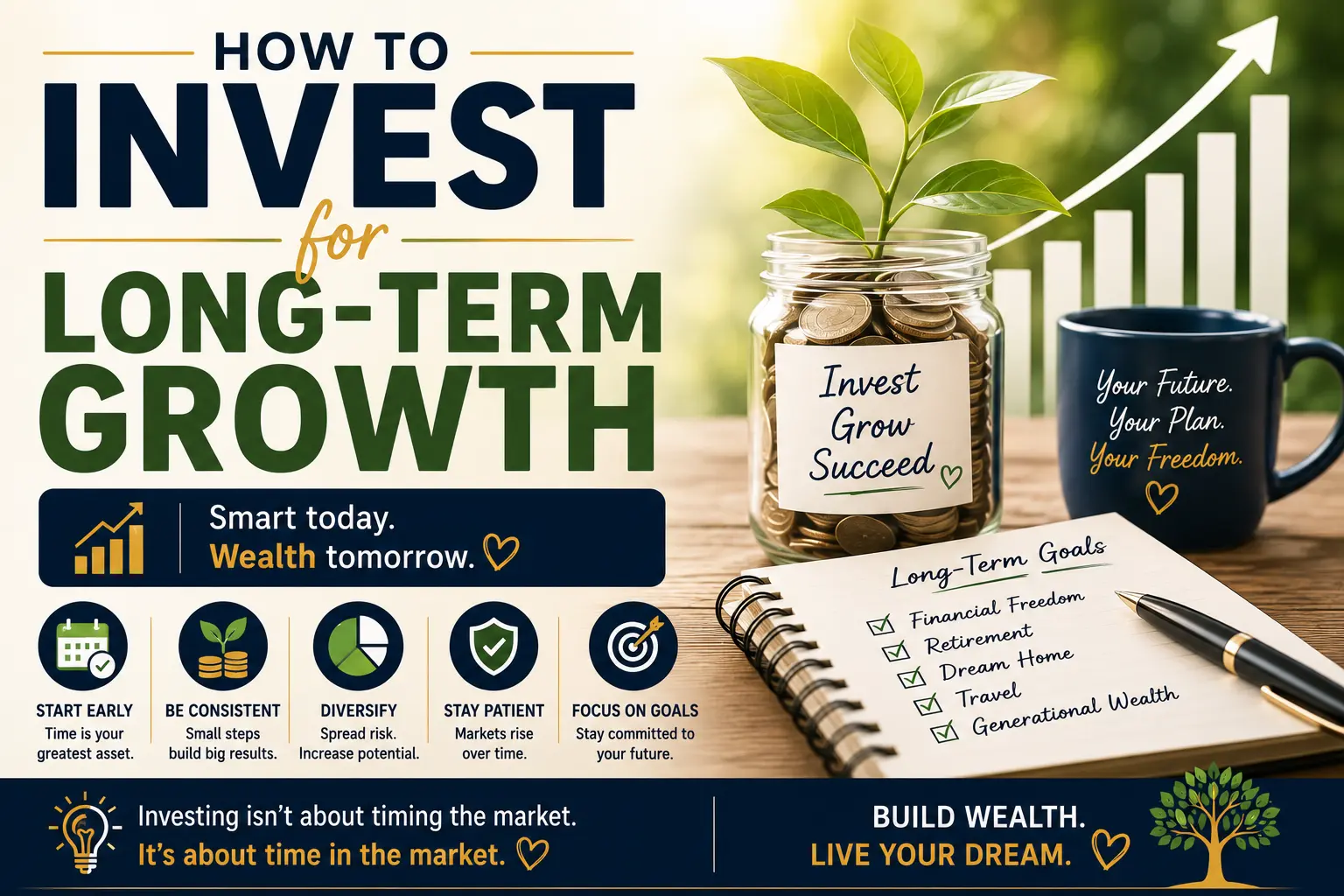
When many people hear the word investing, they immediately think about stock market headlines.
One day the market is climbing.
The next day it’s falling.
Television commentators discuss economic uncertainty, company earnings, interest rates, and market predictions, often making investing seem complicated or even intimidating.
Because of this, many beginners assume that successful investing requires perfect timing, advanced financial knowledge, or the ability to predict what the market will do next.
In reality, long-term investing is much simpler than many people believe.
The goal isn’t to guess which stock will double next month or to react to every headline that appears in the news.
Instead, successful long-term investors focus on steadily growing their wealth over many years by making consistent, informed decisions and allowing time to work in their favor.
Time is one of the most powerful advantages an investor can have.
Money invested today has the opportunity to grow not only through investment returns but also because those returns can generate additional returns over time. This process, often referred to as compound growth, is one of the primary reasons long-term investing has helped countless people build wealth.
Whether your dream is retiring comfortably, purchasing a home, helping your children pay for college, or achieving greater financial independence, investing can play an important role in reaching those goals.
The key is understanding that investing is not about becoming rich overnight.
It’s about creating opportunities for your money to grow steadily while remaining focused on your long-term objectives.
In this guide, you’ll learn how long-term investing works, why patience often produces better results than chasing short-term market movements, common investing mistakes to avoid, and practical strategies that can help you build wealth with confidence over time.
Whether you’re preparing to invest your first $100 or expanding an existing portfolio, understanding these principles can help you make decisions that support your financial future.
💡 Action Moment: Build Financial Clarity Before You Invest
Before opening an investment account or choosing where to invest your money, it’s important to understand your overall financial picture.
Ask yourself:
- Do I have a realistic monthly budget?
- Have I built an emergency fund?
- Am I carrying high-interest debt?
- How much money can I comfortably invest each month?
- What financial goals am I investing for?
These questions help determine whether you’re financially prepared to begin investing consistently.
That’s exactly why 7 Days to Financial Clarity™ is such a valuable first step.
This free guide helps you organize your income, expenses, debts, savings, and financial priorities so you understand how investing fits into your complete financial plan.
Investing becomes much easier when you know exactly where your money is going and how much you can confidently invest without creating financial stress elsewhere.
Financial clarity creates investment confidence.
Why Long-Term Investing Matters
Many people mistakenly believe that investing is only for wealthy individuals.
The truth is that long-term investing is often more about consistency than income.
Someone who invests modest amounts every month over many years may accumulate significant wealth simply by remaining disciplined and allowing their investments time to grow.
By comparison, someone who constantly waits for the “perfect” time to invest may spend years sitting on the sidelines while missing valuable opportunities for growth.
Long-term investing also reduces the pressure to react to every market movement.
Financial markets naturally experience periods of growth and decline.
These fluctuations are normal.
Historically, markets have experienced downturns, recoveries, and long periods of growth.
Investors who maintain a long-term perspective are generally better positioned to benefit from those recoveries than investors who panic during periods of uncertainty.
Rather than focusing on what the market may do tomorrow, successful long-term investors ask a different question:
“Where do I want my finances to be ten, twenty, or thirty years from now?”
That shift in perspective often leads to better financial decisions.
Investing Is Different From Saving
Saving and investing are both important parts of a healthy financial plan, but they serve different purposes.
Savings provide stability.
Investments provide growth.
Money kept in a savings account is generally intended for short-term needs, emergencies, or upcoming expenses.
Because safety and accessibility are priorities, savings accounts typically generate modest returns.
Investments, on the other hand, are designed for goals that are many years into the future.
While investments can fluctuate in value over shorter periods, they also have greater potential to grow over the long term.
Imagine you’re planning a vacation next year.
Keeping that money in a savings account makes sense because you’ll need it soon.
Now imagine you’re saving for retirement thirty years from today.
Allowing that money to remain invested over several decades provides much greater opportunity for long-term growth.
Understanding the difference between saving and investing helps you choose the right strategy for each financial goal.
Start With Clear Financial Goals
One of the biggest mistakes beginners make is investing without knowing exactly why they’re investing.
Having a specific goal helps guide many future decisions.
Your investment strategy may look very different depending on whether you’re investing to:
- Retire comfortably.
- Long investment timelines often allow for greater exposure to long-term growth opportunities.
- Purchase a home.
- Your investment timeline may influence how much investment risk is appropriate.
- Build financial independence.
- Consistent investing combined with disciplined saving can gradually create multiple income-producing assets.
- Support your children’s education.
- Clearly defined education goals make it easier to estimate future funding needs.
When your investments have a purpose, it becomes easier to remain disciplined during periods of market uncertainty.
Goals provide perspective.
Perspective supports patience.
The Earlier You Begin, the More Time Works for You
Many people delay investing because they believe they don’t have enough money.
Others assume they’ve already missed their opportunity because they didn’t begin investing in their twenties.
Fortunately, successful investing isn’t reserved for people who start at a specific age.
What matters most is beginning as soon as your financial situation reasonably allows.
Every year your investments remain invested provides additional opportunities for long-term growth.
Waiting several years may not seem significant today.
However, over decades, that lost time can reduce the amount your investments have the opportunity to earn and compound.
The perfect time to begin investing rarely arrives.
Most successful investors simply begin with what they can afford and increase their contributions as their financial situation improves.
Consistency Often Matters More Than Perfection
Many new investors spend months researching investments because they’re afraid of making the wrong decision.
While learning is valuable, waiting indefinitely can become its own costly mistake.
Long-term investing isn’t about making one perfect investment.
It’s about developing consistent habits.
Regular investing.
Diversification.
Patience.
Periodic reviews.
Continuing to learn.
These habits, repeated over many years, often have a greater impact than trying to predict which investment will perform best next month.
Building wealth is usually the result of many good financial decisions made consistently—not one extraordinary decision made once.
You’re already investing time in improving your finances, and that’s something to be proud of. Before you continue, download our free 7 Days To Financial Clarity™ workbook and start putting these ideas into action.

Part 2: Building a Strong Foundation for Long-Term Investing
Many people assume successful investing is about finding the “perfect” investment.
In reality, long-term success is usually built on something much less exciting—but far more effective.
It’s built on a solid investment strategy.
Rather than chasing the latest market trend or trying to predict which company will grow the fastest next year, successful investors focus on creating a diversified portfolio that can continue growing through different economic conditions.
No one can accurately predict what financial markets will do tomorrow.
However, you can control how you prepare for the future.
That preparation begins with understanding several key investing principles.
Understand Your Risk Tolerance
Every investment carries some level of risk.
The important question isn’t whether risk exists.
It’s how much risk is appropriate for your personal financial situation.
Some investments experience larger price swings but have historically offered greater long-term growth potential.
Others fluctuate much less but may produce slower growth over time.
Neither approach is automatically better.
The right balance depends on several personal factors.
For example, consider:
- Your investment timeline.
- Someone investing for retirement thirty years from now may be able to tolerate more short-term market fluctuations than someone planning to use the money within the next three years.
- Your financial responsibilities.
- Your income stability, emergency savings, debt obligations, and family commitments all influence how much investment risk feels appropriate.
- Your comfort level.
- If market declines cause significant anxiety and lead you to sell investments prematurely, a more conservative approach may help you remain invested over the long term.
Understanding your own risk tolerance helps you build a portfolio you can confidently maintain through both good and challenging market conditions.
Diversification Helps Reduce Risk
One of the oldest principles in investing remains one of the most effective.
Don’t rely on a single investment.
Imagine investing your entire savings into one company.
If that business performs exceptionally well, you may benefit significantly.
But if the company struggles financially, your portfolio could suffer substantial losses.
Diversification helps reduce that risk by spreading your investments across different assets.
Instead of depending on one investment to succeed, you’re allowing multiple investments to work together.
A diversified portfolio may include:
- Stocks.
- Companies that offer long-term growth potential but can experience greater short-term price fluctuations.
- Bonds.
- Investments that generally provide more stability and income, although they typically grow more slowly than stocks over long periods.
- Exchange-Traded Funds (ETFs).
- Investment funds that allow you to purchase many securities through a single investment.
- Mutual Funds.
- Professionally managed funds that pool money from many investors to purchase diversified portfolios.
Diversification doesn’t eliminate investment risk.
However, it helps reduce the impact that poor performance from one investment may have on your overall portfolio.
Why Many Beginners Choose Index Funds
When people first begin investing, they often wonder whether they should try to select individual stocks.
While some experienced investors enjoy researching companies, many beginners prefer a simpler approach.
That’s one reason index funds have become increasingly popular.
Rather than attempting to identify tomorrow’s winning company, index funds seek to track the performance of a broader market index.
Instead of depending on the success of one business, you’re investing in many companies at the same time.
This approach offers several potential advantages.
Index funds are often appreciated because they:
- Provide instant diversification.
- A single investment can represent dozens or even hundreds of companies.
- Require less day-to-day management.
- Investors don’t need to constantly monitor individual businesses.
- Encourage long-term thinking.
- Broad market investing naturally shifts attention away from short-term market movements.
For many beginners, simplicity encourages consistency.
And consistency is often one of the greatest contributors to long-term investment success.
Don’t Let Market Headlines Control Your Decisions
Financial news is designed to capture attention.
Every day you’ll hear predictions about recessions, market rallies, inflation, elections, interest rates, and global events.
Some headlines sound incredibly optimistic.
Others sound alarming.
If you react emotionally to every headline, investing can quickly become exhausting.
Successful long-term investors recognize that market fluctuations are normal.
History has shown that markets have experienced periods of uncertainty many times before.
Economic downturns.
Financial crises.
Political changes.
Global events.
Despite these challenges, long-term investors who remained disciplined have often benefited from the eventual recovery.
This doesn’t mean markets always move upward in the short term.
It means patience has historically been one of the most valuable investing skills.
Invest Consistently Instead of Waiting for the Perfect Time
Many people delay investing because they’re waiting for the “right” moment.
They hope the market will fall before they begin.
Unfortunately, no one consistently knows when that perfect moment will arrive.
Some investors spend years waiting while the market continues moving forward.
Instead of trying to predict short-term movements, many long-term investors focus on investing consistently.
For example, contributing a fixed amount each month helps remove emotion from the process.
During months when prices are higher, your investment purchases fewer shares.
During market declines, the same contribution purchases more shares.
Over time, this disciplined approach helps many investors remain focused on their long-term objectives rather than short-term uncertainty.
Consistency often proves more valuable than perfect timing.
Avoid Letting Emotions Drive Investment Decisions
One of the greatest challenges investors face isn’t understanding financial markets.
It’s managing their own emotions.
When investments increase in value, excitement may encourage people to take unnecessary risks.
When markets decline, fear may tempt them to sell investments at exactly the wrong time.
Neither emotion supports long-term investing.
Instead, successful investors develop habits that help them remain disciplined.
They understand that temporary market declines don’t necessarily represent permanent losses unless investments are sold.
Rather than making decisions based on headlines or emotions, they return to their long-term plan.
That plan becomes an anchor during uncertain times.
💡 Action Moment: Align Your Investments With Your Financial Goals
Before choosing specific investments, take time to define exactly what you’re trying to accomplish.
Your investment strategy should support your goals—not someone else’s.
The LookingAtFinance Financial Goal Assessment helps you identify which financial objective deserves your greatest attention.
For example:
- If your goal is retirement, your investment timeline may allow for a stronger focus on long-term growth.
- If you’re saving for a home, your strategy may balance growth with preserving money you’ll need sooner.
- If your objective is financial independence, building a diversified portfolio and investing consistently may become central parts of your long-term plan.
- If you’re focused on creating generational wealth, your investment decisions may emphasize patience, disciplined contributions, and long-term ownership.
When you understand why you’re investing, temporary market fluctuations become much easier to put into perspective.
Goals create direction.
Direction encourages discipline.
Long-Term Investors Focus on Progress, Not Perfection
Some months you’ll be able to invest more.
Other months unexpected expenses may require reducing your contributions temporarily.
That’s completely normal.
Long-term investing isn’t about making perfect decisions every single month.
It’s about continuing to move forward whenever possible.
Even relatively small, consistent investments can become meaningful over many years.
The habit of investing regularly often matters more than trying to contribute large amounts only occasionally.
Successful investing is rarely built through one extraordinary decision.
It’s usually built through hundreds of ordinary decisions made consistently over time.
📈 Watch Your Money Grow
Successful investing isn’t about guessing—it’s about understanding long-term growth. Use our free Investment Growth Calculator to see how regular investing can build wealth over time.

Part 3: Staying Invested for Long-Term Success
Starting your investment journey is an important milestone.
Remaining committed to that journey is often the greater challenge.
Many people begin investing with enthusiasm.
They open an account, make their first investment, and imagine the wealth they’ll build over the coming years.
Then something happens.
The market declines.
Economic uncertainty dominates the headlines.
Their investment balance drops below what they originally contributed.
Doubt begins to replace confidence.
Some investors panic and sell everything, believing they’re protecting themselves from further losses.
Ironically, that decision often locks in temporary losses and prevents them from participating when markets eventually recover.
One of the most valuable lessons successful investors learn is that temporary declines are a normal part of long-term investing.
The goal isn’t to avoid every market downturn.
The goal is to build a strategy you can confidently maintain through both good times and difficult ones.
Don’t Confuse Short-Term Volatility With Long-Term Failure
Watching your investment balance fluctuate can be uncomfortable, especially if you’re new to investing.
However, it’s important to understand that market volatility and long-term investment success are not the same thing.
Markets naturally rise and fall.
Individual companies experience good years and difficult years.
Entire industries sometimes struggle before recovering.
These movements are a normal part of investing.
Long-term investors recognize that a temporary decline doesn’t necessarily mean their investment strategy has failed.
Instead of reacting emotionally, they ask questions such as:
- Has my long-term goal changed?
- If your objective remains the same, your investment strategy may not need significant adjustments.
- Has my financial situation changed?
- Major life events may justify reviewing your investment plan.
- Am I making decisions based on facts or emotions?
- Emotional reactions often produce costly investing mistakes.
Separating temporary market movements from long-term financial goals helps investors remain focused during uncertain periods.
Review Your Investments Without Obsessing Over Them
Technology has made it incredibly easy to check investment balances.
With a smartphone, you can monitor your portfolio several times each day.
While this convenience has benefits, it can also encourage unnecessary worry.
Imagine planting a tree.
You wouldn’t expect it to grow noticeably every day.
Checking it every few hours wouldn’t make it grow faster.
Investments often work in a similar way.
Long-term wealth develops gradually.
Constantly monitoring daily market movements may increase stress without improving investment results.
Instead, many investors establish a regular review schedule.
For example, they may review their investments:
- Every three months.
- This provides enough time to observe meaningful changes without becoming distracted by daily market noise.
- Twice each year.
- Periodic reviews allow investors to confirm they’re still progressing toward their long-term objectives.
- Annually.
- A yearly review is an excellent opportunity to evaluate contributions, rebalance investments if necessary, and adjust financial goals.
Review your investments with purpose—not out of fear.
Continue Investing During Market Downturns
When markets decline, many people feel tempted to stop investing.
That reaction is understandable.
After all, seeing investment values fall can feel discouraging.
However, market downturns have historically presented opportunities for disciplined long-term investors.
If you’re investing consistently, lower market prices may allow you to purchase more shares with the same monthly contribution.
As markets recover over time, those additional investments may benefit from future growth.
This doesn’t mean market declines are enjoyable.
It means they are a normal part of long-term investing.
Remaining consistent during challenging periods often requires discipline, but discipline is one of the characteristics that separates long-term investors from short-term speculators.
Rebalance Your Portfolio Periodically
As different investments grow at different rates, your portfolio may gradually drift away from the balance you originally intended.
For example, imagine you initially decided to invest:
- 70% in stocks.
- 30% in bonds.
After several years of strong stock market growth, your portfolio might become:
- 82% stocks.
- 18% bonds.
While this increase reflects successful growth, it may also expose you to more investment risk than you originally intended.
Rebalancing simply means adjusting your portfolio so it once again reflects your desired allocation.
This doesn’t necessarily need to happen frequently.
Many investors review their allocation once or twice each year.
The purpose isn’t to maximize short-term returns.
It’s to maintain a level of investment risk that remains appropriate for your financial goals.
Don’t Let Inflation Quietly Reduce Your Wealth
Inflation is one of the biggest challenges long-term investors face.
As prices increase over time, the purchasing power of money gradually declines.
Imagine placing a large amount of cash under your mattress for twenty years.
The number of dollars wouldn’t change.
However, what those dollars could buy almost certainly would.
Food.
Housing.
Transportation.
Healthcare.
Education.
The cost of many goods and services tends to rise over long periods.
Investing gives your money the opportunity to grow faster than inflation over time, helping preserve—and potentially increase—your purchasing power.
This is one of the primary reasons many people invest instead of relying exclusively on savings accounts for long-term financial goals.
Keep Learning as Your Portfolio Grows
Successful investors understand that learning doesn’t end after opening an investment account.
Financial markets evolve.
New investment products become available.
Tax rules change.
Economic conditions shift.
Continuing your financial education helps you make more informed decisions throughout your investing journey.
Some valuable habits include:
- Reading trusted personal finance books.
- Expanding your understanding of investing principles strengthens long-term decision-making.
- Following reputable financial educators.
- Choose educational sources that emphasize evidence-based investing rather than sensational predictions.
- Reviewing your financial goals annually.
- As your life changes, your investment priorities may evolve as well.
The more knowledge you develop, the more confident you’ll become in making long-term financial decisions.
💡 Action Moment: Visualize Your Future Wealth
One of the most motivating aspects of investing is seeing how consistent contributions can grow over time.
Many people underestimate the impact that regular investing may have over ten, twenty, or thirty years.
That’s why the LookingAtFinance Investment Growth Calculator is such a valuable planning tool.
Instead of guessing what your investments might become, the calculator helps you create realistic projections based on your own goals.
You can use it to:
- Estimate how your investments may grow over time.
- Explore how regular monthly contributions could accumulate over different investment periods.
- Compare different contribution amounts.
- Discover how increasing your monthly investment—even modestly—may significantly improve your long-term results.
- Set meaningful long-term targets.
- Whether you’re investing for retirement, a future home, or financial independence, seeing a projected goal can provide greater motivation.
- Track your progress year after year.
- Watching your portfolio move steadily toward your goal reinforces the value of consistency and patience.
While no calculator can predict future market performance, seeing the potential impact of disciplined investing often helps people stay committed during periods when progress feels slow.
Wealth Is Usually Built Gradually
One of the biggest misconceptions about investing is that wealth is created through spectacular investment wins.
In reality, many financially successful people built their portfolios slowly.
They invested consistently.
They increased contributions as their income grew.
They remained patient during market declines.
They resisted chasing investment trends.
Most importantly, they allowed time to work on their behalf.
Building wealth isn’t usually about finding one extraordinary investment.
It’s about making ordinary financial decisions consistently over many years.
Those habits may seem small today.
But over decades, they often produce remarkable results.
Every financial journey is different. Take our free
Financial Goal Assessment to discover which area deserves your attention first
and receive a clear direction for your next financial milestone.

A Real-Life Example: Two Investors, Two Different Outcomes
Many people believe successful investing depends on extraordinary intelligence or the ability to predict the future.
In reality, long-term investing often comes down to patience, discipline, and consistency.
Consider the stories of two fictional investors.
Both earned similar incomes.
Both started investing at roughly the same age.
Both wanted to retire comfortably.
Yet after twenty years, their financial situations looked very different.
Emily’s Story
Emily understood that investing was a long-term commitment.
Before investing, she organized her finances, paid off high-interest debt, built an emergency fund, and created a monthly budget.
Once she was financially prepared, she began investing a fixed amount every month.
She didn’t worry about predicting market highs or lows.
Instead, she focused on habits she could control.
Every year she reviewed her investments.
She increased her monthly contributions whenever she received a salary increase.
She kept a diversified portfolio and avoided reacting to alarming news headlines.
There were years when the market performed exceptionally well.
There were also years when her portfolio temporarily declined.
Instead of panicking, Emily reminded herself why she had invested in the first place.
Her goal was thirty years away—not thirty days.
Two decades later, she had accumulated substantial wealth, not because she found the perfect investment, but because she consistently followed a thoughtful plan.
Jason’s Story
Jason also wanted to build wealth.
However, his approach was very different.
He constantly searched for “the next big investment.”
Whenever financial news suggested a particular industry was booming, he moved his money into it.
When markets declined, he became nervous and sold investments.
After markets recovered, he bought back in—often at higher prices.
He frequently switched investment strategies based on social media trends, television personalities, and conversations with friends.
Although he spent far more time thinking about investing than Emily did, his results were much less impressive.
His frequent buying and selling prevented him from fully benefiting from long-term market growth.
Instead of allowing time to work for him, he repeatedly interrupted his own progress.
The Difference Wasn’t Income
Emily didn’t earn significantly more money than Jason.
She didn’t discover secret investment opportunities.
She didn’t predict market movements.
The biggest difference was her mindset.
She understood that investing is a marathon, not a sprint.
Jason focused on short-term excitement.
Emily focused on long-term consistency.
That simple difference shaped their financial futures.
Long-Term Investing Checklist
Building wealth doesn’t require perfection.
It requires consistently practicing good financial habits over many years.
Use this checklist each year to keep your investment plan on track.
Prepare Before Investing
☐ Maintain a realistic monthly budget.
☐ Build an emergency fund.
☐ Pay down high-interest debt whenever possible.
☐ Define clear long-term financial goals.
☐ Invest only money you won’t need in the near future.
Build a Strong Portfolio
☐ Diversify your investments.
☐ Understand your personal risk tolerance.
☐ Invest consistently throughout the year.
☐ Focus on long-term growth instead of short-term trends.
☐ Avoid making emotional investment decisions.
Stay on Track
☐ Review your investments periodically.
☐ Rebalance your portfolio when appropriate.
☐ Increase contributions as your income grows.
☐ Continue learning about investing.
☐ Remain patient during market fluctuations.
Strengthen Your Financial Future
☐ Review your financial goals annually.
☐ Use financial planning tools to monitor your progress.
☐ Celebrate milestones without becoming complacent.
☐ Stay committed to your long-term strategy.
☐ Remember that consistency usually outperforms perfection.
Frequently Asked Questions
How much money do I need to start investing?
Many investment platforms allow people to begin with relatively small amounts.
The most important factor isn’t the size of your first investment—it’s establishing the habit of investing consistently.
As your income grows, you can gradually increase your contributions.
Should I pay off debt before investing?
It depends on the type of debt.
High-interest debt, such as many credit card balances, often deserves priority because the interest charges can outweigh potential investment returns.
Lower-interest debt may allow you to balance debt repayment with investing, depending on your overall financial situation and goals.
How long should I plan to stay invested?
Long-term investing generally means remaining invested for many years, often ten years or longer.
The longer your investment horizon, the more opportunity your portfolio has to recover from temporary market declines and benefit from long-term growth.
Is it normal for investments to lose value temporarily?
Yes.
Financial markets naturally experience periods of growth and decline.
Temporary losses are a normal part of investing.
Long-term investors generally focus on their overall financial goals rather than short-term market movements.
How often should I review my portfolio?
For many investors, reviewing a portfolio a few times each year—or annually—is sufficient.
Checking investments too frequently may encourage emotional decision-making rather than thoughtful long-term planning.
Can I become wealthy by investing small amounts?
Consistent investing over many years can produce meaningful results.
While individual outcomes vary, regularly investing affordable amounts and increasing contributions over time can significantly improve your long-term financial position.
The combination of discipline, patience, and time often has a greater impact than trying to make one large investment all at once.
Final Thoughts
Long-term investing isn’t about finding shortcuts.
It’s about building a financial future one decision at a time.
Every contribution you make represents an investment in your future self.
Every month you remain disciplined strengthens the habits that support long-term financial success.
There will always be market uncertainty.
There will always be headlines predicting dramatic changes.
There will always be someone claiming to know exactly what will happen next.
Successful investors understand that none of those things matter as much as maintaining a thoughtful plan.
They invest consistently.
They diversify their portfolios.
They continue learning.
They remain patient during difficult periods.
Most importantly, they allow time to work on their behalf.
Building wealth doesn’t happen overnight.
But with discipline, patience, and consistency, investing can become one of the most effective tools for achieving financial security, financial independence, and lasting peace of mind.
Your Next Steps
Reading about investing is an excellent beginning.
Taking action is what moves you closer to your financial goals.
Here are three practical steps you can take today.
Step 1: Build Financial Clarity
Before increasing your investments, organize your financial life.
Download 7 Days to Financial Clarity™ to review your income, expenses, debts, savings, and current financial priorities.
Knowing where your money goes each month makes it easier to determine how much you can comfortably invest while maintaining financial stability.
Step 2: Define Your Long-Term Goal
Complete the LookingAtFinance Financial Goal Assessment to identify the financial objective that should guide your investment decisions.
Whether your priority is:
- Retiring comfortably.
- Purchasing your first home.
- Building financial independence.
- Creating generational wealth.
- Funding your children’s education.
- Achieving greater financial security.
Understanding your primary objective helps you build an investment strategy that supports your future rather than reacting to short-term market events.
Step 3: Estimate Your Future Investment Growth
Once you’ve established your goals, use the LookingAtFinance Investment Growth Calculator to estimate how consistent investing could help you build wealth over time.
The calculator allows you to:
- Project long-term portfolio growth.
- Explore how regular monthly investments may grow over different time horizons.
- Compare contribution amounts.
- See how increasing your monthly investment—even modestly—can influence your future portfolio value.
- Stay motivated.
- Visualizing long-term progress helps reinforce the importance of consistency and patience.
Remember that investment projections are estimates rather than guarantees, but they can provide valuable perspective as you plan for your financial future.
Key Takeaway
Long-term investing isn’t about predicting tomorrow’s market—it’s about consistently making decisions that support your financial future. By investing regularly, staying diversified, remaining patient during market fluctuations, and keeping your goals in focus, you give yourself the opportunity to build lasting wealth one step at a time.
🚀 Ready To Keep Going?
You have invested time learning today. Now take the next step by downloading our free 7 Days To Financial Clarity™ workbook and begin building a stronger financial future.
