
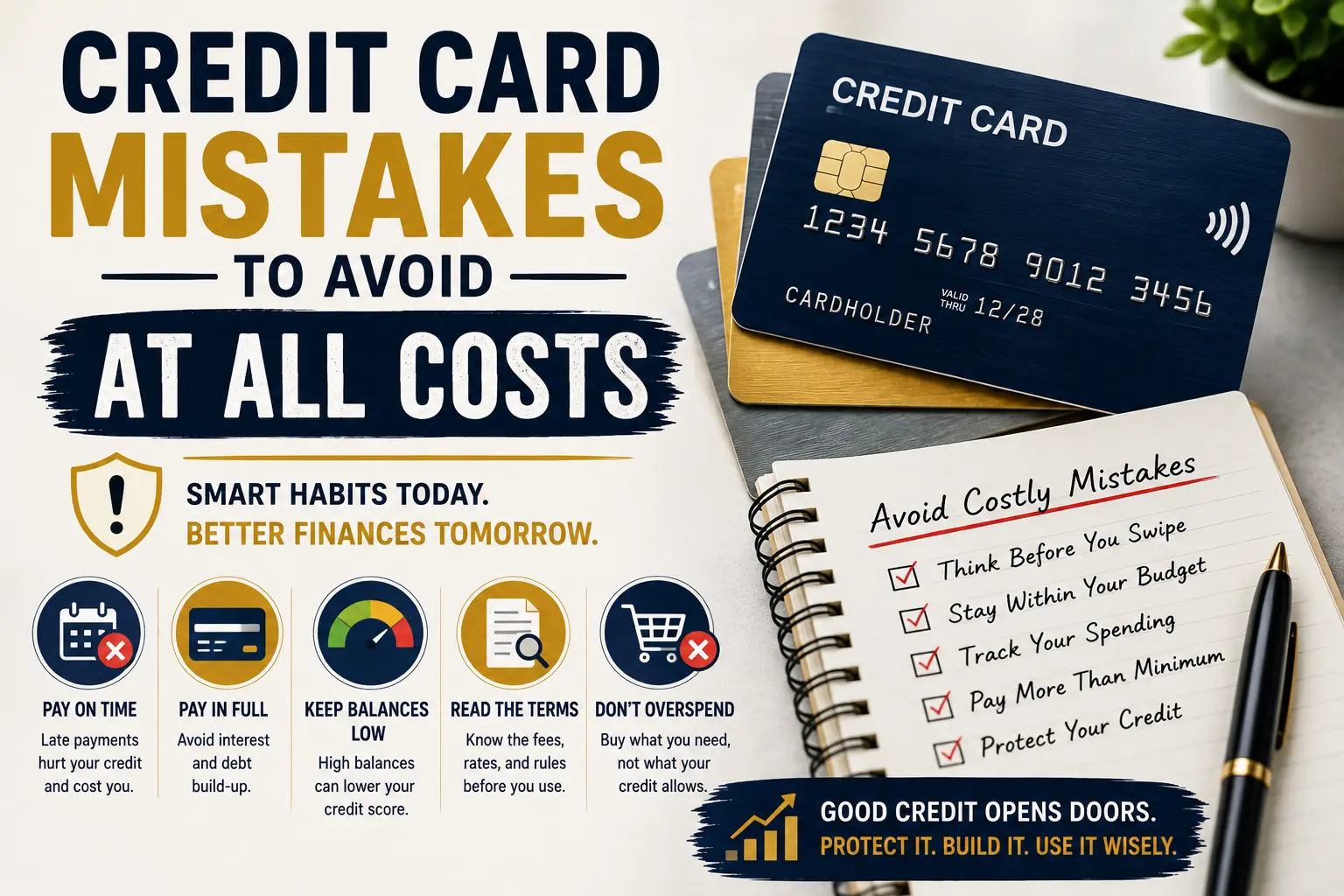
Credit cards can be one of the most useful financial tools available—or one of the most expensive.
The difference usually isn’t the card itself.
It’s how the card is used.
For millions of people, a credit card provides convenience, fraud protection, rewards, and an opportunity to build a strong credit history. Used responsibly, it can make everyday purchases easier while opening doors to lower interest rates, better loan options, and improved financial opportunities in the future.
Unfortunately, the same credit card can become a source of overwhelming debt if it’s not managed carefully.
Many people don’t get into financial trouble because they make one huge mistake. Instead, problems often develop slowly through a series of small decisions that seem harmless at the time.
A missed payment here.
An impulse purchase there.
Paying only the minimum balance each month.
Applying for several new cards in a short period.
Over time, these habits can lead to growing balances, expensive interest charges, lower credit scores, and financial stress that may take years to overcome.
The encouraging news is that most credit card mistakes are completely avoidable once you understand how they happen.
Learning what to avoid is just as important as learning how to use credit wisely.
In this guide, you’ll discover the most common credit card mistakes people make, why they can be costly, and practical strategies for avoiding them. You’ll also learn how responsible credit card habits can help you build a healthier financial future instead of creating unnecessary debt.
Whether you’re applying for your first credit card or trying to improve your current financial habits, understanding these common pitfalls can save you thousands of dollars over your lifetime.
💡 Action Moment: Build Financial Awareness Before Using More Credit
Before looking at interest rates, rewards programs, or credit card offers, take a moment to understand your current financial situation.
Ask yourself:
- Do I know exactly how much I owe?
- Am I paying my balance in full every month?
- How much of my monthly income goes toward debt?
- Am I using credit because it’s convenient or because I don’t have enough cash?
- If an emergency happened tomorrow, would I rely on another credit card?
These questions don’t exist to make you feel guilty.
They exist because understanding your financial habits is the first step toward improving them.
That’s exactly why 7 Days to Financial Clarity™ was created.
This free guide helps you organize your income, expenses, debts, and financial priorities so you can see the complete picture of your finances. When you understand where your money is going, it becomes much easier to use credit cards as financial tools instead of financial crutches.
Financial confidence begins with awareness.
Why Credit Card Mistakes Can Become So Expensive
One of the reasons credit card mistakes are so dangerous is that they often don’t feel serious at first.
Imagine charging a $75 purchase because payday is only a few days away.
Then you add another $120 for groceries.
A week later, you use your card for gas, a meal with friends, and a few online purchases.
None of these individual transactions seems significant.
But if you’re unable to pay the balance when the statement arrives, interest may begin accumulating on what seemed like ordinary spending.
The longer the balance remains unpaid, the more expensive those purchases become.
That’s why responsible credit card users don’t just think about today’s purchase—they think about tomorrow’s payment.
Using a credit card should never mean spending money you don’t realistically expect to repay.
Mistake #1: Paying Only the Minimum Payment
One of the most common—and expensive—credit card mistakes is paying only the minimum amount listed on your monthly statement.
At first glance, this option may seem helpful. After all, making the minimum payment keeps your account in good standing and helps you avoid late fees.
The problem is that minimum payments are designed primarily to keep the account active, not to eliminate your debt quickly.
If you consistently pay only the minimum:
- A larger portion of your payment goes toward interest rather than reducing your balance.
- It can take years to repay even a relatively small balance.
- You may pay hundreds or even thousands of dollars in additional interest over time.
- Carrying debt for long periods can make it harder to achieve other financial goals, such as saving for emergencies or investing.
Whenever possible, pay your statement balance in full. If that’s not possible, pay as much above the minimum as your budget comfortably allows. Every additional dollar goes toward reducing the principal, helping you become debt-free sooner and lowering the amount of interest you’ll pay overall.
Mistake #2: Missing Payment Due Dates
Payment history is one of the most important factors that influences your credit score.
Unfortunately, many people miss payments—not because they don’t want to pay, but because they simply forget.
A missed payment can trigger:
- Late payment fees.
- Additional interest charges.
- Potential increases in your interest rate.
- Damage to your credit history if the payment becomes significantly overdue.
One simple habit can prevent most of these problems: automate your payments or set reminders several days before your due date.
Paying on time, every time, is one of the easiest ways to build a strong credit history.
Mistake #3: Treating Available Credit Like Extra Income
A common misconception is that having a high credit limit means you have more money to spend.
In reality, your credit limit represents the maximum amount a lender is willing to let you borrow—not money you actually own.
Spending based on your available credit instead of your available income often leads to:
- Larger monthly payments.
- Higher interest charges.
- Greater financial stress.
- Difficulty paying off balances.
A healthier approach is to treat your credit card exactly like cash.
Before making a purchase, ask yourself:
“If I didn’t have this credit card, would I still buy this today?”
If the answer is no, it may be worth waiting.
Mistake #4: Using Credit Cards for Everyday Living Expenses
Credit cards can be convenient for groceries, fuel, and household purchases—but relying on them because your paycheck no longer covers basic expenses may signal a deeper financial issue.
If you regularly use credit cards to pay for necessities and can’t pay the balance in full each month, your debt may continue growing.
Rather than opening another credit card, it may be time to review your budget, reduce unnecessary spending, or explore ways to increase your income.
Credit cards can bridge short-term cash flow when used carefully, but they should never become a long-term substitute for a balanced budget.
You’re already investing time in improving your finances, and that’s something to be proud of. Before you continue, download our free 7 Days To Financial Clarity™ workbook and start putting these ideas into action.

Part 2: More Credit Card Mistakes That Can Cost You Thousands
By now, it’s probably clear that most credit card problems don’t happen overnight.
Financial difficulties usually develop gradually through habits that seem harmless in the moment. A single late payment, an unnecessary purchase, or carrying a balance for one extra month may not seem significant. However, when these habits continue over months or years, they can become expensive obstacles to building wealth.
Fortunately, understanding these mistakes before they become habits gives you a tremendous advantage.
Let’s continue with some of the most common—and often overlooked—credit card mistakes.
Mistake #5: Maxing Out Your Credit Card
Many people assume that if they haven’t exceeded their credit limit, they’re using their credit card responsibly.
Unfortunately, that’s not always true.
Even if you make every payment on time, consistently carrying a balance close to your credit limit can negatively affect your financial health.
Lenders pay attention to something called credit utilization, which measures how much of your available credit you’re currently using.
For example, if your credit card has a $5,000 limit and your balance is $4,500, you’re using 90% of your available credit. While this may not violate your card agreement, it signals to lenders that you’re relying heavily on borrowed money.
High credit utilization can:
- Lower your credit score.
- Credit scoring models generally favor borrowers who use only a small portion of their available credit.
- Make future lenders cautious.
- Heavy credit usage may suggest financial strain, even if you’ve never missed a payment.
- Reduce financial flexibility.
- With most of your available credit already in use, unexpected emergencies become more difficult to manage.
As a general guideline, many financial experts recommend keeping your credit utilization well below your available limit whenever possible.
Remember, a higher credit limit isn’t an invitation to spend more.
It’s an opportunity to demonstrate responsible borrowing.
Mistake #6: Applying for Too Many Credit Cards at Once
It can be tempting to apply for multiple credit cards, especially when attractive sign-up bonuses and reward offers appear everywhere.
While opening a new card occasionally isn’t necessarily harmful, submitting several applications within a short period can create problems.
Every application may result in a credit inquiry, and multiple inquiries over a short time can signal increased borrowing activity.
More importantly, opening numerous accounts often encourages additional spending simply because more credit becomes available.
Applying for too many cards can lead to:
- More monthly payments to manage.
- Keeping track of multiple due dates becomes increasingly difficult.
- Greater temptation to overspend.
- Additional available credit sometimes encourages unnecessary purchases.
- More complexity.
- Different interest rates, rewards programs, annual fees, and payment schedules can become confusing.
Instead of collecting credit cards, focus on using one or two responsibly before considering another.
Quality financial habits matter far more than the number of cards in your wallet.
Mistake #7: Ignoring the Interest Rate
Many people pay close attention to rewards but pay very little attention to the Annual Percentage Rate (APR).
This usually isn’t a problem if you pay your statement balance in full every month because interest generally isn’t charged on new purchases during the grace period.
However, if you regularly carry a balance, your interest rate becomes extremely important.
A higher APR means a larger portion of your monthly payment goes toward interest instead of reducing your actual debt.
Before accepting any credit card offer, ask yourself:
- What is the purchase APR?
- This determines how much interest you’ll pay if you carry a balance.
- Is the promotional rate temporary?
- Some introductory offers expire after several months.
- What happens after the promotion ends?
- Understanding the standard rate helps you avoid unpleasant surprises.
The lower your interest costs, the faster your payments reduce your debt rather than simply covering finance charges.
Mistake #8: Taking Cash Advances
Cash advances may seem convenient during an emergency.
Unfortunately, they’re often one of the most expensive ways to borrow money.
Unlike ordinary purchases, cash advances frequently begin accumulating interest immediately, without the benefit of a grace period.
Many card issuers also charge an additional cash advance fee.
This means you’re often paying:
- An upfront transaction fee.
- A percentage of the amount withdrawn or a minimum fee, whichever is greater.
- Higher interest rates.
- Cash advances often carry higher APRs than regular purchases.
- Immediate interest charges.
- Interest usually starts accumulating from the day you withdraw the money.
Whenever possible, consider less expensive alternatives before using a credit card for a cash advance.
Mistake #9: Spending for Rewards Instead of Need
Credit card rewards can be valuable.
Cash back, travel points, airline miles, and purchase protections are excellent benefits—when they’re earned through purchases you were already planning to make.
Problems arise when people begin spending money simply to earn rewards.
Imagine spending an extra $500 just to earn $10 or $15 in cash back.
The reward may feel satisfying, but you’ve still spent hundreds of dollars you didn’t need to spend.
Use rewards wisely by:
- Purchasing items already included in your budget.
- Rewards should be a bonus, not the reason for making the purchase.
- Paying the balance in full.
- Interest charges can quickly eliminate the value of any rewards earned.
- Choosing rewards that match your lifestyle.
- Select programs you’ll actually use instead of chasing every promotional offer.
Rewards work best when they support good financial habits—not when they encourage unnecessary spending.
Mistake #10: Not Reviewing Your Monthly Statements
Many people make their monthly payment without ever reviewing their statement.
That habit can allow small problems to go unnoticed for months.
Reviewing your statement helps you identify:
- Unauthorized purchases.
- Detect fraudulent transactions before they become larger problems.
- Subscription renewals.
- Notice recurring charges for services you no longer use.
- Billing errors.
- Mistakes occasionally happen and are much easier to resolve quickly.
- Spending patterns.
- Understanding where your money goes helps improve future budgeting decisions.
Spending just a few minutes reviewing your statement each month can help protect both your finances and your credit.
Mistake #11: Letting Emotional Spending Control Your Credit Card
Money decisions are rarely based on numbers alone.
Stress, boredom, excitement, frustration, and celebration can all influence spending.
Because credit cards remove the immediate feeling of handing over cash, emotional purchases often feel easier to justify.
Before making an unplanned purchase, pause and ask yourself:
“Am I buying this because I truly need it—or because of how I’m feeling right now?”
Creating a short waiting period before making discretionary purchases often helps separate emotional decisions from thoughtful ones.
Over time, this simple habit can save hundreds—or even thousands—of dollars.
💡 Action Moment: Connect Better Credit Habits to Bigger Financial Goals
Avoiding credit card mistakes isn’t just about saving money on interest or protecting your credit score.
It’s about creating more opportunities for your future.
Every dollar that isn’t spent on unnecessary interest can be redirected toward something meaningful.
Perhaps your goal is to:
- Eliminate credit card debt.
- Free up more of your monthly income for saving and investing.
- Build an emergency fund.
- Reduce your reliance on credit when unexpected expenses arise.
- Save for a home.
- Improve your financial position before applying for a mortgage.
- Invest for retirement.
- Begin building long-term wealth instead of paying long-term interest.
The LookingAtFinance Financial Goal Assessment helps you identify which financial objective should become your highest priority.
Once you have a clear destination, avoiding unnecessary credit card debt becomes much easier because every financial decision supports a purpose.
Good Credit Habits Create Financial Freedom
Building excellent credit isn’t about perfection.
Everyone makes financial mistakes from time to time.
What matters most is developing consistent habits that move you in the right direction.
Paying on time, borrowing responsibly, reviewing your statements, and spending intentionally may seem like small actions.
But over many years, these habits can improve your credit score, reduce borrowing costs, increase financial flexibility, and help you qualify for better financial opportunities.
Responsible credit use isn’t just about avoiding problems.
It’s about creating options for the future.
Knowing your balance is only the beginning. Use our free Debt Payoff Calculator to build a repayment strategy, compare payoff timelines, and take control of your debt with confidence.

Part 3: How to Recover from Credit Card Mistakes and Build Better Financial Habits
If you’ve recognized some of your own habits while reading this article, don’t be discouraged.
Nearly everyone who has used a credit card has made a financial mistake at some point. The important thing isn’t whether you’ve made mistakes in the past—it’s whether you’re willing to change the habits that created them.
Credit scores can improve.
Debt can be repaid.
Healthy financial habits can be learned.
The sooner you begin making small, consistent improvements, the easier it becomes to regain control of your finances.
Remember, every positive financial decision you make today has the potential to improve your financial future.
Start by Creating a Repayment Plan
If you’re carrying credit card debt, one of the most important things you can do is create a clear repayment strategy.
Many people continue making payments without having a specific plan. As a result, they often feel like they’re making little progress because much of each payment goes toward interest instead of reducing the balance.
Having a repayment plan gives every payment a purpose.
As you review your balances, consider writing down:
- Each credit card balance
- Knowing exactly how much you owe removes uncertainty and helps you prioritize your repayments.
- The interest rate for each card
- Higher-interest balances often cost you more money over time and may deserve extra attention.
- The minimum monthly payment
- Understanding your required payment helps you build a realistic monthly budget.
- The amount you can realistically pay above the minimum
- Even small additional payments can shorten your repayment timeline and reduce interest costs.
When you can clearly see your debt, it becomes much easier to build a plan for eliminating it.
Pay More Than the Minimum Whenever Possible
Making only the minimum payment may keep your account current, but it usually isn’t the fastest—or least expensive—way to become debt-free.
Whenever your budget allows, try to pay more than the required minimum.
Even modest increases can make a significant difference over time.
For example:
- Paying an extra $25 each month.
- Reduces your principal balance more quickly.
- Paying an extra $50 each month.
- Helps decrease the amount of interest you’ll pay over the life of the debt.
- Increasing payments after receiving a raise or bonus.
- Allows you to make meaningful progress without permanently changing your monthly budget.
Small improvements may not feel dramatic at first, but consistency is what produces long-term results.
Stop Adding New Debt While Paying Off Existing Balances
One of the biggest challenges people face is trying to pay off debt while continuing to add new purchases to the same credit card.
Imagine trying to empty a bathtub while leaving the faucet running.
Progress becomes much slower because new debt replaces the debt you’re working so hard to eliminate.
If possible, consider using cash, a debit card, or the money already available in your checking account for everyday purchases while focusing on reducing your existing balances.
This approach allows your payments to work toward eliminating debt instead of simply maintaining it.
Build an Emergency Fund
Many people rely on credit cards because they don’t have savings available when unexpected expenses arise.
Unfortunately, emergencies are a normal part of life.
Vehicles need repairs.
Appliances stop working.
Medical expenses appear unexpectedly.
Without emergency savings, it’s easy to reach for a credit card simply because it’s available.
Even setting aside a small amount each month can gradually reduce your dependence on borrowed money.
Over time, your emergency fund becomes a financial cushion that protects both your budget and your peace of mind.
Use Credit Cards as a Payment Tool—Not a Borrowing Tool
One of the healthiest ways to think about credit cards is to view them as a convenient payment method rather than a source of extra income.
Many financially successful people use credit cards regularly.
The difference is that they already have the money available before making the purchase.
Instead of asking:
“Can I put this on my credit card?”
Ask yourself:
“Could I pay for this today without borrowing?”
If the answer is yes, the credit card simply becomes a convenient way to complete the transaction while potentially earning rewards and enjoying fraud protection.
If the answer is no, it may be worth waiting until the purchase fits comfortably within your budget.
Build Habits That Strengthen Your Credit Score
Improving your credit score isn’t about finding quick tricks or shortcuts.
It’s about demonstrating consistent financial responsibility over time.
Lenders want to see that you can borrow money and repay it reliably.
Some of the most effective habits include:
- Pay every bill on time
- Consistent on-time payments are one of the strongest indicators of responsible credit management.
- Keep balances low
- Using only a portion of your available credit generally reflects healthy borrowing habits.
- Review your statements regularly
- Monitoring your accounts helps you catch errors, fraud, and unnecessary spending before they become larger problems.
- Avoid unnecessary credit applications
- Opening new accounts only when you truly need them helps keep your credit profile stable.
- Be patient
- Strong credit develops over time through consistent, responsible financial decisions.
Building excellent credit isn’t about perfection.
It’s about consistency.
Know the Difference Between Good Debt and Bad Debt
Not all debt has the same impact on your financial future.
Some borrowing may help improve your long-term financial position, while other debt can become an expensive burden.
For example:
- Mortgage loans
- Often help people purchase a home while building equity over time.
- Student loans
- May increase future earning potential when used for valuable education or training.
- Business loans
- Can help entrepreneurs grow profitable businesses when managed responsibly.
By comparison, high-interest credit card debt used to finance everyday purchases usually provides little long-term financial benefit while becoming increasingly expensive if balances aren’t repaid quickly.
Whenever possible, avoid borrowing for purchases that lose value quickly or provide only short-term satisfaction.
Learn to Recognize Spending Triggers
Many credit card purchases aren’t driven by necessity.
They’re driven by emotions or habits.
Some people spend more when they’re stressed.
Others shop when they’re bored, celebrating, or feeling discouraged.
Understanding your own spending triggers can help you make better financial decisions.
Ask yourself:
- Do I spend more when I’m tired?
- Do online sales encourage impulse buying?
- Am I influenced by social media or advertising?
- Do I shop because I need something—or because I want temporary excitement?
Simply becoming aware of these patterns often reduces unnecessary spending.
Replacing impulse purchases with intentional decisions helps protect both your budget and your long-term financial goals.
💡 Action Moment: Create Your Debt Elimination Plan
If you’re carrying credit card debt, knowing your balance is only the beginning.
The next step is understanding exactly how long it may take to become debt-free—and how much faster you could reach that goal by increasing your monthly payment.
The LookingAtFinance Debt Payoff Calculator helps you build a personalized repayment strategy by allowing you to:
- Estimate your payoff timeline
- See approximately how long it could take to eliminate your credit card debt based on your current payments.
- Understand the impact of larger payments
- Explore how paying even a little extra each month may reduce both your repayment time and total interest costs.
- Set realistic monthly repayment goals
- Build a repayment plan that fits your budget while keeping you motivated.
- Track your progress
- Watching your balance decline month after month can provide encouragement and help you stay committed.
The sooner you have a clear repayment plan, the sooner every payment begins moving you toward financial freedom instead of simply keeping debt under control.
Responsible Credit Use Creates More Financial Opportunities
Credit cards aren’t inherently good or bad.
They’re financial tools.
Used carelessly, they can create years of unnecessary debt.
Used wisely, they can help you build excellent credit, qualify for better loan terms, reduce borrowing costs, and provide valuable convenience and security.
The goal isn’t to avoid credit cards altogether.
The goal is to make sure your credit cards always work for you—not the other way around.
Every on-time payment, every thoughtful purchase, and every extra dollar you apply toward your balance strengthens your financial foundation.
Those small decisions, repeated consistently over time, often make the biggest difference.
Every financial journey is different. Take our free
Financial Goal Assessment
to discover which area deserves your attention first and receive a clear direction for your next financial milestone.

A Real-Life Example: Two Cardholders, Two Financial Futures
Credit cards don’t determine your financial future.
The habits behind how you use them do.
Let’s look at two fictional examples of people who started with similar financial situations but made very different decisions.
Amanda’s Story
Amanda received her first credit card shortly after beginning her career.
She viewed it as a convenient payment tool rather than extra income.
Before making purchases, she always asked herself whether she could afford to pay the balance when the statement arrived.
Most months, she paid her statement balance in full.
On the rare occasions when she carried a balance, she made larger-than-minimum payments until it was completely repaid.
She also reviewed her monthly statements carefully and monitored her spending.
Over time she developed several simple habits that protected her finances.
She consistently:
- Paid every bill before the due date.
- Her strong payment history helped build an excellent credit profile.
- Used only a portion of her available credit.
- Keeping balances low demonstrated responsible borrowing.
- Avoided impulse purchases.
- She waited before making non-essential purchases to determine whether she truly needed them.
- Maintained an emergency fund.
- Unexpected expenses rarely forced her to rely on credit cards.
Five years later, Amanda had:
- An excellent credit score.
- Little to no revolving credit card debt.
- Lower borrowing costs when financing a vehicle.
- Greater confidence in managing her finances.
- More money available for investing and long-term savings.
Her success didn’t come from earning an unusually high income.
It came from making consistent financial decisions month after month.
Jason’s Story
Jason also received his first credit card around the same time.
Initially, he intended to use it responsibly.
However, he gradually began viewing his available credit as additional spending money.
Whenever something unexpected came up, he reached for his credit card.
When he wanted a new phone, he used his credit card.
Weekend trips.
Online shopping.
Dining out.
Holiday gifts.
Over time, these purchases became routine.
Although Jason always made the minimum payment, he rarely paid more.
Interest charges accumulated month after month.
Eventually, several challenges appeared.
He began experiencing:
- Higher monthly payments.
- More of his income went toward debt rather than savings.
- Growing interest charges.
- His balances declined much more slowly than expected.
- Financial stress.
- Unexpected expenses became increasingly difficult to manage.
- Reduced financial flexibility.
- Large balances limited his ability to qualify for favorable loan terms.
Jason didn’t make one catastrophic financial mistake.
Instead, many small decisions gradually created a larger problem.
The Difference Wasn’t Income
Amanda and Jason earned similar salaries.
Neither received an unexpected inheritance.
Neither won the lottery.
Their financial outcomes were shaped by everyday habits.
Amanda consistently made intentional decisions.
Jason often made convenient decisions.
That difference, repeated over several years, created dramatically different financial futures.
The lesson is simple.
Responsible credit card use isn’t about avoiding every mistake.
It’s about developing habits that consistently move you toward financial stability.
Credit Card Success Checklist
Healthy credit habits don’t require complicated financial strategies.
Instead, they involve a series of practical behaviors that become part of your everyday routine.
Use this checklist as a monthly reminder.
Build Strong Credit Habits
☐ Pay every credit card payment on time.
☐ Pay your statement balance in full whenever possible.
☐ Pay more than the minimum if you’re carrying a balance.
☐ Keep your credit utilization low.
☐ Review every monthly statement carefully.
Protect Yourself Financially
☐ Monitor your accounts for unauthorized transactions.
☐ Set up payment reminders or automatic payments.
☐ Review recurring subscriptions charged to your card.
☐ Avoid cash advances unless absolutely necessary.
☐ Understand your card’s interest rate and fees.
Spend With Purpose
☐ Use your credit card only for planned purchases.
☐ Avoid emotional spending.
☐ Don’t chase rewards through unnecessary purchases.
☐ Compare prices before making large purchases.
☐ Pause before making impulse purchases.
Strengthen Your Financial Future
☐ Build an emergency fund.
☐ Review your budget each month.
☐ Pay down high-interest debt.
☐ Track your progress toward financial goals.
☐ Continue learning about personal finance.
Frequently Asked Questions
Is it bad to carry a credit card balance every month?
Not necessarily, but carrying a balance usually means you’ll pay interest unless you’re within a promotional period.
Whenever possible, paying your statement balance in full helps you avoid unnecessary interest charges and keeps more of your money working toward your own financial goals instead of finance charges.
How many credit cards should I have?
There isn’t one perfect number.
Some people manage several credit cards responsibly, while others prefer using only one or two.
The important question isn’t how many cards you own.
It’s whether you can manage them responsibly by making payments on time and avoiding unnecessary debt.
Will closing a credit card improve my credit score?
Not always.
Closing a credit card may reduce your available credit, which could increase your credit utilization ratio.
Before closing an account, consider how the decision might affect your overall credit profile.
If you’re unsure, reviewing your broader financial picture first can help you make a more informed decision.
Should I use my credit card every month?
Using your card occasionally and paying the balance in full can demonstrate responsible credit management.
However, you don’t need to spend money simply to keep using your card.
The goal is responsible use—not unnecessary spending.
How long does it take to improve a credit score?
Every financial situation is different.
Many people begin seeing improvement after consistently making on-time payments, reducing balances, and avoiding new debt.
Building excellent credit is generally a gradual process that rewards consistent habits over time.
What’s the biggest mistake new credit card users make?
One of the most common mistakes is believing that available credit is the same as available cash.
A credit limit represents borrowed money that eventually must be repaid.
Understanding that distinction from the beginning can prevent many future financial problems.
Final Thoughts
Credit cards aren’t designed to make people wealthy.
They’re designed to provide access to borrowed money.
Whether that borrowed money becomes a helpful financial tool or a source of long-term debt depends almost entirely on the habits of the person using it.
Fortunately, those habits are within your control.
Every time you pay on time, spend intentionally, avoid unnecessary debt, and review your finances, you’re strengthening your financial future.
Don’t focus on being a perfect credit card user.
Focus on becoming a consistent one.
Small decisions repeated month after month often have a greater impact than one dramatic financial change.
Over time, responsible credit habits can help you qualify for better loan terms, reduce borrowing costs, improve your financial confidence, and create more opportunities to achieve the goals that matter most.
Your Next Steps
Understanding credit card mistakes is valuable.
Taking action is what creates lasting financial change.
Here are three practical steps you can begin today.
Step 1: Get Complete Financial Clarity
Download 7 Days to Financial Clarity™ and organize your income, monthly expenses, debts, and savings goals.
When you clearly understand your financial picture, it becomes much easier to make confident decisions about how you use credit.
Instead of reacting to each monthly statement, you’ll begin managing your finances proactively.
Step 2: Identify Your Most Important Financial Goal
Complete the LookingAtFinance Financial Goal Assessment to determine which financial objective deserves your immediate attention.
Whether your priority is:
- Eliminating credit card debt,
- Building an emergency fund,
- Improving your credit score,
- Saving for a home,
- Increasing your savings,
- Or preparing for retirement,
having a clearly defined goal makes every financial decision more meaningful.
Purpose creates motivation, and motivation encourages consistency.
Step 3: Build a Debt-Free Roadmap
If you’re currently carrying credit card balances, don’t rely on guesswork.
Use the LookingAtFinance Debt Payoff Calculator to create a repayment strategy based on your own financial situation.
The calculator can help you:
- Estimate your payoff date.
- See how long it may take to eliminate your balances based on your current payments.
- Compare different payment amounts.
- Discover how paying even a little extra each month may save significant interest and shorten your repayment timeline.
- Stay motivated.
- Watching your balances decrease over time can reinforce positive financial habits and help you remain focused on becoming debt-free.
Every payment you make is another step toward greater financial freedom.
Key Takeaway
The most expensive credit card mistakes rarely happen because of one large purchase. They happen because of small habits repeated over time. By paying on time, avoiding unnecessary debt, keeping balances manageable, and spending intentionally, you can use credit cards as powerful financial tools instead of allowing them to become long-term financial burdens.
You have invested time learning today. Now take the next step by downloading our free 7 Days To Financial Clarity™ workbook and begin building a stronger financial future. Discover practical strategies to save more, improve your credit, protect your finances, and build lasting wealth with confidence.
