
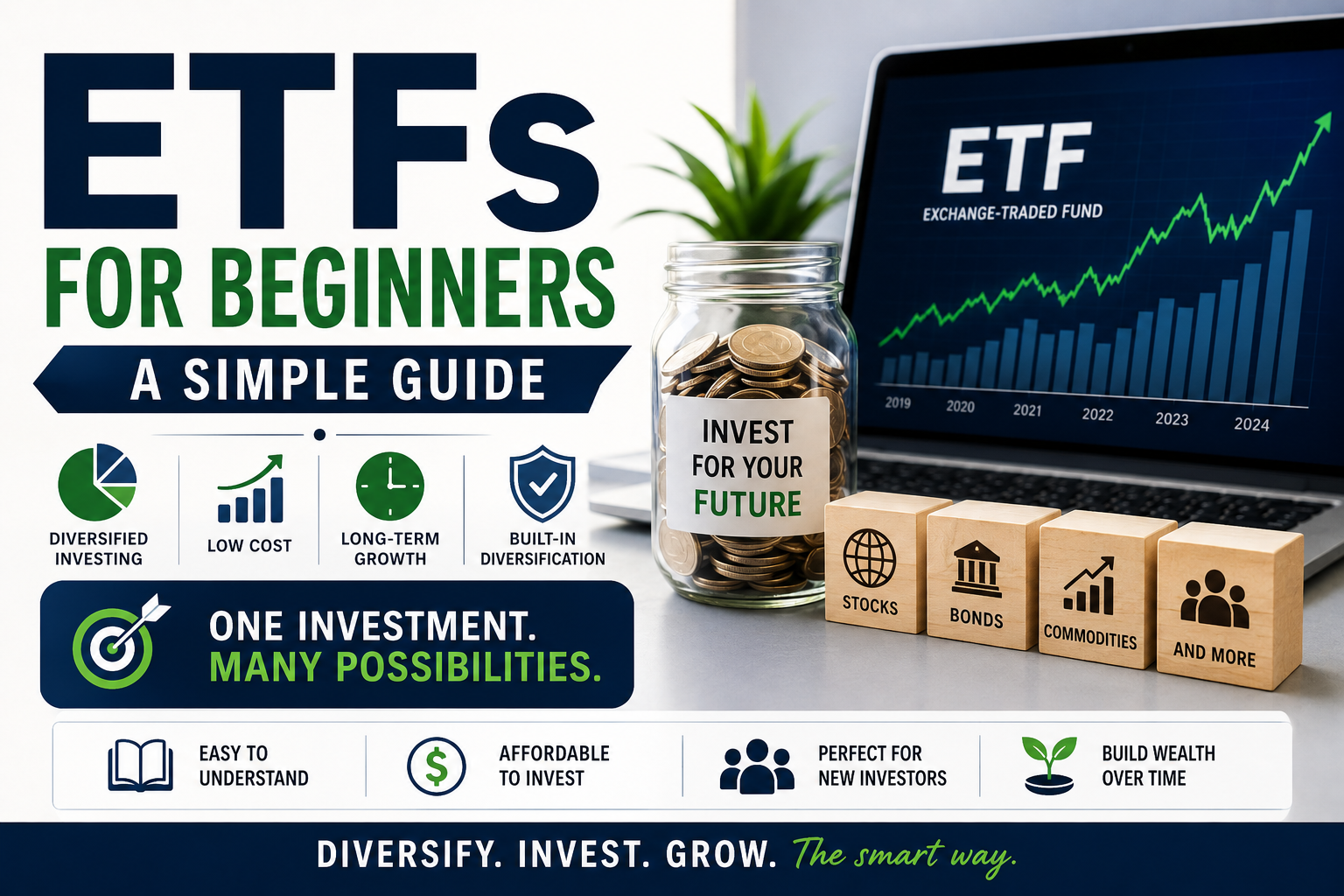
If you’ve spent any time learning about investing, you’ve probably come across the term:
ETF
Financial experts recommend them.
Retirement accounts often contain them.
Many beginner investors use them.
Yet despite their popularity, many people aren’t entirely sure what ETFs actually are.
Some investors assume ETFs are complicated financial products.
Others think they are only for experienced investors.
The reality is much simpler.
In fact, ETFs are often considered one of the most beginner-friendly investment options available.
Why?
Because they make investing easier.
Instead of researching dozens or even hundreds of individual investments, an ETF can provide exposure to many investments through a single purchase.
This helps simplify:
- Diversification
- Portfolio building
- Long-term investing
- Risk management
For many investors, ETFs provide a practical way to participate in the stock market without needing to become investment experts.
This beginner ETF guide explains everything in simple language so new investors can understand how ETFs work and how they fit into a long-term investment strategy.
- What an ETF is
- How ETFs work
- Why ETFs are popular
- The different types of ETFs
- How investors make money with ETFs
- Risks to understand
- How beginners can get started
Most importantly, you’ll discover why ETFs have become one of the most widely used investing tools in the world.
What Is an ETF?
Let’s start with the basics.
The term ETF may sound technical, but the concept is surprisingly simple.
A Simple Definition
ETF stands for:
Exchange-Traded Fund
An ETF is an investment fund that holds a collection of assets.
These assets may include:
- Stocks
- Bonds
- Commodities
- Other investments
Rather than buying each investment individually, investors can buy a single ETF that contains many investments.
Think of it as buying a basket rather than purchasing every item separately.
What ETF Stands For
The name itself provides clues about how ETFs work.
Exchange-Traded
ETFs are bought and sold on stock exchanges.
This means investors can purchase ETF shares much like they purchase stocks.
Fund
The ETF itself is a fund that owns multiple investments.
Investors buy shares of the fund rather than buying each investment individually.
How ETFs Work
At their core, ETFs pool together many investments into a single package.
Investors purchase shares of that package.
Example
Imagine you want to invest in:
- Technology companies
- Healthcare companies
- Financial companies
- Consumer businesses
Instead of purchasing shares of dozens of individual companies, you might purchase an ETF that already contains those companies.
One purchase provides exposure to many businesses.
This is one reason ETFs are so popular.
Why ETFs Were Created
ETFs were designed to make investing:
- Simpler
- More accessible
- More diversified
Many investors wanted an easy way to own broad groups of investments without needing to buy every asset individually.
ETFs helped solve that problem.
Today, investors can find ETFs covering:
- Entire stock markets
- Specific industries
- Bonds
- International markets
- Dividend-focused investments
- Retirement strategies
and much more.
Real-Life Example
Imagine visiting a grocery store.
You could purchase:
- Apples
- Oranges
- Bananas
- Grapes
- Strawberries
one at a time.
Or you could purchase a pre-made fruit basket.
An ETF works similarly.
Instead of purchasing many individual investments separately, you purchase one fund containing many investments.
This convenience is one reason ETFs appeal to beginners.
You’re already investing time in improving your finances, and that’s something to be proud of. Before you continue, download our free 7 Days To Financial Clarity™ workbook and start putting these ideas into action.

How ETFs Work
Understanding how ETFs work helps explain why they have become such an important investing tool.
Fortunately, the process is relatively straightforward.
One Investment, Many Holdings
One of the biggest advantages of ETFs is that a single investment can provide exposure to many holdings.
Example
An ETF may contain:
- 50 companies
- 100 companies
- 500 companies
- Or even thousands of companies
When you purchase shares of the ETF, you gain exposure to all of those holdings.
Owning Multiple Companies at Once
This is very different from purchasing an individual stock.
Individual Stock
Own one company.
ETF
Own many companies through a single investment.
This diversification helps reduce reliance on any one business.
Built-In Diversification
Diversification is one of the most important concepts in investing.
Diversification means spreading investments across multiple assets.
The goal is to reduce risk.
Why It Matters
Imagine investing all of your money in one company.
If that company struggles, your investment may suffer significantly.
Now imagine owning an ETF containing hundreds of companies.
A problem affecting one company may have a smaller impact on the overall investment.
This is one reason many beginners appreciate ETFs.
How ETF Shares Are Bought and Sold
ETFs trade on stock exchanges throughout the trading day.
This means investors can buy and sell ETF shares much like stocks.
Similarities to Stocks
Investors can:
- Purchase shares
- Sell shares
- Monitor prices
- Build portfolios
using ETFs.
The buying process often feels very similar to stock investing.
Example of an ETF Portfolio
Imagine an ETF that tracks a broad stock market index.
The ETF might contain companies from industries such as:
- Technology
- Healthcare
- Finance
- Manufacturing
- Consumer goods
Rather than researching and purchasing hundreds of individual companies, investors can access broad market exposure through a single ETF.
This simplicity is one reason ETFs have become so popular.
Why ETFs Are Popular
Now that you understand how ETFs work, let’s discuss why so many investors use them.
Diversification Made Easy
One of the biggest reasons investors choose ETFs is diversification.
Instead of relying on one company, ETFs often provide exposure to many businesses.
Benefits
- Reduced company-specific risk
- Broader market exposure
- Simpler portfolio management
Diversification is one of the most powerful risk-management tools available to investors.
Beginner Friendly
ETFs remove much of the complexity associated with investing.
Many beginners are unsure how to evaluate individual companies.
ETFs simplify the process.
Why Beginners Like ETFs
They provide:
- Simplicity
- Diversification
- Accessibility
- Ease of use
This makes ETFs attractive to investors who are still learning.
Low Maintenance
Managing dozens of individual stocks can require significant research and monitoring.
ETFs often require less maintenance.
Example
An investor owning hundreds of companies through a single ETF may spend less time researching individual businesses.
This convenience appeals to many long-term investors.
Cost Efficiency
Many ETFs have relatively low costs compared to some other investment products.
This allows investors to keep more of their returns.
Why Costs Matter
Every dollar spent on fees is a dollar that cannot continue compounding.
Over long periods, lower costs can make a meaningful difference.
Why Many Investors Choose ETFs
ETFs help solve several common investing challenges.
They provide:
✓ Diversification
✓ Simplicity
✓ Accessibility
✓ Cost efficiency
✓ Long-term investing opportunities
This combination explains why ETFs have become one of the most widely used investment vehicles in the world.
A Key Lesson Before Moving Forward
ETFs are not a separate investment category competing with stocks and bonds.
Instead, they are a way to own stocks, bonds, or other investments in a convenient package.
Remember:
✓ ETFs contain multiple investments.
✓ ETFs provide diversification.
✓ ETFs are easy to buy and sell.
✓ ETFs are popular among beginners and experienced investors alike.
ETFs vs Individual Stocks
One of the first decisions many investors face is whether to buy:
- Individual stocks
- ETFs
Both options can be valuable.
However, they serve different purposes and involve different levels of risk.
Understanding the differences can help beginners make more informed decisions.
Owning One Company vs Many
The biggest difference between individual stocks and ETFs is diversification.
Individual Stocks
When you purchase a stock, you own shares in a single company.
Example
If you buy shares of one company, your investment performance depends heavily on that company’s success.
If the company performs well, your investment may grow significantly.
If the company struggles, your investment may lose value.
ETFs
An ETF contains many investments.
Example
Instead of owning one company, you might own:
- 100 companies
- 500 companies
- Or even thousands of companies
through a single ETF.
This spreads risk across multiple businesses.
Risk Differences
Risk is one of the most important considerations when comparing ETFs and individual stocks.
Individual Stocks Carry Company-Specific Risk
Every business faces challenges.
Examples include:
- New competitors
- Changing consumer preferences
- Regulatory issues
- Economic downturns
If you own a single stock, those challenges can have a major impact on your investment.
Example
A company reports disappointing earnings.
Its stock price falls sharply.
Because your investment is concentrated in that company, the decline affects your entire position.
ETFs Reduce Company-Specific Risk
Because ETFs hold many investments, they provide diversification.
Why This Helps
A problem affecting one company usually has a smaller impact on the overall ETF.
The ETF’s performance depends on many holdings rather than a single business.
This is one reason ETFs are often considered beginner friendly.
Potential Return Differences
Many beginners wonder:
Can individual stocks outperform ETFs?
The answer is yes.
However, there is an important trade-off.
Individual Stocks
A successful company may generate exceptional returns.
Example
An investor selects a company that experiences rapid growth.
The stock increases substantially in value.
The investor benefits directly from that growth.
The Challenge
Consistently identifying future winners is difficult.
Even professional investors struggle to do this consistently.
ETFs
ETFs generally provide broader market exposure.
Instead of trying to identify individual winners, investors participate in the performance of many companies.
Result
Returns may be less dramatic than the very best-performing stocks.
However, diversification often reduces risk.
Which Is Better for Beginners?
There is no universal answer.
However, many financial educators recommend ETFs as a starting point for beginners.
Why?
Because ETFs offer:
- Diversification
- Simplicity
- Lower maintenance
- Reduced company-specific risk
Many investors begin with ETFs and later add individual stocks if desired.
Pros and Cons Comparison
Individual Stocks
Pros
✓ Potentially higher returns
✓ Direct ownership of specific companies
✓ Greater control over investment selection
Cons
✗ Higher risk
✗ More research required
✗ Greater volatility
✗ Company-specific risk
ETFs
Pros
✓ Diversification
✓ Simplicity
✓ Lower maintenance
✓ Broad market exposure
Cons
✗ Less concentrated upside
✗ Limited control over individual holdings
✗ Market risk still exists
Types of ETFs
One reason ETFs have become so popular is the wide variety available.
Investors can choose ETFs that align with different goals and strategies.
Let’s explore some of the most common types.
Stock ETFs
Stock ETFs invest primarily in stocks.
These are among the most popular ETFs available.
What They Contain
Stock ETFs may hold:
- Large companies
- Small companies
- Domestic companies
- International companies
or combinations of these investments.
Why Investors Use Stock ETFs
Stock ETFs provide exposure to stock market growth without requiring investors to select individual companies.
Benefits
- Diversification
- Growth potential
- Broad market exposure
Many beginner investors start here.
Bond ETFs
Bond ETFs invest primarily in bonds.
These ETFs provide exposure to:
- Government bonds
- Corporate bonds
- Municipal bonds
- Other fixed-income investments
Why Investors Use Bond ETFs
Bond ETFs are often used for:
- Stability
- Income
- Risk reduction
They may play an important role in diversified portfolios.
Index ETFs
Index ETFs are among the most popular ETF categories.
These ETFs aim to track a market index.
What Is an Index?
A market index measures the performance of a group of investments.
Examples include:
- Large-company indexes
- Broad market indexes
- International indexes
An index provides a snapshot of market performance.
Why Index ETFs Are Popular
Index ETFs allow investors to participate in the performance of an entire market segment through a single investment.
Benefits
- Broad diversification
- Simplicity
- Low maintenance
This approach is often called passive investing.
Sector ETFs
Sector ETFs focus on specific industries.
Examples include:
- Technology
- Healthcare
- Energy
- Financial services
- Consumer goods
Why Investors Use Sector ETFs
Some investors want greater exposure to particular industries.
Sector ETFs make this possible.
Important Consideration
Sector ETFs may involve greater concentration risk because they focus on a specific area of the economy.
Dividend ETFs
Dividend ETFs focus on companies that pay dividends.
These ETFs are popular among investors seeking income.
Why Investors Like Dividend ETFs
Potential benefits include:
- Dividend income
- Diversification
- Long-term growth opportunities
Many investors use dividend ETFs as part of retirement and income-focused strategies.
Understanding the Differences
Each ETF category serves a different purpose.
Stock ETFs
Focus on growth.
Bond ETFs
Focus on income and stability.
Index ETFs
Focus on broad market exposure.
Sector ETFs
Focus on specific industries.
Dividend ETFs
Focus on income-producing companies.
Understanding these categories helps investors select ETFs that align with their financial goals.
A Key Lesson Before Moving Forward
ETFs are incredibly flexible investment tools.
They can provide exposure to:
✓ Stocks
✓ Bonds
✓ Entire markets
✓ Specific industries
✓ Dividend-paying companies
For many beginners, the challenge is not finding an ETF.
The challenge is understanding which type of ETF fits their goals.
What Is an Index ETF?
If you spend any time researching ETFs, you’ll quickly encounter the term:
Index ETF
In fact, many investors consider index ETFs to be one of the best starting points for beginners.
Why?
Because they offer a simple way to invest in large groups of companies without needing to select individual stocks.
Let’s break down what that means.
Understanding Market Indexes
Before understanding index ETFs, you need to understand indexes.
A market index is a tool used to measure the performance of a group of investments.
Think of an index as a scoreboard.
It helps investors track how a collection of investments is performing over time.
Why Indexes Exist
Imagine trying to determine whether the stock market is performing well.
Looking at a single company wouldn’t provide a complete picture.
Instead, investors often look at indexes that represent many companies.
This creates a broader view of market performance.
Examples of Market Indexes
Different indexes track different groups of investments.
Some focus on:
- Large companies
- Small companies
- International companies
- Specific industries
Others attempt to represent broad segments of the overall market.
These indexes help investors understand trends and performance.
The S&P 500 Explained
One of the most widely followed market indexes is the S&P 500.
Many beginner investors hear about it regularly in financial news.
What Is the S&P 500?
The S&P 500 is an index that tracks approximately 500 large companies.
These companies operate across many industries, including:
- Technology
- Healthcare
- Financial services
- Consumer goods
- Energy
Because it includes many businesses, the index provides a broad snapshot of the market.
Why Investors Pay Attention to It
Many investors view the S&P 500 as a useful measure of overall stock market performance.
When news reports discuss:
“The market performed well today”
they are often referencing major indexes such as the S&P 500.
Important Point
The S&P 500 is not a stock.
It is an index.
However, investors can purchase ETFs designed to track its performance.
📈 Watch Your Money Grow
Successful investing isn’t about guessing—it’s about understanding long-term growth. Use our free Investment Growth Calculator to see how regular investing can build wealth over time.

How Index ETFs Work
An index ETF attempts to mirror the performance of a specific index.
Example
Suppose an ETF tracks the S&P 500.
The ETF owns investments designed to closely resemble the companies included in the index.
When the index rises or falls, the ETF generally moves in a similar direction.
Why This Approach Is Popular
Rather than trying to select individual winning stocks, investors gain exposure to an entire group of companies.
This simplifies investing.
Benefits
- Broad diversification
- Reduced company-specific risk
- Lower maintenance
- Simpler decision-making
For many beginners, this approach feels far less intimidating than selecting individual stocks.
Why Index Investing Is Popular
Index investing has grown tremendously in popularity over the past several decades.
Many investors appreciate its simplicity and long-term focus.
Broad Diversification
One index ETF may provide exposure to hundreds of companies.
This helps reduce dependence on any single business.
Example
If one company struggles, the impact on the overall ETF may be limited.
This diversification is one of the primary reasons investors choose index ETFs.
Reduced Research Requirements
Selecting individual stocks often requires:
- Research
- Monitoring
- Analysis
- Ongoing evaluation
Index ETFs reduce much of that workload.
Instead of evaluating hundreds of companies individually, investors purchase exposure to an entire market segment.
Long-Term Investing Focus
Many index investors focus on:
- Years
- Decades
- Long-term goals
rather than daily market movements.
This perspective encourages patience and discipline.
Passive Investing Explained
Index investing is often associated with passive investing.
Passive investing is a strategy that seeks to match market performance rather than outperform it.
Active vs Passive Investing
Active Investing
Active investors attempt to:
- Select winning stocks
- Time market movements
- Outperform indexes
This often requires significant research and effort.
Passive Investing
Passive investors typically:
- Purchase index funds or ETFs
- Remain diversified
- Focus on long-term growth
Rather than trying to beat the market, they aim to participate in overall market growth.
Why Many Investors Prefer Passive Investing
Passive investing offers several advantages.
Simplicity
Investment decisions are often easier.
Diversification
Broad market exposure reduces company-specific risk.
Lower Costs
Many passive investment products have relatively low fees.
Less Stress
Investors spend less time reacting to market news and short-term fluctuations.
Why Many Experts Recommend Index ETFs
While there is no single investment that works for everyone, many financial professionals view index ETFs as strong options for beginner investors.
Diversification from Day One
A single index ETF can provide exposure to hundreds of companies.
This makes diversification easy.
Why This Matters
Many investing mistakes occur when investors become overly concentrated in a small number of holdings.
Index ETFs help reduce this risk.
Simplicity for Beginners
Many new investors feel overwhelmed by the number of investment choices available.
Index ETFs simplify the process.
Instead of evaluating individual companies, investors can focus on broader financial goals.
Consistency Over Prediction
Many beginners assume successful investing requires predicting the future.
In reality, many investors focus on consistency rather than prediction.
Index ETFs support this approach.
Example
An investor contributes regularly to an index ETF over many years.
Rather than trying to predict short-term market movements, they focus on long-term participation.
This strategy often aligns well with beginner investing goals.
A Real-Life Example
Imagine two investors.
Investor A
Spends significant time researching individual companies.
Attempts to identify future winners.
Frequently buys and sells investments.
Investor B
Invests regularly in a broad-market index ETF.
Remains diversified.
Focuses on long-term growth.
Which Investor Wins?
There is no guarantee.
However, history has shown that many investors struggle to consistently outperform broad market indexes over long periods.
This reality is one reason index investing has become so popular.
The Key Lesson
Index ETFs provide a simple way to invest in broad segments of the market.
They offer:
✓ Diversification
✓ Simplicity
✓ Lower maintenance
✓ Broad market exposure
✓ Long-term growth opportunities
For many beginners, index ETFs represent a practical starting point for building wealth through investing.
A Key Lesson Before Moving Forward
Understanding index ETFs is important because they form the foundation of many successful investing strategies.
Remember:
✓ Indexes measure groups of investments.
✓ Index ETFs track those indexes.
✓ Passive investing focuses on participation rather than prediction.
✓ Diversification helps reduce risk.
✓ Many beginners start with index ETFs because they simplify investing.
How Investors Make Money with ETFs
After learning how ETFs work, many beginners ask the same question:
“How do ETFs actually make money?”
The answer is similar to how investors make money from stocks and bonds.
ETFs can generate returns through:
- Capital Appreciation
- Dividend Income
- Reinvested Distributions
- Compound Growth Over Time
Let’s explore each one.
Capital Appreciation
Capital appreciation occurs when the value of an investment increases.
This is one of the primary ways ETF investors build wealth.
How ETF Prices Increase
Because ETFs hold underlying investments, their value is influenced by the performance of those holdings.
Example
Suppose an ETF owns hundreds of companies.
As those companies grow and become more valuable, the ETF’s value may increase as well.
If the ETF’s price rises, investors may benefit through capital appreciation.
Why ETF Values Change
ETF prices can rise due to:
- Business growth
- Economic expansion
- Increased corporate profits
- Investor confidence
- Market appreciation
Just like stocks, ETF prices fluctuate over time.
However, because ETFs often contain many investments, price movements may be less dramatic than those of individual stocks.
Long-Term Growth Potential
Many investors use ETFs as long-term wealth-building tools.
Why?
Because broad groups of companies often grow over time.
Rather than depending on one business, ETF investors participate in the growth of many businesses simultaneously.
This diversification can make long-term investing easier and less stressful.
Dividend Income
Many ETFs hold companies that pay dividends.
When those companies distribute profits, the ETF may receive those payments.
The ETF can then distribute income to its investors.
What Are ETF Distributions?
ETF investors often receive payments called distributions.
These payments may come from:
- Dividends
- Interest income
- Other sources generated by the ETF’s holdings
Depending on the ETF, distributions may be paid:
- Monthly
- Quarterly
- Semi-annually
- Annually
Why Investors Like Dividend Income
Dividend income provides an additional source of return.
Benefits May Include
- Cash flow
- Income generation
- Portfolio growth
- Reinvestment opportunities
Many retirees and income-focused investors appreciate ETFs that generate regular distributions.
Reinvesting Distributions
One of the most powerful investing strategies is reinvesting distributions.
Instead of spending dividend income, investors use those payments to purchase additional ETF shares.
How Reinvestment Works
Imagine an ETF pays a distribution.
Rather than withdrawing the money, you reinvest it.
The payment purchases additional shares.
Those additional shares may generate future distributions.
The cycle continues.
Why Reinvestment Matters
Reinvestment allows returns to generate additional returns.
This process is one of the foundations of compound growth.
Over long periods, reinvested distributions can significantly increase portfolio value.
Long-Term Compound Growth
Compound growth is one of the most important concepts in investing.
It occurs when investment gains remain invested and generate additional gains.
The Snowball Effect
Imagine rolling a snowball down a hill.
At first, growth is slow.
As the snowball grows larger, it gathers more snow.
Growth accelerates.
Investing often works the same way.
Example
You invest consistently.
Your ETF grows.
Distributions are reinvested.
Future growth occurs on:
- Original contributions
- Previous gains
- Reinvested distributions
Over time, this creates a compounding effect.
Why Time Matters
Compound growth becomes more powerful as time increases.
This is one reason many investors focus on:
- Long-term investing
- Consistent contributions
- Patience
Rather than trying to generate quick profits.
Building Wealth Over Time
Most successful investors do not become wealthy overnight.
Instead, they follow a simple process:
- Invest consistently.
- Remain diversified.
- Reinvest income.
- Stay invested.
Over time, these habits may produce meaningful results.
ETF Fees Explained
One of the advantages often associated with ETFs is cost efficiency.
However, ETFs are not completely free.
Understanding fees is important because costs can affect long-term returns.
What Is an Expense Ratio?
The most common ETF fee is called an expense ratio.
An expense ratio represents the annual cost of operating the ETF.
This fee helps cover:
- Administration
- Management
- Operational expenses
How Expense Ratios Work
The fee is typically expressed as a percentage.
Example
Suppose an ETF has an expense ratio of:
0.10%
This means investors pay approximately:
$1 per year
for every:
$1,000 invested
The fee is generally deducted automatically from the fund.
Why Fees Matter
At first glance, small fees may not seem important.
However, investing is often a long-term process.
Over decades, fees can accumulate.
Small Differences Add Up
Consider two similar investments.
One charges:
0.10%
The other charges:
1.00%
The difference may appear small.
Yet over many years, the lower-cost investment may leave more money available for growth and compounding.
Keeping More of Your Returns
Every dollar paid in fees is a dollar that cannot continue growing.
This is one reason many investors prefer low-cost ETFs.
Benefits
- Lower expenses
- Greater efficiency
- More money invested
- Better compounding potential
Comparing ETF Costs
Not all ETFs have identical fees.
Some ETFs focus on:
- Broad market indexes
- Passive investing
These often have relatively low expense ratios.
Other specialized ETFs may charge higher fees.
Important Reminder
A higher fee does not automatically mean better performance.
Investors should understand what they are paying for and how fees may affect long-term returns.
A Simple Fee Example
Imagine two investors.
Both invest:
$10,000
Both earn similar market returns.
However:
Investor A
Pays lower fees.
Investor B
Pays higher fees.
Over many years, Investor A may retain more of their investment gains simply because less money was lost to fees.
Why ETF Costs Are Often Attractive
Many ETFs have become popular because they combine:
✓ Diversification
✓ Simplicity
✓ Accessibility
✓ Relatively low costs
These features can make ETFs appealing to both beginners and experienced investors.
A Key Lesson Before Moving Forward
ETFs generate returns in several ways.
Investors may benefit from:
✓ Capital appreciation
✓ Dividend income
✓ Reinvested distributions
✓ Long-term compound growth
At the same time, investors should understand the impact of fees.
Even small costs can influence long-term results.
Risks of Investing in ETFs
ETFs are often praised for their simplicity, diversification, and accessibility.
While these advantages are real, it’s important to understand that ETFs are not risk-free.
Every investment involves some level of risk.
Successful investors recognize these risks and learn how to manage them rather than avoid investing altogether.
Let’s explore the most common ETF risks.
Market Risk
The most significant risk for most ETF investors is market risk.
Market risk refers to the possibility that the overall market declines.
Why Market Risk Matters
Even a highly diversified ETF can lose value when markets fall.
Example
Suppose you own a broad stock market ETF.
The ETF contains hundreds of companies.
If the overall stock market experiences a decline, the ETF may decline as well.
Diversification reduces company-specific risk, but it cannot eliminate market risk.
Understanding Market Declines
Market declines are a normal part of investing.
They may occur because of:
- Economic slowdowns
- Rising interest rates
- Inflation concerns
- Global events
- Investor uncertainty
These declines can be uncomfortable, but they are not unusual.
Important Lesson
Temporary declines do not necessarily indicate a bad investment.
Long-term investors often expect periods of volatility.
Sector Concentration Risk
Not all ETFs are broadly diversified.
Some focus on specific industries.
These are often called sector ETFs.
What Is Sector Risk?
Sector risk occurs when an ETF concentrates investments in one part of the economy.
Examples include:
- Technology
- Healthcare
- Energy
- Financial services
If that sector struggles, the ETF may underperform.
Example
Imagine an ETF focused entirely on technology companies.
If the technology sector experiences difficulties, the ETF may decline significantly.
A broader ETF containing multiple industries may be less affected.
Why Beginners Should Understand This
Many beginners assume all ETFs are highly diversified.
That is not always true.
The level of diversification depends on what the ETF owns.
Understanding the holdings inside an ETF is important before investing.
Volatility
Volatility refers to how much investment prices fluctuate over time.
ETFs experience volatility because their underlying investments experience volatility.
Why ETF Prices Change
ETF prices move because the investments inside the ETF move.
Example
If an ETF owns stocks and those stocks rise or fall, the ETF’s value changes as well.
This is normal investing behavior.
Different ETFs Have Different Volatility Levels
Some ETFs are more volatile than others.
Broad-Market ETFs
Often experience moderate volatility.
Sector ETFs
May experience larger price swings.
Bond ETFs
Typically experience lower volatility than many stock ETFs.
Understanding these differences helps investors choose ETFs that align with their risk tolerance.
Emotional Investing
One of the biggest investing risks isn’t found in the market.
It’s found in human behavior.
Many investors make emotional decisions during periods of uncertainty.
Common Emotional Mistakes
Examples include:
Selling During Market Declines
Investors panic when prices fall.
Chasing Performance
Investors buy after prices have already risen significantly.
Constantly Changing Strategies
Investors abandon long-term plans because of short-term events.
Why Emotions Can Be Expensive
Emotional decisions often lead investors to:
- Buy high
- Sell low
- Miss recoveries
- Reduce long-term returns
This is one reason many successful investors focus on discipline rather than prediction.
Understanding ETF Risks
The goal is not to avoid risk entirely.
The goal is understanding risk and managing it responsibly.
Helpful Perspective
ETFs can reduce certain risks through diversification.
However, they cannot eliminate:
- Market risk
- Economic risk
- Behavioral risk
Understanding these realities helps investors develop realistic expectations.
ETFs vs Mutual Funds
As beginners learn about ETFs, they often encounter another investment option:
Mutual Funds
Both ETFs and mutual funds allow investors to own diversified collections of investments.
However, there are important differences.
Similarities
ETFs and mutual funds share several characteristics.
Both can provide:
- Diversification
- Professional management
- Exposure to many investments
- Long-term investing opportunities
Because of these similarities, many beginners wonder which option is better.
Differences
Although similar, ETFs and mutual funds operate differently.
Trading Flexibility
ETFs trade on stock exchanges throughout the day.
Investors can buy and sell ETF shares whenever markets are open.
Mutual Funds
Mutual funds generally trade once per day after markets close.
This is one of the biggest operational differences.
Accessibility
Many ETFs are easy to purchase through brokerage accounts.
Some mutual funds may have:
- Minimum investment requirements
- Different account restrictions
This varies depending on the fund.
Cost Considerations
Many ETFs are known for relatively low costs.
Some mutual funds also have low fees.
Others may charge higher expenses.
Why This Matters
Lower costs leave more money available for investment growth.
Over long periods, fee differences can become meaningful.
ETF vs Mutual Fund Comparison
| Feature | ETF | Mutual Fund |
| Trades During Market Hours | Yes | No |
| Diversification | Yes | Yes |
| Long-Term Investing | Yes | Yes |
| Expense Ratios | Often Low | Varies |
| Ease of Purchase | High | High |
| Portfolio Flexibility | High | Moderate |
Which Is Better for Beginners?
There is no single correct answer.
However, many beginner investors appreciate ETFs because they offer:
- Simplicity
- Diversification
- Transparency
- Flexibility
- Low costs
These characteristics often align well with beginner investing goals.
How Investors Manage ETF Risk
Although risk cannot be eliminated, investors can often reduce unnecessary risk through smart investing habits.
Diversification
Diversification remains one of the most important risk-management tools available.
Owning many investments can reduce dependence on any single company or industry.
Example
A broad-market ETF containing hundreds of companies may reduce company-specific risk compared to owning a single stock.
Long-Term Investing
Many investors manage risk by focusing on long-term goals rather than short-term market movements.
Why This Helps
Markets experience ups and downs.
Longer time horizons provide opportunities for:
- Recovery
- Growth
- Compounding
Patience often becomes an investing advantage.
Consistent Contributions
Many investors use regular contributions rather than trying to perfectly time the market.
This strategy is commonly known as Dollar-Cost Averaging.
Benefits
- Encourages discipline
- Reduces emotional decision-making
- Builds investing habits
Consistency often matters more than perfect timing.
Staying Focused on Goals
Investors who maintain a clear plan are often better prepared for market volatility.
Rather than reacting to headlines, they focus on:
- Retirement goals
- Wealth-building goals
- Long-term objectives
This mindset helps reduce emotional investing mistakes.
🎯 Find Your Best Next Step
Every financial journey is different. Take our free Financial Goal Assessment to discover which area deserves your attention first and receive a clear direction for your next financial milestone.

A Key Lesson Before Moving Forward
ETFs offer many advantages, but they are still investments.
That means they involve risk.
Remember:
✓ Diversification reduces risk but does not eliminate it.
✓ Broad-market ETFs and sector ETFs behave differently.
✓ Emotions can become an investor’s biggest challenge.
✓ Long-term investing helps manage volatility.
✓ Consistency often beats prediction.
ETFs and Retirement Investing
One reason ETFs have become so popular is their suitability for long-term financial goals.
Retirement investing is one of the most common examples.
Many retirement portfolios include ETFs because they offer:
- Diversification
- Simplicity
- Cost efficiency
- Long-term growth potential
These characteristics can make retirement investing easier to manage.
Long-Term Wealth Building
Retirement is often decades away for many investors.
This long time horizon creates opportunities for:
- Compound growth
- Consistent investing
- Portfolio diversification
ETFs help investors participate in these opportunities without needing to manage dozens of individual investments.
Example
An investor contributes regularly to a diversified ETF over many years.
Those contributions remain invested.
Growth compounds over time.
This process can gradually build substantial retirement savings.
Diversification for Retirement
Diversification is particularly important for long-term investing.
A diversified ETF may provide exposure to:
- Multiple industries
- Different company sizes
- Various sectors of the economy
This broad exposure helps reduce reliance on any single company.
Why This Matters
Over a retirement investing timeline, different industries may experience periods of strength and weakness.
Diversification helps smooth the journey.
Why ETFs Are Common in Retirement Portfolios
Many retirement investors appreciate ETFs because they combine:
✓ Diversification
✓ Accessibility
✓ Low maintenance
✓ Long-term growth opportunities
This combination makes ETFs a practical choice for many retirement strategies.
Investing for Decades
Successful retirement investing often focuses on consistency rather than perfection.
Many investors:
- Contribute regularly
- Stay invested
- Ignore short-term noise
- Allow compounding to work
ETFs support this long-term approach.
ETFs and Investing with Little Money
Another reason ETFs are popular is accessibility.
Many beginners assume investing requires thousands of dollars.
Fortunately, that is not necessarily true.
Why ETFs Are Beginner Friendly
ETFs allow investors to gain exposure to many investments through a single purchase.
This simplicity makes them attractive to new investors.
Benefits Include
- Easy diversification
- Broad market exposure
- Lower maintenance
- Flexible investment amounts
Many beginners find ETFs easier to understand than building portfolios of individual stocks.
Starting Small
One of the biggest investing myths is that large amounts of money are required.
Many investors begin with:
- $25
- $50
- $100
per month.
Why Small Amounts Matter
Small investments help develop:
- Investing habits
- Consistency
- Financial discipline
The key is getting started.
Consistent Contributions
Successful investing often involves regular contributions.
Some investors contribute:
- Weekly
- Biweekly
- Monthly
Others invest whenever funds become available.
Why Consistency Matters
Regular investing helps:
- Build momentum
- Reduce emotional decision-making
- Support long-term growth
Consistency often matters more than the size of any single contribution.
Dollar-Cost Averaging
Dollar-Cost Averaging is a strategy where investors contribute fixed amounts on a regular schedule.
Rather than trying to predict market movements, investors remain consistent.
Benefits
- Encourages discipline
- Reduces emotional investing
- Simplifies investing decisions
Many ETF investors use this approach as part of their long-term strategy.
Building Wealth One Contribution at a Time
Many people imagine wealth is created through large investments.
In reality, wealth often develops through:
- Small contributions
- Long time horizons
- Consistency
- Compound growth
ETFs make this process accessible to a wide range of investors.
Real-Life Example
Let’s compare two investors.
Investor A Picks Individual Stocks
Investor A spends significant time researching companies.
They attempt to identify future winners.
Some investments perform very well.
Others perform poorly.
The portfolio experiences substantial fluctuations.
Advantages
- Potential for exceptional returns
- Direct company ownership
Challenges
- Significant research required
- Greater volatility
- Higher company-specific risk
Investor B Uses ETFs
Investor B prefers a simpler approach.
They invest consistently in a diversified ETF.
Rather than focusing on individual companies, they focus on long-term goals.
Advantages
- Diversification
- Simplicity
- Lower maintenance
Challenges
- Less concentrated upside
- Market risk still exists
Comparing the Results
There is no guarantee either investor will outperform.
However, many investors find ETFs easier to manage over long periods.
Why?
Because ETFs reduce many of the challenges associated with selecting and monitoring individual companies.
The Lesson
Successful investing often involves:
- Consistency
- Patience
- Diversification
ETFs support these principles.
This is one reason they have become popular among both beginners and experienced investors.
Common ETF Myths
Despite their popularity, ETFs are sometimes misunderstood.
Let’s address a few common myths.
ETFs Are Only for Beginners
This is false.
Many experienced investors use ETFs.
In fact, some professional investors incorporate ETFs into their portfolios.
Reality
ETFs can be useful for investors at all experience levels.
ETFs Guarantee Profits
No investment can guarantee profits.
ETFs rise and fall with the value of their underlying holdings.
Reality
ETFs can lose value.
Investors should understand market risk before investing.
ETFs Are Risk-Free
Diversification helps reduce risk.
However, ETFs still face:
- Market risk
- Economic risk
- Volatility
Reality
ETFs reduce certain risks but do not eliminate all risk.
You Need Lots of Money
Many investors start with modest contributions.
Reality
Investing is often more about consistency than starting size.
ETFs Are Too Complicated
Most ETFs are easier to understand than many people expect.
Reality
At their core, ETFs are simply collections of investments packaged together into a single investment.
Beginner ETF Checklist
Before investing in ETFs, review this checklist.
Before You Invest
✓ Create a budget
✓ Build an emergency fund
✓ Understand ETF basics
✓ Define financial goals
✓ Open an investment account
✓ Learn about diversification
During Your First Year
✓ Start investing consistently
✓ Focus on diversified ETFs
✓ Learn investing fundamentals
✓ Avoid emotional decisions
✓ Monitor fees
✓ Stay patient
Long-Term Habits
✓ Continue contributing regularly
✓ Reinvest distributions when appropriate
✓ Maintain diversification
✓ Review goals periodically
✓ Ignore short-term market noise
✓ Allow compounding time to work
Final Thoughts
ETFs have transformed investing.
They provide a simple way for investors to gain exposure to:
- Stocks
- Bonds
- Entire markets
- Specific sectors
through a single investment.
For beginners, ETFs solve many common investing challenges.
They offer:
- Diversification
- Simplicity
- Accessibility
- Cost efficiency
without requiring investors to become stock-picking experts.
While ETFs are not risk-free, they can be valuable tools for long-term wealth building.
The most important lessons from this article are simple:
- ETFs contain multiple investments.
- Diversification helps reduce risk.
- Costs matter.
- Consistency matters.
- Time matters.
- Compound growth matters.
Most importantly:
You do not need to know everything before getting started.
Many successful investors begin with basic knowledge and modest contributions.
They learn as they go.
The combination of:
Consistency + Diversification + Time
has helped countless investors build wealth over the long term.
Frequently Asked Questions
What is an ETF?
An ETF (Exchange-Traded Fund) is an investment fund that holds a collection of assets such as stocks or bonds and trades on a stock exchange.
Are ETFs good for beginners?
Yes. Many beginners appreciate ETFs because they provide diversification, simplicity, and broad market exposure.
How much money do I need to start investing in ETFs?
Many investors begin with small contributions, often as little as $25 to $100 per month.
Are ETFs safer than stocks?
ETFs often reduce company-specific risk through diversification, but they still carry market risk.
What is an index ETF?
An index ETF seeks to track the performance of a market index such as the S&P 500.
Do ETFs pay dividends?
Many ETFs distribute dividends or other income generated by their underlying holdings.
Can ETFs lose money?
Yes. ETF values can decline when the investments they hold decline.
Should beginners buy ETFs or individual stocks?
Many beginners start with ETFs because they provide diversification and require less research than individual stocks.
What is an ETF expense ratio?
An expense ratio is the annual fee charged by an ETF to cover operating expenses.
Are ETFs good for retirement investing?
Many investors use ETFs as part of retirement strategies because they provide diversification and long-term growth potential.
🚀 Ready To Keep Going?
You have invested time learning today. Now take the next step by downloading our free 7 Days To Financial Clarity™ workbook and begin building a stronger financial future.
