
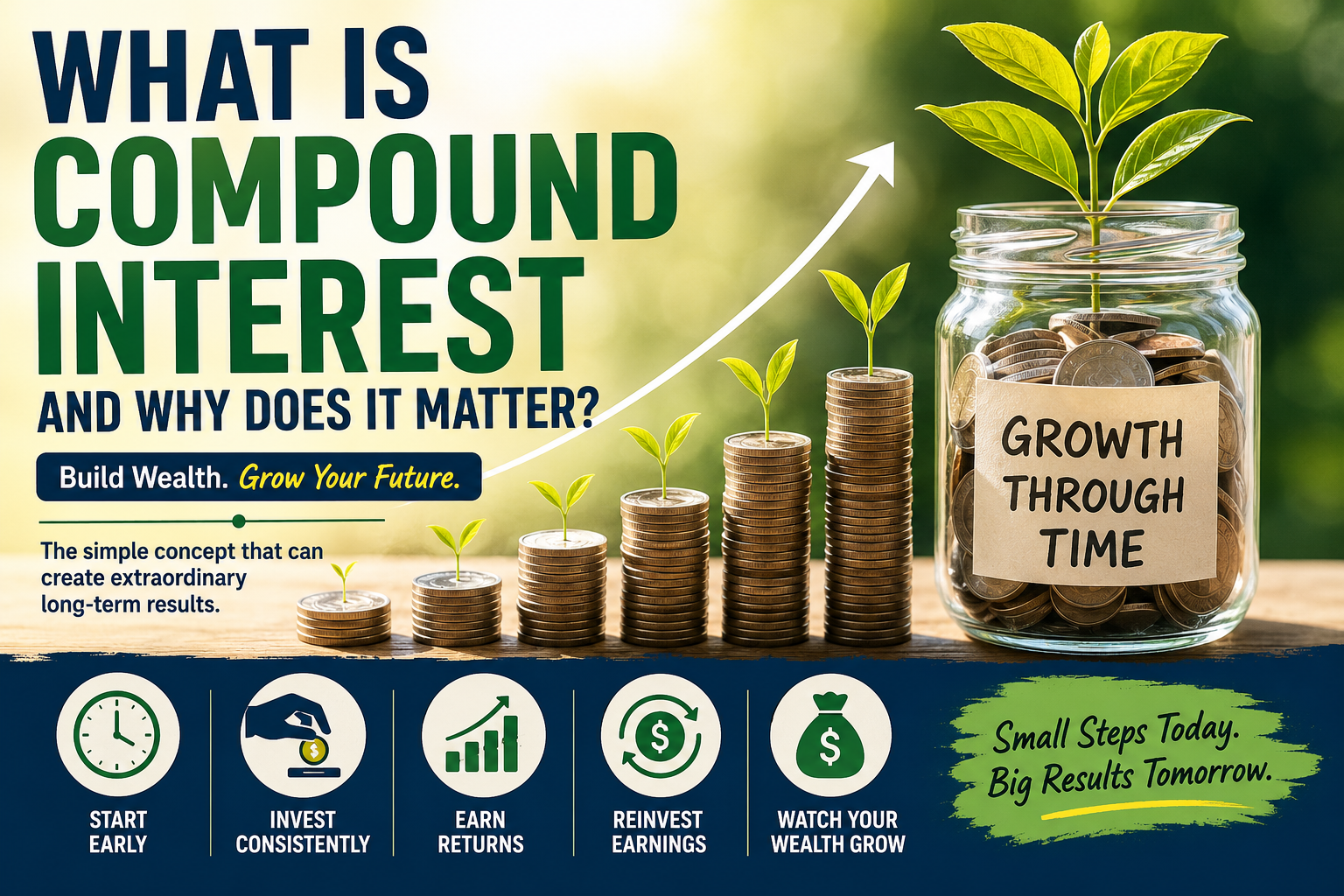
If you’ve spent any time learning about personal finance, investing, or wealth building, you’ve probably heard the term compound interest.
Financial experts frequently describe compound interest as one of the most powerful forces in wealth creation.
Some even refer to it as the “eighth wonder of the world.”
While that may sound like an exaggeration, compound interest has helped countless people grow savings, build investment portfolios, and prepare for retirement.
The challenge is that many beginners don’t fully understand how it works.
At first glance, compound interest can seem like just another financial term.
In reality, it represents a simple concept with extraordinary long-term potential.
Unlike earning money through work alone, compound interest allows your money to begin generating additional money.
Over time, those earnings can generate even more earnings.
This creates a cycle of growth that can become increasingly powerful as the years pass.
One reason many people struggle to appreciate compound interest is that its effects often appear small in the beginning.
The real power emerges over long periods.
This is why investors frequently emphasize:
- Starting early
- Investing consistently
- Remaining patient
Whether your goal is:
- Building wealth
- Saving for retirement
- Growing investments
- Achieving financial independence
understanding compound interest can help you make smarter financial decisions.
In this article, you’ll learn:
- What compound interest is
- How it works
- How it differs from simple interest
- Why time matters so much
- How compound growth affects investing
- Common mistakes to avoid
- Practical ways to benefit from compounding
Most importantly, you’ll discover why compound interest is one of the most valuable tools available to long-term investors.
What Is Compound Interest?
Compound interest is often explained using complicated financial language.
Fortunately, the concept itself is actually quite simple.
At its core, compound interest means earning interest not only on your original money but also on the interest that has already been earned.
This is why compound interest is sometimes described as:
“Interest earning interest.”
The process creates a snowball effect.
As earnings accumulate, future earnings are calculated on a larger and larger amount.
Over time, growth can accelerate.
A Simple Definition
Compound interest occurs when interest or investment earnings are added to the original balance, allowing future earnings to be calculated on both the original amount and previous earnings.
Instead of growth occurring only on your initial investment, growth occurs on an increasingly larger balance.
This is what makes compounding so powerful.
How Compound Interest Works
Many investors use a compound interest calculator to estimate how their money may grow over time under different contribution and return scenarios.
Let’s look at a simple example.
Imagine you invest:
$1,000
and earn:
10%
during the first year.
At the end of the year, your balance becomes:
$1,100
Now the important part happens.
During the second year, earnings are calculated on:
$1,100
instead of the original:
$1,000
This means your earnings become larger because the balance has grown.
Each year, the process repeats.
The larger the balance becomes, the more powerful the growth can be.
Interest on Interest Explained
The phrase “interest on interest” is what makes compound interest different from ordinary growth.
Let’s continue the example.
Year 1
Starting Balance:
$1,000
Ending Balance:
$1,100
Year 2
Starting Balance:
$1,100
Ending Balance:
$1,210
Year 3
Starting Balance:
$1,210
Ending Balance:
$1,331
Notice something important.
The growth amount increases each year even though the percentage remains the same.
That’s because earnings are being generated on previous earnings.
This effect can become dramatic over decades.
Why It Is Different from Simple Interest
Many people assume all interest works the same way.
It doesn’t.
The difference between simple interest and compound interest can have a major impact on long-term results.
Simple interest calculates earnings only on the original amount.
Compound interest calculates earnings on both the original amount and accumulated earnings.
The longer the time period, the larger the difference becomes.
We’ll examine this comparison more closely in the next section.
Real-Life Example
Imagine two friends each save:
$5,000
Both earn the same annual return.
The difference is how their earnings are handled.
Person A
Withdraws earnings every year.
Person B
Leaves earnings invested.
Over time, Person B’s balance begins growing faster because earnings remain invested and continue generating additional earnings.
This illustrates one of the most important principles of wealth building:
Money that remains invested often has greater growth potential than money that is continually withdrawn.
Simple Interest vs Compound Interest
To truly appreciate compound interest, it helps to compare it with simple interest.
Although both involve earning returns, the long-term outcomes can be dramatically different.
Let’s examine each one.
What Is Simple Interest?
Simple interest is calculated only on the original amount of money invested or deposited.
Future earnings do not generate additional earnings.
The growth remains linear.
In other words, the same amount of interest is earned each period.
Example of Simple Interest
Suppose you invest:
$1,000
at:
10% simple interest.
Each year you earn:
$100
After five years:
Year 1 = $1,100
Year 2 = $1,200
Year 3 = $1,300
Year 4 = $1,400
Year 5 = $1,500
Notice that growth remains constant.
The account gains the same amount each year.
What Is Compound Interest?
Compound interest works differently.
Earnings remain invested and continue generating additional earnings.
This creates exponential rather than linear growth.
Example of Compound Interest
Using the same:
$1,000
and:
10% annual growth
Year 1 = $1,100
Year 2 = $1,210
Year 3 = $1,331
Year 4 = $1,464
Year 5 = $1,611
The difference may not seem enormous initially.
However, over longer periods, the gap becomes increasingly significant.
Side-by-Side Comparison
Let’s compare the balances after five years.
Simple Interest
$1,500
Compound Interest
$1,611
The compound interest account already has a larger balance despite starting with the same amount.
Now imagine:
- 10 years
- 20 years
- 30 years
The difference becomes much more substantial.
You’re already investing time in improving your finances, and that’s something to be proud of. Before you continue, download our free 7 Days To Financial Clarity™ workbook and start putting these ideas into action.

Why Compounding Wins Over Time
The true advantage of compound interest is not what happens during the first few years.
It’s what happens over decades.
This is why experienced investors focus so heavily on:
- Time
- Patience
- Consistency
Compounding rewards those who allow their money to remain invested for extended periods.
The longer the time horizon, the more opportunities there are for earnings to generate additional earnings.
This is one reason financial experts frequently encourage people to start investing as early as possible.
Even relatively small amounts can grow significantly when given enough time.
A Key Lesson Before Moving Forward
Many people believe wealth is built through large investments.
While investment size certainly matters, compound interest teaches a different lesson:
Time is often more powerful than amount.
A person who starts investing modestly at an early age may ultimately accumulate more wealth than someone who invests larger amounts but starts much later.
This principle will become even clearer as we explore the factors that drive compound growth in the next section.
Why Compound Interest Matters
Now that you understand how compound interest works, an important question remains:
Why does it matter so much?
After all, earning a little extra interest each year may not sound life-changing.
The answer lies in what happens over long periods of time.
Compound interest is powerful because it allows growth to build upon previous growth.
Instead of starting from scratch every year, your money continues growing on an increasingly larger base.
This creates a cycle that can accelerate wealth building over time.
For many investors, compound interest becomes one of the most important drivers of long-term financial success.
Money Begins Working for You
Most people earn money by exchanging time for income.
They work a job, run a business, freelance, or operate a side hustle.
In each case, income depends largely on effort and time.
Compound interest introduces a different concept:
Your money begins working alongside you.
Instead of relying solely on future earnings from work, your existing money can potentially generate additional earnings.
Over time, those earnings may generate even more earnings.
This is one reason many financially successful people focus not only on increasing income but also on investing and compounding.
Growth Can Accelerate Over Time
One reason compound interest feels unimpressive in the beginning is that growth starts slowly.
The early years may not seem exciting.
However, compounding becomes more powerful as balances increase.
A Simple Illustration
Imagine a small snowball rolling downhill.
At first, it grows slowly.
As it collects more snow, it becomes larger.
The larger it becomes, the faster it can grow.
Compound interest works in a similar way.
Growth builds upon previous growth.
The longer the process continues, the more noticeable the results become.
Small Contributions Can Become Significant
Many people delay investing because they believe they need a large amount of money to get started.
Compound interest suggests otherwise.
Consistency often matters more than size.
Example
Suppose two people invest:
- $100 per month
- $500 per month
Both benefit from compounding.
The person investing more may accumulate wealth faster, but both investors benefit from allowing time and consistency to work together.
This is encouraging because it means wealth building does not necessarily require a large starting balance.
It often begins with a habit.
The Importance of Consistency
Compound interest rewards consistency.
Irregular investing can still be beneficial, but regular contributions often produce stronger long-term results.
This is one reason many investors automate contributions.
By investing consistently, they allow compounding to work continuously.
Why Consistency Matters
Consistent investing:
- Adds new money regularly
- Creates discipline
- Reduces emotional decision-making
- Strengthens long-term growth potential
When combined with patience, consistency can become a powerful wealth-building strategy.
The Three Ingredients of Compound Growth
Compound interest depends on three key factors.
Understanding these factors helps explain why some investments grow faster than others.
The three ingredients are:
- Time
- Consistent Contributions
- Rate of Return
Let’s examine each one.
Ingredient #1: Time
If compound interest had a best friend, it would be time.
Time is often the most important factor influencing long-term growth.
The longer money remains invested, the more opportunities it has to compound.
Why Starting Early Matters
Many people focus on how much money they invest.
While that is important, the timing of when you start investing can be equally important—or even more important.
Starting early gives compounding more years to work.
Those additional years can create dramatic differences in future wealth.
Example
Consider two investors.
Investor A
Starts investing at age:
25
Investor B
Starts investing at age:
35
Both invest the same amount every month.
Investor A benefits from an additional decade of compounding.
That extra time can significantly increase long-term results.
The Key Lesson
You cannot recover lost time.
You can always invest more money later.
You cannot go back and give your investments more years to grow.
This is why starting early is so valuable.
Ingredient #2: Consistent Contributions
Time alone is powerful.
However, combining time with regular contributions can be even more effective.
Consistent contributions increase the amount of money participating in compound growth.
The Power of Regular Investing
Many investors contribute money:
- Monthly
- Biweekly
- With each paycheck
This approach creates a steady flow of new investments.
Each contribution begins its own compounding journey.
Why This Works
Instead of relying entirely on one large investment, you continuously add fuel to the growth process.
Over time, those contributions can become a major driver of wealth accumulation.
A Helpful Perspective
Think of each contribution as planting another seed.
Some seeds have more time to grow than others.
Eventually, many of them may contribute to the overall harvest.
Ingredient #3: Rate of Return
The third ingredient is the rate of return.
This refers to how quickly investments grow.
Higher returns generally create faster growth.
However, they often involve higher levels of risk.
How Returns Affect Growth
Even small differences in return rates can have a significant impact over long periods.
Consider:
- 5% annual growth
- 7% annual growth
- 10% annual growth
Initially, the differences may appear modest.
Over decades, however, the gap can become substantial because of compounding.
Why This Matters
Many investors spend enormous amounts of time searching for extraordinary returns.
Often, a better approach is to:
- Invest consistently
- Remain diversified
- Stay invested for the long term
Compounding can do much of the heavy lifting.
Real-Life Example
Imagine three investors.
Each begins with:
$10,000
and leaves the money invested for many years.
The only difference is the average return achieved.
Although none of them make additional contributions, the investor earning a higher average return experiences faster growth over time.
The longer the investment period, the more noticeable the differences become.
This demonstrates how powerful the combination of time and returns can be.
The Cost of Waiting to Start
One of the most expensive investing mistakes is delaying action.
Many people assume they can start later and simply invest more money.
While larger contributions can help, waiting often comes with a hidden cost:
Lost compounding time.
Let’s see why.
Investor A Starts Early
Investor A begins investing at age:
25
They contribute consistently and allow their investments to grow over time.
The key advantage is not necessarily the amount invested.
The advantage is time.
Every contribution has years or decades available to compound.
Investor B Starts Later
Investor B waits until age:
35
Perhaps they were:
- Busy with other priorities
- Nervous about investing
- Waiting for more money
- Waiting for the perfect time
Eventually they begin investing.
However, they now have fewer years available for compounding.
Comparing the Results
Even if Investor B contributes more money later, Investor A may still accumulate greater wealth because of the additional years of growth.
This surprises many people.
They assume investing more money always produces better outcomes.
In reality, time often plays an equally important role.
The Hidden Cost of Delay
The cost of waiting is rarely visible.
No bill arrives in the mail.
No warning appears.
However, every year spent delaying reduces the amount of time available for compound growth.
This is why financial educators often encourage people to start as soon as reasonably possible.
The earlier compounding begins, the more opportunities it has to work.
The Biggest Lesson
If there is one lesson to remember from this section, it is this:
The best time to start benefiting from compound interest was years ago. The second-best time is today.
You do not need a perfect strategy.
You do not need a large amount of money.
You do not need expert-level investing knowledge.
You simply need to begin.
📈 Watch Your Money Grow
Successful investing isn’t about guessing—it’s about understanding long-term growth. Use our free Investment Growth Calculator to see how regular investing can build wealth over time.

A Key Compound Interest Principle Before Moving Forward
Compound interest rewards three things:
✓ Time
✓ Consistency
✓ Patience
Most people focus on finding the perfect investment.
Compound interest suggests a different path.
Often, the greatest advantage comes not from extraordinary investment choices but from allowing ordinary investments to grow over extraordinary periods of time.
In the next section, we’ll explore how compound interest works in real-world investing, including stocks, ETFs, dividend reinvestment, savings accounts, and retirement planning.
How Compound Interest Works in Investing
When most people hear the term “compound interest,” they immediately think about savings accounts.
While compound interest certainly applies to savings, its greatest wealth-building potential is often found in investing.
This is because investments generally offer greater long-term growth potential than traditional savings products.
When investment earnings remain invested rather than being withdrawn, they can continue generating additional growth year after year.
Over time, this creates a powerful compounding effect.
Let’s explore how compounding works across different types of investments.
Stocks and Compound Growth
Stocks are one of the most common ways investors benefit from compounding.
When you purchase stock, you become a partial owner of a company.
As that company grows, your investment may increase in value.
How Compounding Works with Stocks
Suppose you invest in a company that grows consistently over many years.
As the value of the business increases, the value of your investment may increase as well.
If you leave those gains invested rather than selling, future growth occurs on a larger balance.
This creates compound growth.
Example
Imagine investing:
$5,000
in a stock investment.
Over time, the investment grows.
Rather than withdrawing gains, you leave them invested.
Future growth is then based on:
- Your original investment
- Previous gains
This cycle can continue for years or even decades.
Why Long-Term Investors Benefit
Compounding generally becomes more noticeable over longer periods.
This is one reason many successful investors maintain long-term investment horizons rather than focusing on short-term market movements.
ETFs and Compound Growth
Exchange-Traded Funds (ETFs) have become one of the most popular investment choices for beginners.
They also work extremely well with a compounding strategy.
What Makes ETFs Attractive?
ETFs typically provide:
- Diversification
- Simplicity
- Broad market exposure
- Lower management costs
These characteristics make them appealing to long-term investors.
How Compounding Works with ETFs
When an ETF increases in value, your investment grows.
If earnings remain invested, future growth occurs on the larger balance.
The process is similar to compounding with stocks.
However, ETFs often provide exposure to many companies rather than a single business.
This diversification may help reduce certain risks.
Why Many Beginners Start Here
Many beginner investors appreciate ETFs because they allow them to focus on:
- Consistency
- Long-term growth
- Diversification
rather than trying to identify individual stock winners.
Dividend Reinvestment
Dividend reinvestment is one of the clearest examples of compounding in action.
What Are Dividends?
Some companies distribute a portion of their profits to shareholders.
These payments are known as dividends.
Investors typically have two choices:
Option 1
Receive the dividends as cash.
Option 2
Reinvest the dividends into additional shares.
The second option often creates stronger long-term compounding.
Why Reinvestment Matters
When dividends purchase additional shares, those new shares may generate their own dividends in the future.
This creates a chain reaction:
- Dividends purchase more shares
- More shares generate more dividends
- More dividends purchase even more shares
Over time, the effect can become significant.
Real-Life Example
Imagine an investor who owns shares in a company that pays dividends regularly.
Instead of spending those dividends, the investor reinvests them.
Years later, the portfolio may contain substantially more shares than originally purchased.
Those additional shares continue contributing to future growth.
This is compounding at work.
Long-Term Investing Benefits
Compounding tends to reward investors who remain invested for long periods.
This is why patience is frequently discussed alongside investing.
Why Time Matters
The first few years of investing may not appear dramatic.
Growth often feels slow.
However, as balances increase, future growth occurs on increasingly larger amounts.
This is when compounding becomes more noticeable.
The Snowball Effect
Think of a snowball rolling downhill.
At first it grows slowly.
As it becomes larger, growth accelerates.
Investments often behave similarly.
The longer they remain invested, the more opportunities there are for compound growth.
Key Takeaway
Many investors underestimate how important time can be.
A portfolio that remains invested for decades may benefit from compounding in ways that seem almost impossible during the early years.
How Compound Interest Works in Savings Accounts
Investing is not the only place where compounding occurs.
Savings products can also benefit from compound interest.
However, the growth rate is often lower.
Understanding this distinction can help you decide when savings and investing are most appropriate.
Interest-Bearing Savings Accounts
Many banks offer savings accounts that pay interest on deposits.
As interest is added to the account, future interest calculations may be based on the larger balance.
This creates compound growth.
Example
Suppose you deposit:
$1,000
into a savings account.
The bank pays interest and adds it to your balance.
Future interest is then calculated using the larger amount.
Although growth may be modest, compounding still occurs.
Benefits
Savings accounts generally offer:
- Accessibility
- Stability
- Emergency fund suitability
These characteristics make them useful for short-term financial goals.
High-Yield Savings Accounts
High-yield savings accounts often pay higher interest rates than traditional savings accounts.
As a result, compounding may occur more quickly.
Why They Matter
Many people use high-yield savings accounts for:
- Emergency funds
- Short-term goals
- Cash reserves
The higher interest rate helps money grow while remaining relatively accessible.
Compounding Advantage
Although the growth rate is typically lower than long-term investing, high-yield savings accounts still benefit from interest-on-interest growth.
Certificates of Deposit (CDs)
Certificates of Deposit, commonly known as CDs, are another example of compounding in action.
A CD generally requires money to remain deposited for a specific period.
In exchange, the financial institution pays interest.
Potential Benefits
CDs may offer:
- Predictable returns
- Fixed interest rates
- Reduced volatility
Potential Drawbacks
Money may be less accessible until the CD reaches maturity.
This limits flexibility compared to standard savings accounts.
Why Savings Compound More Slowly
Many people wonder why investing often produces larger long-term balances than savings accounts.
The answer is generally tied to growth rates.
Savings products typically prioritize:
- Stability
- Security
- Accessibility
Investments often prioritize:
- Growth
- Appreciation
- Long-term wealth building
Because of these differences, investing may provide greater compounding potential over long periods.
However, higher potential returns usually involve higher risk.
This is why both savings and investing play important roles in a balanced financial plan.
Compound Interest and Retirement Planning
Retirement planning may be one of the best examples of compound interest in action.
Most retirement strategies rely heavily on the idea that money invested today can continue growing for decades.
The earlier investing begins, the greater the potential impact of compounding.
Why Retirement Accounts Benefit from Compounding
Retirement accounts are often designed for long-term investing.
Because money may remain invested for decades, compounding has substantial time to work.
Why This Matters
A person investing in their twenties may have:
- 30 years
- 40 years
- Or more
before retirement.
Those decades provide numerous opportunities for compound growth.
The Long-Term Advantage
Even modest contributions can become meaningful when given enough time.
This is one reason retirement planning emphasizes consistency rather than perfection.
Starting in Your 20s vs Starting in Your 40s
One of the most powerful illustrations of compounding involves comparing early and late starters.
Investor A
Begins investing in their twenties.
Investor B
Begins investing in their forties.
Both contribute regularly.
Both remain disciplined.
However, Investor A benefits from significantly more years of compounding.
The Result
Investor A may ultimately accumulate considerably more wealth despite contributing similar amounts.
The difference comes from time rather than investment skill.
This example demonstrates why financial educators consistently encourage people to start early.
The Snowball Effect of Long-Term Investing
Compounding often appears slow during the early years.
Then something interesting happens.
Growth begins accelerating.
The balance becomes larger.
Future earnings become larger.
Those larger earnings create even larger future earnings.
The cycle continues.
Why Investors Stay Patient
Many successful investors understand that compounding is front-loaded with patience and back-loaded with results.
The biggest rewards often occur after years of consistency.
A Powerful Reminder
You do not need to become wealthy overnight.
You simply need to give compound growth enough time to work.
A Key Lesson Before Moving Forward
Compound interest appears in many areas of personal finance:
✓ Stocks
✓ ETFs
✓ Dividend investing
✓ Savings accounts
✓ Retirement accounts
The principle remains the same.
Money that remains invested or deposited can continue generating additional growth.
The longer the process continues, the greater the potential impact.
In the next section, we’ll examine the most common mistakes people make with compound interest and explore real-life examples that show how small decisions today can dramatically affect future wealth.
Every financial journey is different. Take our free
Financial Goal Assessment to discover which area deserves your attention first
and receive a clear direction for your next financial milestone.

Common Compound Interest Mistakes
Compound interest is one of the most powerful wealth-building tools available.
However, many people unintentionally reduce its effectiveness through avoidable mistakes.
The good news is that most of these mistakes can be corrected.
Understanding them now can help you maximize the benefits of compounding throughout your financial journey.
Waiting Too Long to Start
Perhaps the most common mistake is delaying action.
Many people believe they need:
- More money
- More knowledge
- Better timing
- Higher income
before they can begin investing.
Unfortunately, waiting often comes at a significant cost.
Why This Matters
Compound interest depends heavily on time.
Every year spent waiting is a year that compounding cannot work on your behalf.
Example
Imagine two people.
One begins investing at age 25.
The other waits until age 35.
Even if both eventually invest the same amount each month, the earlier investor benefits from an additional decade of compounding.
Those extra years can create a substantial difference in long-term wealth.
The Lesson
Starting imperfectly is often better than waiting for perfect conditions.
Withdrawing Earnings Too Early
Another common mistake is removing investment earnings before compounding has time to work.
This can interrupt the growth cycle.
Why Reinvestment Matters
When earnings remain invested, they can generate additional earnings.
When earnings are withdrawn, that future growth potential is reduced.
Example
Suppose an investment earns:
$500
If that money remains invested, it can continue growing.
If it is withdrawn and spent, the compounding process slows.
The Lesson
Whenever practical, allowing earnings to remain invested may increase long-term growth potential.
Investing Inconsistently
Compound interest rewards consistency.
Investors who contribute regularly often benefit more than those who invest sporadically.
Why Consistency Matters
Regular contributions:
- Add new money to the growth process
- Increase invested capital
- Strengthen long-term results
Common Problem
Some investors contribute only when:
- Markets are rising
- They feel confident
- News headlines seem positive
This approach can create gaps in the compounding process.
Better Approach
Develop a consistent investing habit and stick with it regardless of market conditions.
Ignoring Fees
Fees may seem small at first.
However, over long periods they can significantly reduce investment growth.
Why Fees Matter
Every dollar paid in fees is a dollar that cannot continue compounding.
This means the true cost may be larger than it initially appears.
Example
Two investors earn identical returns.
One pays significantly higher fees.
Over decades, the lower-fee investor may accumulate considerably more wealth.
The Lesson
Pay attention to investment costs and understand how fees affect long-term growth.
Chasing Quick Profits
Many people become attracted to investments promising rapid wealth.
Unfortunately, this mindset often conflicts with the principles of compounding.
Why It Happens
People naturally want results quickly.
Social media frequently highlights:
- Overnight success stories
- Massive gains
- Speculative opportunities
These stories receive attention because they are exciting.
The Reality
Most long-term wealth is built through:
- Consistency
- Patience
- Time
- Discipline
rather than quick wins.
The Lesson
Compounding rewards long-term thinking.
Real-Life Examples
The concept of compound interest becomes easier to understand when viewed through practical examples.
Let’s examine three investors and see how different decisions affect long-term outcomes.
Example 1: Small Monthly Contributions
Meet Olivia.
Olivia wants to start investing but believes she doesn’t have enough money.
After learning about compound interest, she decides to invest:
$100 per month
instead of waiting.
What Happens?
Initially, progress appears slow.
However, each contribution begins its own compounding journey.
As years pass:
- Contributions accumulate
- Earnings grow
- Previous earnings generate new earnings
Lesson
Small, consistent contributions can become meaningful over time.
Example 2: Consistent Long-Term Investing
Meet Daniel.
Daniel begins investing regularly in his thirties.
Rather than trying to predict market movements, he focuses on:
- Consistency
- Diversification
- Long-term growth
He continues investing during:
- Bull markets
- Bear markets
- Economic uncertainty
What Happens?
Over time, Daniel benefits from:
- Compound growth
- Market recoveries
- Increasing investment balances
Lesson
Consistency often outperforms attempts to perfectly time the market.
Example 3: The Late Starter
Meet Karen.
Karen spends years telling herself she’ll start investing later.
She eventually begins, but much later than originally planned.
What Happens?
Karen still benefits from investing.
However, she has fewer years available for compounding.
To reach similar goals, she may need to:
- Invest more money
- Save more aggressively
- Accept a longer timeline
Lesson
The cost of waiting can be substantial.
Time is often one of the most valuable investing assets available.
Compound Interest Myths Debunked
Compound interest is widely discussed, but several misconceptions continue to prevent people from taking advantage of it.
Let’s address some of the most common myths.
You Need a Lot of Money to Benefit
This myth discourages many beginners.
Reality
Compound interest works regardless of account size.
Larger balances may grow faster, but even small amounts can benefit from compounding.
The most important step is getting started.
Compound Interest Makes You Rich Quickly
This misconception often leads to disappointment.
Reality
Compounding is powerful precisely because it works over long periods.
The process usually begins slowly.
Growth becomes more noticeable after years of consistency.
Important Reminder
Compound interest is a long-term wealth-building tool, not a get-rich-quick strategy.
Only Investors Benefit from Compounding
Many people assume compound interest only applies to investing.
Reality
Compounding can occur in:
- Savings accounts
- Retirement accounts
- Certificates of Deposit
- Dividend-paying investments
The principle applies wherever earnings remain invested and continue generating additional earnings.
It’s Too Late for Me to Start
This is one of the most damaging myths.
Reality
Starting earlier is generally better.
However, starting later is still usually better than never starting at all.
Every year invested creates an opportunity for growth.
The Lesson
Focus on what you can do today rather than regretting what you didn’t do yesterday.
How to Start Benefiting from Compound Interest Today
Understanding compound interest is valuable.
Taking action is even more valuable.
Fortunately, benefiting from compounding does not require complicated strategies.
Simple actions taken consistently can make a significant difference over time.
Build an Emergency Fund
Before investing aggressively, establish financial stability.
An emergency fund can help prevent the need to withdraw investments during unexpected situations.
This protects the compounding process.
Begin Investing Consistently
You do not need a large amount of money to start.
The important thing is developing the habit of investing regularly.
Consistency creates momentum.
Reinvest Earnings
Whenever possible, consider allowing earnings to remain invested.
This gives compound growth additional opportunities to work.
Examples include:
- Dividend reinvestment
- Interest reinvestment
- Long-term portfolio growth
Increase Contributions Over Time
As income increases, consider increasing investment contributions.
Sources of additional income may include:
- Salary increases
- Side hustles
- Freelancing
- Online businesses
- Make-money-online opportunities
Even small increases can have meaningful long-term effects.
Stay Patient
Patience may be the most overlooked ingredient of compound growth.
Many investors quit too early because results appear slow.
The greatest benefits of compounding often occur after years of consistency.
Trust the process.
A Key Lesson Before Moving Forward
Compound interest is not complicated.
The challenge is not understanding it.
The challenge is giving it enough time to work.
People who benefit most from compounding often share a few common traits:
✓ They start.
✓ They stay consistent.
✓ They remain patient.
✓ They think long term.
In the final section, we’ll connect compound interest to wealth building, retirement planning, and make-money-online income streams before wrapping up with practical checklists, FAQs, and final takeaways.
Why Compound Interest and Make Money Online Work Together
Most people think of earning money and investing money as separate activities.
In reality, they are closely connected.
The more income you generate, the more opportunities you have to invest and benefit from compound growth.
This is why many financially successful people focus on both increasing income and investing consistently.
Income provides the fuel.
Compound interest helps that fuel create long-term wealth.
Using Side Hustle Income to Accelerate Compounding
One of the fastest ways to increase investing contributions is to generate additional income.
Examples include:
- Freelancing
- Blogging
- Content creation
- Consulting
- Virtual assistance
- Selling digital products
- Other online business opportunities
Rather than spending all of that extra income, investing a portion of it can significantly increase the amount participating in compound growth.
Example
Suppose someone earns:
$300 per month
through a side hustle.
Instead of spending the entire amount, they invest it consistently.
Over time, those contributions begin generating their own growth, which can then generate even more growth through compounding.
The side hustle provides the income.
Compound interest helps multiply its long-term impact.
Turning Extra Income into Long-Term Wealth
Many people focus heavily on earning more money but overlook what happens after the money is earned.
Income alone does not automatically create wealth.
Wealth is often created when income is:
- Earned
- Saved
- Invested
- Allowed to compound
This is one reason investing and income growth work so well together.
The more income available for investing, the more powerful compounding can become over time.
The Wealth-Building Formula
A simple formula to remember is:
Earn More → Save More → Invest More → Compound More → Build More Wealth
Each step supports the next.
Additional income creates opportunities to invest.
Investing creates opportunities for compound growth.
Compound growth helps build long-term wealth.
This is why increasing income and investing consistently are often viewed as complementary financial strategies rather than competing goals.
Beginner Compound Interest Checklist
Understanding compound interest is important.
Applying it is what creates results.
Use this checklist as a practical guide.
Before You Start
✓ Create a basic budget
✓ Build an emergency fund
✓ Address high-interest debt
✓ Learn the fundamentals of investing
✓ Set clear financial goals
✓ Commit to long-term thinking
During Your First Year
✓ Open an investment or savings account
✓ Begin contributing consistently
✓ Reinvest earnings whenever possible
✓ Avoid emotional financial decisions
✓ Continue learning about investing
✓ Focus on progress rather than perfection
Long-Term Habits
✓ Stay invested
✓ Increase contributions when income grows
✓ Review goals annually
✓ Maintain diversification
✓ Ignore short-term market noise
✓ Allow compounding time to work
✓ Remain patient during market fluctuations
Final Thoughts
Compound interest may seem like a simple concept, but its impact can be extraordinary.
It allows money to generate earnings and then allows those earnings to generate additional earnings.
Over time, this creates a powerful cycle of growth.
The most important lesson is that compound interest rewards:
- Time
- Consistency
- Patience
Many people believe wealth is built through large investments or perfect timing.
More often, wealth is built through small actions repeated consistently over long periods.
This is why financial experts frequently encourage people to start as early as possible.
You do not need a large amount of money.
You do not need to become an investing expert overnight.
You do not need to predict the future.
You simply need to begin.
Whether you are:
- Saving for retirement
- Building an investment portfolio
- Growing wealth
- Investing side hustle income
- Pursuing financial independence
compound interest can become one of your most valuable financial allies.
The sooner you start, the more opportunities your money has to grow.
And when it comes to compound interest, time is often your greatest advantage.
Frequently Asked Questions
What is compound interest?
Compound interest is the process of earning interest or investment growth on both your original money and previously earned interest or gains.
How does compound interest work?
As earnings are added to an account or investment, future earnings are calculated on the larger balance. This creates a cycle where growth builds upon previous growth.
What is the difference between simple and compound interest?
Simple interest is calculated only on the original amount. Compound interest is calculated on the original amount plus accumulated earnings.
Why is compound interest important?
Compound interest allows money to grow faster over time because earnings continue generating additional earnings.
How much money do I need to start benefiting from compound interest?
There is no minimum amount required to benefit from compounding. Consistency and time are often more important than starting balance.
Does compound interest work with stocks?
Yes. Compound growth can occur when investment gains and dividends remain invested and continue generating future growth.
How often does compound interest compound?
The frequency depends on the account or investment. Some accounts compound daily, monthly, quarterly, or annually.
Can compound interest help with retirement planning?
Yes. Retirement investing often relies heavily on compound growth because investments may remain invested for several decades.
Is it too late to start investing?
Starting earlier is generally better, but beginning today is usually better than continuing to wait.
What is the biggest mistake people make with compound interest?
One of the most common mistakes is delaying action and losing valuable years that could have been used for compounding.
🚀 Ready To Keep Going?
You have invested time learning today. Now take the next step by downloading our free 7 Days To Financial Clarity™ workbook and begin building a stronger financial future.
