
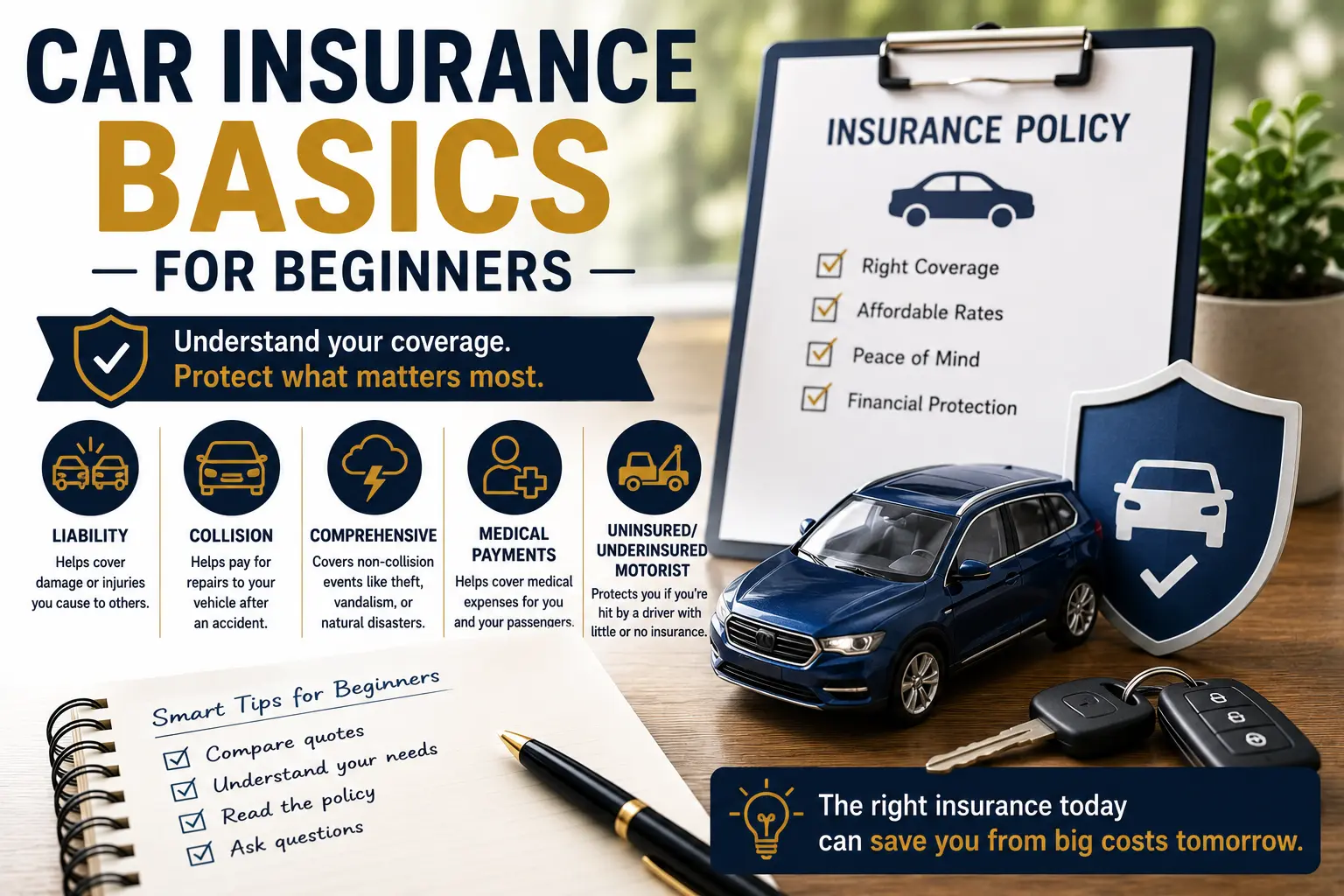
Buying your first car is exciting.
Whether it’s a brand-new vehicle, a reliable used car, or the family car you’re finally responsible for insuring, becoming a vehicle owner brings new opportunities—and new responsibilities.
One of the biggest responsibilities is understanding car insurance.
For many beginners, car insurance can feel confusing. Insurance companies use terms like premium, deductible, liability, collision coverage, and comprehensive coverage, making it difficult to know what you’re actually paying for.
Because of this confusion, many people simply choose the cheapest policy they can find without understanding what it covers—or doesn’t cover.
Unfortunately, that decision can become expensive after an accident.
Car insurance isn’t just another monthly bill.
It’s designed to help protect you financially when unexpected events occur.
A well-chosen policy can help pay for:
- Damage to your vehicle.
- Damage you cause to someone else’s property.
- Medical expenses resulting from an accident.
- Legal liability in certain situations.
- Theft or vandalism.
- Weather-related damage.
- Other covered losses outlined in your policy.
Without insurance—or with inadequate coverage—you could be responsible for paying thousands of dollars out of your own pocket after an accident.
Understanding how car insurance works allows you to make informed decisions that protect both your vehicle and your financial future.
In this guide, you’ll learn:
- What car insurance is.
- Why it’s important.
- The different types of coverage.
- How premiums are determined.
- Ways to lower insurance costs.
- Common mistakes beginners make.
- Practical tips for choosing coverage that fits your needs.
By the end of this article, you’ll have a solid understanding of car insurance and feel more confident making insurance decisions that support your overall financial goals.
💡 Action Moment: Start With Your Overall Financial Picture
Before choosing a car insurance policy, it’s helpful to understand how vehicle ownership fits into your overall financial life.
Owning a car involves more than just monthly insurance premiums.
You may also need to budget for:
- Fuel.
- Maintenance.
- Registration fees.
- Repairs.
- Parking.
- Loan payments.
- Emergency expenses.
If you’re unsure where your money is currently going, start by downloading 7 Days to Financial Clarity™.
This free guide helps you organize your finances, identify spending patterns, and build a stronger financial foundation before taking on major financial commitments like vehicle ownership.
When you understand your finances, choosing the right insurance coverage becomes much easier.
What Is Car Insurance?
Car insurance is a legal contract between you and an insurance company.
In exchange for paying a monthly or annual premium, the insurance company agrees to help cover certain financial losses if a covered event occurs.
These events may include:
- Traffic accidents.
- Vehicle theft.
- Fire.
- Storm damage.
- Vandalism.
- Injuries caused during an accident.
- Damage to another person’s property.
Exactly what is covered depends on the policy you purchase and the terms of your insurance contract.
Think of insurance as a way of sharing financial risk.
Instead of one driver bearing the full cost of a major accident alone, many policyholders contribute premiums into a larger pool. When covered losses occur, the insurer uses those funds to help pay eligible claims according to the policy.
This system helps protect individuals from financial losses that might otherwise be difficult to manage on their own.
Why Is Car Insurance Important?
Many people think of car insurance simply because it’s required by law in many places.
While legal requirements are important, insurance serves a much larger purpose.
Its primary role is financial protection.
An accident can happen in a matter of seconds, but the financial consequences may last much longer.
Depending on the situation, costs could include:
- Vehicle repairs.
- Medical treatment.
- Legal expenses.
- Damage to another person’s property.
- Towing and storage fees.
- Temporary transportation costs.
Without insurance, these expenses could place significant strain on your finances.
Having appropriate coverage provides a measure of financial stability during an already stressful situation.
It Helps Protect Other People Too
Car insurance doesn’t only protect you.
Many policies also provide coverage if you’re legally responsible for causing injury to another person or damaging someone else’s property.
For example, if you accidentally collide with another vehicle, liability coverage may help pay for covered damages up to your policy limits.
This protection benefits everyone involved by helping ensure that financial responsibility doesn’t fall entirely on one individual.
It Can Protect Your Savings
Imagine you’ve spent years building an emergency fund and saving toward important goals such as buying a home or preparing for retirement.
A serious accident without adequate insurance could force you to use those savings to cover unexpected expenses.
Appropriate insurance coverage helps reduce the likelihood that one unforeseen event will derail years of financial progress.
How Car Insurance Works
Although insurance policies can vary, the basic process is fairly straightforward.
Step 1: Purchase a Policy
You choose an insurance policy based on your needs and agree to pay a premium.
Your premium may be paid:
- Monthly.
- Quarterly.
- Semi-annually.
- Annually.
Step 2: Your Coverage Begins
Once your policy becomes active and your premium requirements are met, you’re protected for the coverages outlined in your contract.
It’s important to review your policy carefully so you understand:
- What is covered.
- What isn’t covered.
- Your deductibles.
- Coverage limits.
- Any exclusions or conditions.
Step 3: A Covered Loss Occurs
If you’re involved in a covered accident or another covered event, you notify your insurance company and begin the claims process.
The insurer investigates the claim and determines what your policy covers based on its terms and conditions.
Step 4: The Claim Is Processed
If the claim is approved, the insurer helps pay covered expenses according to your policy.
Depending on the type of claim, this may involve:
- Repairing your vehicle.
- Paying medical expenses.
- Compensating another party for covered damages.
- Reimbursing other covered losses.
The amount paid depends on your coverage limits, deductible, and the specific circumstances of the claim.
Important Car Insurance Terms Every Beginner Should Know
Insurance becomes much less intimidating once you understand a few key terms.
Premium
Your premium is the amount you pay to keep your insurance policy active.
It may be paid monthly or annually, depending on your policy.
Several factors influence your premium, including your driving history, the type of vehicle you drive, where you live, and the coverage you choose.
Deductible
A deductible is the amount you’re responsible for paying out of pocket before your insurance coverage begins paying for certain covered claims.
For example, if you have a $500 deductible and a covered repair costs $2,000, you would generally pay the first $500, while your insurer would pay the remaining covered amount according to your policy terms.
Choosing a higher deductible often lowers your premium, but it also means you’ll need more savings available if you need to file a claim.
Coverage Limit
Your coverage limit is the maximum amount your insurance company will pay for a covered loss under your policy.
Different parts of your policy may have different limits.
Understanding these limits helps ensure you have adequate financial protection.
Claim
A claim is a formal request you submit to your insurance company after a covered event.
The insurance company reviews the details, determines whether the event is covered under your policy, and processes payment if appropriate.
Policy
Your policy is the legal agreement that outlines:
- Your coverages.
- Your responsibilities.
- The insurer’s responsibilities.
- Coverage limits.
- Deductibles.
- Exclusions.
- Conditions for making a claim.
Reading your policy carefully helps you understand what protection you’ve purchased.
Why Understanding These Terms Matters
Many insurance misunderstandings happen because people purchase policies without fully understanding the language.
Taking a little time to learn these basic terms can make it much easier to compare policies, ask informed questions, and choose coverage that fits both your needs and your budget.
You’re already investing time in improving your finances, and that’s something to be proud of. Before you continue, download our free 7 Days To Financial Clarity™ workbook and start putting these ideas into action.

Types of Car Insurance Coverage
One of the biggest misconceptions about car insurance is that every policy provides the same level of protection.
In reality, car insurance is made up of different types of coverage, each designed to protect you against specific financial risks.
Some cover damage to your own vehicle.
Others help pay for injuries or property damage you cause to other people.
Some cover events that have nothing to do with a collision at all.
Understanding these coverages makes it much easier to compare policies and choose protection that fits your needs.
Let’s look at the most common types of car insurance coverage.
Liability Coverage
Liability coverage is one of the most important parts of a car insurance policy.
In many states and provinces, it’s also required by law.
Liability insurance helps protect you financially if you’re legally responsible for causing an accident that injures another person or damages their property.
Instead of paying those expenses entirely out of your own pocket, your liability coverage may help pay covered costs up to the limits of your policy.
Liability coverage generally has two main components.
Bodily Injury Liability
This coverage may help pay for expenses related to injuries suffered by other people if you’re legally responsible for an accident.
Depending on your policy, this could include covered costs such as:
- Medical treatment
- Rehabilitation
- Lost income
- Legal defense, when applicable
- Settlements or judgments, subject to policy limits
Keep in mind that policy limits apply, meaning your insurer will only pay up to the maximum amounts outlined in your policy.
Property Damage Liability
Property damage liability helps cover damage you cause to someone else’s property.
Examples include:
- Another person’s vehicle
- Fences
- Mailboxes
- Buildings
- Utility poles
- Garage doors
Without adequate liability coverage, you could be personally responsible for paying these costs if they exceed your policy limits.
Collision Coverage
Collision coverage helps pay to repair or replace your own vehicle if it’s damaged in a covered collision.
This generally applies regardless of who was responsible for the accident, although the exact claims process varies depending on your insurer and local laws.
Examples include:
- Hitting another vehicle
- Striking a guardrail
- Backing into a pole
- Rolling your vehicle
Collision coverage usually requires you to pay your deductible before insurance contributes toward covered repairs.
Comprehensive Coverage
Despite its name, comprehensive coverage doesn’t mean “everything.”
Instead, it generally protects your vehicle against certain non-collision events.
Examples may include:
- Theft
- Fire
- Falling trees
- Hail damage
- Flooding
- Vandalism
- Animal collisions
- Windstorms
For many people, comprehensive coverage provides valuable protection against risks that are difficult to predict.
Like collision coverage, it typically includes a deductible.
Personal Injury Protection (PIP)
Depending on where you live, Personal Injury Protection (often called PIP) may be available or required.
PIP can help pay certain medical expenses for you and your passengers after a covered accident, regardless of who caused it.
Depending on the policy and local regulations, it may also help with expenses such as:
- Rehabilitation
- Lost wages
- Essential services during recovery
- Funeral expenses in covered situations
Availability and requirements vary by state or province, so it’s important to review your local insurance rules.
Medical Payments Coverage
Medical Payments Coverage—sometimes called MedPay—is another type of protection available in some areas.
It generally helps pay certain medical expenses for you and your passengers following a covered accident.
Unlike health insurance, MedPay is designed specifically for medical costs resulting from automobile accidents and typically has defined coverage limits.
Whether this coverage is available depends on where you live and your insurer’s offerings.
Uninsured Motorist Coverage
Not every driver carries insurance, even where it’s legally required.
If you’re involved in an accident caused by an uninsured driver, uninsured motorist coverage may help protect you from bearing all of the financial costs yourself.
Depending on your policy, this coverage may help pay for:
- Medical expenses
- Lost income
- Other covered damages
Without this protection, recovering costs from an uninsured driver can be difficult.
Underinsured Motorist Coverage
Sometimes the other driver has insurance—but not enough.
If the costs from an accident exceed the other driver’s policy limits, underinsured motorist coverage may help bridge part of the gap, subject to your own policy terms.
This can become especially important when serious injuries or extensive property damage are involved.
Roadside Assistance
Many insurers offer optional roadside assistance coverage.
Although it isn’t designed to cover accident damage, it can be extremely helpful during everyday driving emergencies.
Services often include:
- Towing
- Battery jump-starts
- Flat tire assistance
- Fuel delivery
- Lockout assistance
- Minor roadside repairs
For drivers who travel frequently or own older vehicles, this optional coverage may provide added peace of mind.
Rental Reimbursement Coverage
If your vehicle is being repaired after a covered claim, rental reimbursement coverage may help pay for the cost of a temporary rental vehicle.
Without this optional coverage, you may need to pay those transportation costs yourself.
If you rely on your vehicle every day for work, school, or family responsibilities, this coverage may be worth considering.
How Much Car Insurance Do You Need?
One of the most common questions beginners ask is:
“How much insurance should I buy?”
Unfortunately, there isn’t a single answer that works for everyone.
The right amount of coverage depends on your personal financial situation, your vehicle, and the level of financial protection you’re comfortable with.
While many jurisdictions require minimum levels of liability coverage, minimum legal requirements aren’t always sufficient to protect your finances after a serious accident.
Instead of asking only:
“What’s the cheapest policy I can buy?”
Consider asking:
“What level of financial protection would help me recover from an unexpected accident without creating unnecessary financial hardship?”
That shift in thinking often leads to better long-term decisions.
Consider the Value of Your Vehicle
If you own a newer or more valuable vehicle, repairing or replacing it could be expensive.
In many cases, drivers choose additional coverages such as collision or comprehensive insurance to help protect that investment.
On the other hand, if your vehicle is older and has a relatively low market value, the cost of certain optional coverages may outweigh the potential benefit.
The decision depends on your individual circumstances and your ability to absorb potential repair or replacement costs.
Think About Your Financial Situation
Insurance isn’t just about protecting your vehicle.
It’s also about protecting your finances.
Ask yourself questions like:
- Could I comfortably pay a large repair bill out of pocket?
- Would I be able to replace my vehicle without insurance assistance?
- How much could I afford if I had to pay a deductible tomorrow?
- Would a major accident significantly disrupt my financial goals?
Answering these questions honestly can help you choose coverage that fits both your budget and your financial priorities.
Review Your Driving Habits
Your daily driving routine can also influence the type of coverage that’s appropriate.
For example, consider:
- How many miles you drive each year.
- Whether you commute daily.
- Where you usually park your vehicle.
- Local weather conditions.
- Traffic patterns in your area.
Someone who drives long distances every day may face different risks than someone who only uses their vehicle occasionally.
💡 Action Moment: Choose Coverage That Supports Your Financial Goals
Car insurance shouldn’t be viewed as a standalone financial decision.
It should fit within your broader financial plan.
Before selecting your coverage, take a few minutes to complete the LookingAtFinance Financial Goal Assessment.
Understanding your current financial priorities can help you make more confident insurance decisions.
For example:
- If your goal is financial security, you may prioritize stronger protection against unexpected expenses.
- If you’re saving for a home, you may want to balance comprehensive coverage with an affordable monthly budget.
- If you’re focused on becoming debt-free, you may look for ways to reduce insurance costs without sacrificing essential protection.
- If you’re building your first long-term financial plan, choosing coverage you understand—and can comfortably afford—may help you stay on track.
When your insurance choices align with your financial goals, you’re not just protecting your vehicle—you’re protecting the progress you’re making toward a more secure financial future.
Remember: The Cheapest Policy Isn’t Always the Best Value
It’s natural to want to save money on insurance.
However, choosing the lowest premium without understanding the coverage can leave you exposed to significant financial risk if an accident occurs.
A policy that costs slightly more each month may provide substantially better protection when you need it most.
Instead of comparing price alone, compare:
- Coverage types.
- Coverage limits.
- Deductibles.
- Exclusions.
- Optional benefits.
- Customer service and claims reputation.
The goal isn’t simply to spend less.
The goal is to purchase protection that gives you confidence without stretching your budget.
Life is full of unexpected expenses, but being prepared can make all the difference. Use our free Emergency Fund Calculator to discover how much you should save and create a financial cushion that gives you greater peace of mind when life throws you a surprise.

What Affects Your Car Insurance Premium?
One of the first questions many new drivers ask is:
“Why does my friend pay less for car insurance than I do?”
The answer is that insurance companies consider many different factors when calculating premiums.
Their goal is to estimate the level of risk associated with insuring a particular driver and vehicle.
Although every insurer uses its own pricing model and local regulations can vary, several common factors often influence the cost of coverage.
Understanding these factors can help you make informed decisions and identify opportunities to reduce your insurance costs over time.
Your Driving Record
Your driving history is one of the most significant factors that insurers consider.
Drivers with a history of safe driving may qualify for lower premiums because they are generally viewed as presenting a lower level of risk.
On the other hand, insurers may charge higher premiums if your record includes:
- At-fault accidents.
- Speeding tickets.
- Reckless driving violations.
- Driving under the influence (DUI/DWI), where applicable.
- Frequent traffic violations.
Maintaining safe driving habits not only protects you and others on the road—it may also help reduce your insurance costs over time.
Your Age and Driving Experience
Newer drivers often pay higher premiums than experienced drivers.
This isn’t because younger drivers are automatically unsafe, but because insurance pricing is based on statistical risk, and less driving experience is often associated with a higher likelihood of claims.
As you gain experience and maintain a safe driving record, your insurance costs may decrease.
Where You Live
Location can also affect insurance premiums.
Insurance companies may consider factors such as:
- Local traffic density.
- Weather patterns.
- Vehicle theft rates.
- Accident frequency.
- Repair costs in the area.
For example, drivers in busy urban areas may face different insurance costs than those living in smaller towns or rural communities.
The Vehicle You Drive
Not all vehicles cost the same to insure.
Several characteristics can influence your premium, including:
- Vehicle value.
- Repair costs.
- Availability of replacement parts.
- Safety features.
- Theft rates.
- Engine performance.
A vehicle with advanced safety features may cost less to insure than a similar model with fewer safety technologies, while luxury or high-performance vehicles often have higher repair or replacement costs.
How Much You Drive
Insurance companies often ask about your annual mileage.
Generally speaking, the more time you spend on the road, the greater your exposure to potential accidents.
Someone who drives a few thousand miles each year may present a different risk profile than someone who commutes long distances every day.
Providing an accurate estimate of your annual mileage helps ensure your policy reflects your actual driving habits.
Your Coverage Choices
The level of protection you choose also affects your premium.
Policies that include additional coverages—such as collision or comprehensive insurance—typically cost more than policies that include only the minimum required coverage.
However, paying a slightly higher premium may provide significantly greater financial protection after an accident or other covered event.
The goal is to balance affordability with adequate protection.
Your Deductible
Your deductible and your premium usually work together.
In many cases:
- Choosing a higher deductible can lower your monthly premium.
- Choosing a lower deductible often results in a higher premium.
Before selecting a higher deductible to save money each month, ask yourself an important question:
“If I had an accident tomorrow, could I comfortably afford to pay this deductible?”
If the answer is no, a lower deductible may provide greater financial security—even if it costs a little more each month.
Claims History
Insurance companies may also review your previous claims history.
Drivers who file frequent claims may be viewed differently than those with fewer claims, although the impact varies depending on the type of claim, the insurer, and local regulations.
Rather than avoiding legitimate claims, focus on driving safely and using your insurance appropriately when covered losses occur.
Practical Ways to Save Money on Car Insurance
Everyone wants affordable insurance.
The good news is that lowering your premium doesn’t always mean sacrificing valuable protection.
Here are several practical strategies that may help reduce your insurance costs.
Compare Quotes From Multiple Insurers
Insurance companies use different pricing models.
Because of this, two insurers may offer very different premiums for similar coverage.
Comparing several quotes before purchasing a policy can help you understand your options and identify the best overall value.
When comparing quotes, make sure you’re comparing similar:
- Coverage types.
- Coverage limits.
- Deductibles.
- Optional benefits.
The lowest price isn’t always the best choice if the coverage is significantly different.
Ask About Available Discounts
Many insurers offer discounts that drivers don’t realize they’re eligible for.
Examples may include discounts for:
- Safe driving.
- Completing approved driver education programs.
- Bundling multiple insurance policies.
- Installing anti-theft devices.
- Low annual mileage.
- Certain occupations or professional associations, where available.
- Good students, where offered.
Since discounts vary by insurer, it’s worth asking what options may apply to your situation.
Review Your Policy Every Year
Your insurance needs can change over time.
For example:
- You may move to a different neighborhood.
- Your vehicle may lose value.
- You may drive fewer miles.
- Your financial situation may improve.
- New discounts may become available.
Reviewing your policy annually helps ensure you’re not paying for coverage that no longer fits your needs while confirming that important protections remain in place.
Drive Safely
Safe driving benefits more than your personal safety.
Avoiding accidents and traffic violations can also contribute to lower insurance costs over time.
Simple habits make a difference:
- Obey speed limits.
- Avoid distracted driving.
- Leave adequate following distance.
- Drive according to weather conditions.
- Never drive while impaired.
These habits help reduce both financial risk and the likelihood of serious accidents.
Bundle Insurance Policies
Many insurance companies offer discounts when customers purchase more than one policy from the same insurer.
For example, you may be able to combine:
- Auto insurance.
- Homeowners insurance.
- Renters insurance.
- Condo insurance.
- Life insurance.
While bundling can reduce costs, compare the total value—not just the discount—to make sure the combined policies still meet your needs.
Increase Your Deductible Carefully
Increasing your deductible can lower your premium.
However, only choose a deductible you could realistically afford if you needed to file a claim tomorrow.
Saving $15 or $20 per month isn’t worthwhile if you would struggle to pay a much larger deductible after an accident.
Balancing affordability today with financial preparedness tomorrow is often the wiser approach.
💡 Action Moment: Could You Afford Your Deductible Tomorrow?
Many drivers focus on lowering their monthly premium without considering one important question:
If your vehicle were damaged tomorrow, could you comfortably pay your deductible?
Even with excellent insurance, you’ll often still be responsible for your deductible before your insurer begins paying covered repair costs.
That’s why building an emergency fund is an important part of responsible vehicle ownership.
Use the LookingAtFinance Emergency Fund Calculator to estimate how much emergency savings you may want to set aside for unexpected expenses such as:
- Insurance deductibles.
- Temporary transportation.
- Minor repairs not covered by insurance.
- Emergency travel.
- Other unexpected financial setbacks.
Having dedicated emergency savings can reduce financial stress and help you recover more quickly when the unexpected happens.
What Should You Do After a Car Accident?
Being involved in an accident can be stressful, even if it’s minor.
Knowing what to do ahead of time can help you stay calm and protect both your safety and your insurance claim.
1. Check for Injuries
Your first priority should always be the safety of everyone involved.
If anyone is injured, contact emergency services immediately and follow the instructions of first responders.
Do not move injured individuals unless it’s necessary to avoid immediate danger.
2. Move to Safety If Possible
If it’s safe to do so and local laws allow, move your vehicle out of the flow of traffic to help reduce the risk of additional collisions.
Turn on your hazard lights and remain aware of your surroundings.
3. Exchange Information
After ensuring everyone’s safety, exchange information with the other driver.
Typical information includes:
- Names.
- Contact information.
- Driver’s license details.
- Insurance company.
- Policy number.
- Vehicle registration information.
Remain calm and courteous during the conversation.
Avoid discussing fault at the scene, as determining responsibility may require additional investigation.
4. Document the Scene
If it’s safe, gather information that may assist with your insurance claim.
This can include:
- Photos of vehicle damage.
- Photos of the surrounding area.
- Road conditions.
- Traffic signs or signals.
- Witness contact information, if available.
The more accurate documentation you have, the easier it may be to explain what occurred.
5. Contact Your Insurance Company
Notify your insurer as soon as reasonably possible after the accident.
They’ll explain the claims process, request any necessary documentation, and guide you through the next steps based on your policy.
Providing accurate and timely information can help your claim move forward more efficiently.
How the Insurance Claims Process Typically Works
Although each insurer has its own procedures, the claims process often follows a similar pattern.
Step 1
Report the accident to your insurance company.
Step 2
Provide requested information and documentation.
Step 3
An insurance representative reviews the claim and evaluates the available information.
Step 4
If the loss is covered under your policy, the insurer determines the amount payable according to your coverage, deductibles, and policy limits.
Step 5
Repairs, reimbursements, or other covered payments are arranged based on the outcome of the claim.
Understanding this general process before an accident occurs can make the experience less overwhelming if you ever need to file a claim.
Insurance Is Just One Part of Financial Protection
Having the right insurance policy is an important step toward protecting your finances.
However, insurance works best when it’s part of a broader financial plan that also includes:
- Responsible budgeting.
- Regular savings.
- An emergency fund.
- Reviewing your coverage as your life changes.
- Understanding the protection you’ve purchased.
When these pieces work together, you’re better prepared not only for accidents but for many of life’s unexpected financial challenges.
Every financial journey is different. Take our free
Financial Goal Assessment to discover which area deserves your attention first
and receive a clear direction for your next financial milestone.

Common Car Insurance Mistakes Beginners Should Avoid
Buying car insurance for the first time can feel overwhelming.
Because there are so many coverage options, pricing differences, and unfamiliar terms, it’s easy to make decisions that seem like good deals today but could become costly later.
Fortunately, many of the most common mistakes can be avoided with a little knowledge and planning.
Buying the Cheapest Policy Without Understanding the Coverage
Everyone wants to save money.
However, choosing the lowest-priced policy without understanding what it includes can leave you financially exposed after an accident.
For example, a cheaper policy may have:
- Lower liability limits.
- Fewer optional coverages.
- Higher deductibles.
- More exclusions.
Before purchasing a policy, compare more than just the monthly premium.
Take time to understand exactly what protection you’re buying.
Choosing a Deductible You Can’t Afford
A higher deductible often lowers your monthly premium.
While that can seem attractive, it also means you’ll need to pay more out of pocket before your insurance begins covering eligible repair costs.
If paying a $1,000 deductible would create financial hardship, selecting that deductible simply to save a few dollars each month may not be the best decision.
Choose a deductible that fits comfortably within your emergency savings and monthly budget.
Not Reviewing Your Policy
Many people purchase insurance and never look at the policy again.
However, your insurance needs may change over time.
For example:
- You purchase a different vehicle.
- You move to a new location.
- Your annual mileage changes.
- You get married.
- You add another driver to your policy.
- You qualify for additional discounts.
Reviewing your coverage each year helps ensure your policy continues to meet your needs.
Letting Your Coverage Lapse
Missing premium payments or allowing your policy to expire can leave you without insurance protection.
A lapse in coverage may also make it more expensive to obtain insurance in the future, depending on your insurer and local regulations.
Setting up automatic payments or calendar reminders can help you maintain continuous coverage.
Not Asking Questions
Insurance can seem complicated, especially when you’re purchasing your first policy.
If you don’t understand something, ask.
Insurance professionals can explain:
- Coverage options.
- Deductibles.
- Policy limits.
- Discounts.
- Claims procedures.
The more informed you are, the more confident you’ll feel making decisions.
Assuming Insurance Covers Everything
No insurance policy covers every possible situation.
Every policy includes terms, conditions, exclusions, and coverage limits.
Reading your policy carefully helps you understand:
- What is covered.
- What isn’t covered.
- When deductibles apply.
- Your responsibilities after an accident.
Understanding these details before you need to file a claim can help prevent surprises later.
Real-Life Example: Two Different Approaches to Car Insurance
Let’s compare two new drivers purchasing their first insurance policy.
Both own similar vehicles and have similar incomes.
Their insurance decisions, however, are very different.
Sophia’s Approach
Sophia spends time researching her options.
She compares several insurance companies and carefully reviews the coverage offered by each.
Instead of choosing the lowest premium automatically, she considers:
- Liability limits.
- Deductible amounts.
- Optional coverages.
- Customer service reviews.
- Claims reputation.
She also builds an emergency fund so she can comfortably afford her deductible if she ever needs to file a claim.
Each year, she reviews her policy to ensure it still matches her needs.
As a result:
- She understands her coverage.
- She feels confident driving.
- She avoids unnecessary financial surprises.
- She protects both her vehicle and her long-term financial goals.
Marcus’s Approach
Marcus focuses almost entirely on finding the cheapest monthly premium.
He doesn’t read the policy and assumes all insurance policies provide similar protection.
To lower his monthly payment, he chooses a very high deductible without considering whether he could actually afford it.
A year later, he’s involved in a covered accident.
Although his insurance helps pay for repairs according to the policy, Marcus struggles to pay his deductible because he has very little emergency savings.
He also discovers that some expenses he expected to be covered fall outside the limits of his policy.
The accident creates far more financial stress than it might have if he had fully understood his coverage beforehand.
The Lesson
Sophia and Marcus both purchased car insurance.
The difference wasn’t simply how much they paid.
The difference was how thoughtfully they approached the decision.
Sophia viewed insurance as part of her overall financial plan.
Marcus viewed insurance as just another monthly bill.
The right insurance policy isn’t necessarily the least expensive one.
It’s the policy that provides appropriate protection while fitting comfortably within your financial situation.
Beginner’s Car Insurance Checklist
Use this checklist whenever you’re shopping for or reviewing your car insurance.
Before Buying a Policy
☐ Understand the different types of coverage.
☐ Compare quotes from multiple insurers.
☐ Review deductibles carefully.
☐ Understand policy limits.
☐ Ask about available discounts.
☐ Read the policy before purchasing.
Every Year
☐ Review your current coverage.
☐ Update your insurer if your circumstances change.
☐ Compare new quotes.
☐ Confirm your deductible still fits your budget.
☐ Check whether you qualify for new discounts.
☐ Review your emergency savings.
After an Accident
☐ Check for injuries first.
☐ Contact emergency services if needed.
☐ Exchange information with the other driver.
☐ Document the accident scene safely.
☐ Notify your insurance company promptly.
☐ Keep records related to your claim.
Frequently Asked Questions
Is car insurance legally required?
In many states, provinces, and countries, at least a minimum level of car insurance is required by law. The specific requirements vary depending on where you live, so it’s important to understand the rules in your jurisdiction before driving.
What is a deductible?
A deductible is the amount you agree to pay out of pocket before your insurance begins paying for certain covered claims.
For example, if you have a $500 deductible and a covered repair costs $2,500, you would generally pay the first $500, and your insurer would pay the remaining covered amount according to your policy.
Is full coverage always necessary?
The term “full coverage” doesn’t have a single legal definition and can mean different things depending on the insurer.
Whether additional coverage is appropriate depends on factors such as your vehicle’s value, your financial situation, your tolerance for risk, and your local insurance requirements.
Review your options carefully before deciding.
Why does my insurance premium change?
Premiums may change for many reasons, including:
- Changes to your driving record.
- Moving to a new location.
- Purchasing a different vehicle.
- Changes in annual mileage.
- Policy updates.
- General changes in insurance costs.
If your premium increases unexpectedly, ask your insurer to explain the reason and discuss whether there are discounts or coverage adjustments available.
Should I file every insurance claim?
Not necessarily.
Whether filing a claim is appropriate depends on the circumstances, the cost of the damage, your deductible, and your policy.
If you’re unsure, contact your insurer and discuss the situation before making a decision.
Can I lower my premium without reducing my protection?
In many cases, yes.
You may be able to lower costs by:
- Comparing quotes.
- Asking about discounts.
- Bundling policies.
- Maintaining a safe driving record.
- Reviewing your coverage annually.
The goal should be improving value—not simply buying the cheapest policy available.
Final Thoughts
Car insurance is about far more than meeting a legal requirement.
It’s one of the most important ways to protect yourself from the financial impact of unexpected events on the road.
A thoughtful insurance decision can help safeguard your savings, reduce financial stress, and provide confidence when life doesn’t go according to plan.
Throughout this guide, you’ve learned that understanding your policy is just as important as purchasing one.
Knowing how premiums work, understanding deductibles, comparing coverage options, and reviewing your policy regularly can help you make better financial decisions throughout your driving life.
Remember, insurance isn’t designed to prevent accidents.
It’s designed to help you recover financially when they happen.
Choosing coverage that matches your needs—and your budget—is one of the smartest investments you can make in your financial security.
Your Next Steps
Now that you understand the basics of car insurance, here are three practical steps you can take to strengthen your overall financial foundation.
1. Organize Your Finances
Download 7 Days to Financial Clarity™ to better understand your income, monthly expenses, savings, and financial priorities before making major financial decisions such as purchasing or updating your car insurance.
2. Align Your Insurance With Your Financial Goals
Complete the LookingAtFinance Financial Goal Assessment to identify your current priorities.
Whether you’re focused on protecting your family, becoming debt-free, saving for your next vehicle, or building long-term financial security, your insurance decisions should support those goals.
3. Build an Emergency Fund for the Unexpected
Even the best insurance policy may require you to pay a deductible or cover expenses that fall outside your policy.
Use the LookingAtFinance Emergency Fund Calculator to estimate how much emergency savings you may need so you’re better prepared for life’s unexpected challenges.
Small, consistent contributions can make a significant difference over time.
Key Takeaway
The best car insurance policy isn’t simply the cheapest one—it’s the one that provides the right level of protection for your needs while fitting comfortably within your overall financial plan.
By understanding your coverage, reviewing your policy regularly, driving responsibly, and maintaining emergency savings, you’ll be better equipped to handle the unexpected while protecting the financial progress you’ve worked hard to achieve.
🚀 Ready To Keep Going?
You have invested time learning today. Now take the next step by downloading our free 7 Days To Financial Clarity™ workbook and begin building a stronger financial future.
