
If you’ve spent any time learning about investing, you’ve probably heard the terms:
- Stocks
- Bonds
Financial experts frequently discuss them.
Retirement accounts contain them.
Investment portfolios often combine them.
Yet many beginners aren’t entirely sure what the difference is.
Some assume stocks and bonds are simply different types of investments.
While that’s true, the differences go much deeper.
Stocks and bonds serve different purposes.
They carry different risks.
They generate returns in different ways.
And they often play different roles in a long-term investment portfolio.
Understanding these differences is important because many investment decisions eventually come down to questions such as:
- Should I invest in stocks?
- Should I invest in bonds?
- Do I need both?
- Which investment is better for beginners?
- How much risk should I take?
The good news is that the concepts are much simpler than they initially appear.
At their core:
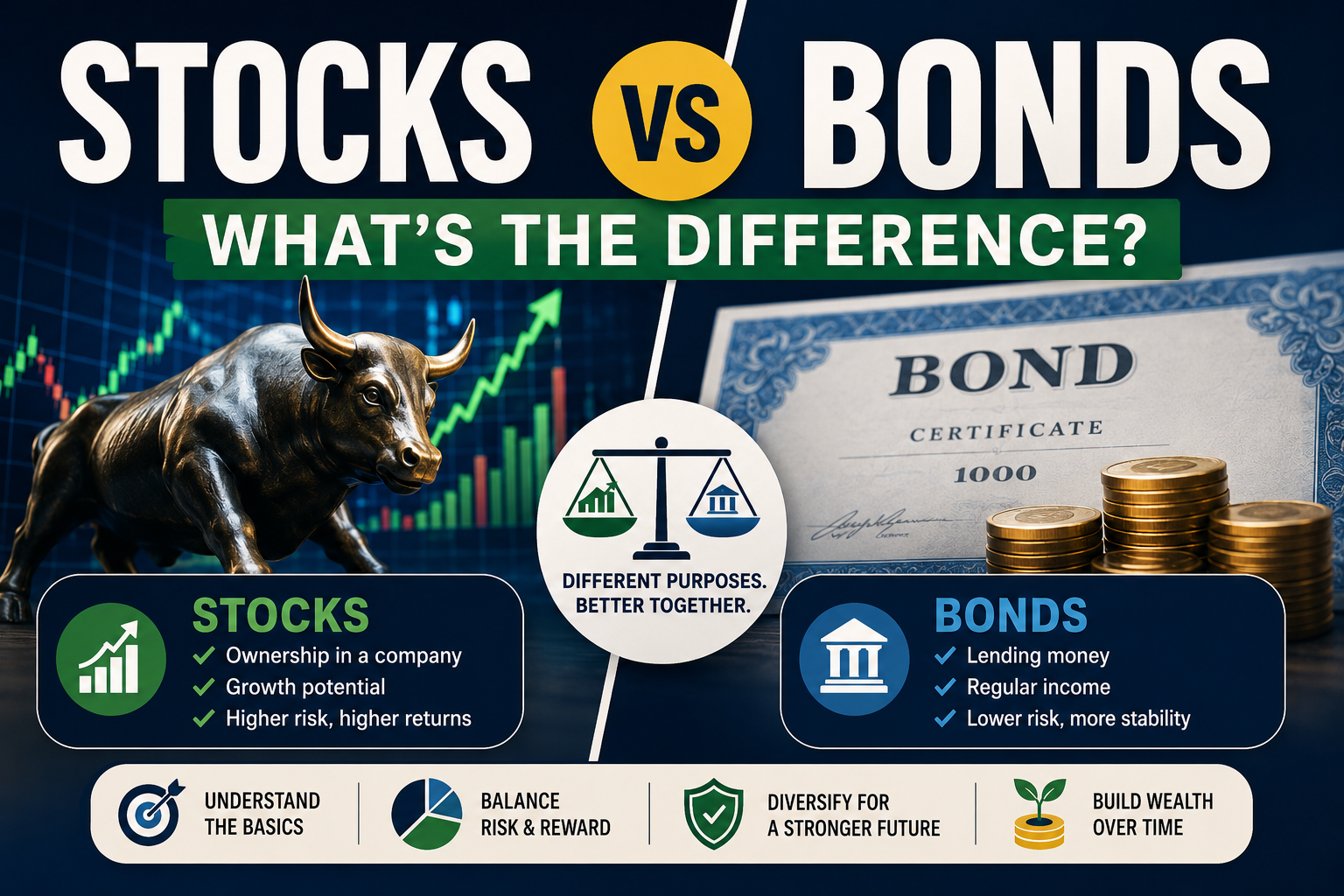
- Stocks represent ownership.
- Bonds represent lending.
That single distinction explains many of the differences between the two investments.
In this article, you’ll learn:
- What stocks are
- What bonds are
- How investors make money from each
- The risks and rewards involved
- Why many investors own both
- How stocks and bonds fit into retirement planning
- Which option may be appropriate for different financial goals
Most importantly, you’ll gain a clear understanding of two of the most important building blocks in investing.
What Are Stocks?
Let’s begin with stocks.
Many people first encounter investing through the stock market.
When someone says they “bought stock,” they mean they purchased ownership in a company.
A Simple Definition
A stock represents ownership in a business.
When you purchase stock, you become a shareholder.
A shareholder owns a small piece of the company.
The number of shares you own determines the size of your ownership stake.
Think About It This Way
Imagine a company is divided into millions of pieces.
Each piece represents a share.
When investors purchase shares, they own a portion of that business.
Although the ownership percentage may be small, it is still ownership.
Ownership in a Company
This ownership is what makes stocks unique.
As a shareholder, your investment is tied directly to the company’s performance.
If the company grows and becomes more valuable, the value of your shares may increase.
If the company struggles, the value of your shares may decline.
Why Investors Like Stocks
Stocks provide an opportunity to participate in business growth.
Examples include companies that:
- Increase profits
- Expand globally
- Develop new products
- Gain customers
- Improve financial performance
Investors hope to benefit from that growth through increasing stock prices and, in some cases, dividend payments.
How Stocks Work
Companies issue shares to raise money.
Investors purchase those shares.
The company receives capital.
Investors receive ownership.
This relationship creates a partnership between businesses and shareholders.
Example
Imagine a company wants to expand operations.
Rather than borrowing all the required money, it sells shares to investors.
Investors provide funding.
The company uses that money to grow.
If growth is successful, shareholders may benefit.
Why Investors Buy Stocks
Investors generally purchase stocks for one or more of the following reasons:
Capital Appreciation
The stock price increases over time.
Dividend Income
Some companies distribute profits to shareholders through dividends.
Long-Term Wealth Building
Stocks have historically been used as a tool for building wealth over long periods.
Fighting Inflation
Investors often use stocks to help maintain purchasing power over time.
Example of Stock Ownership
Imagine you purchase shares in a successful technology company.
As the company expands:
- Revenue increases
- Profits grow
- New products launch
Investors become more optimistic.
Demand for shares rises.
The stock price may increase.
Because you own part of the company, you participate in that growth.
This is the basic appeal of stock investing.
What Are Bonds?
Stocks represent ownership.
Bonds are very different.
Instead of becoming an owner, you become a lender.
This distinction is the foundation of bond investing.
A Simple Definition
A bond is essentially a loan.
When investors purchase bonds, they are lending money to an organization.
That organization may be:
- A government
- A corporation
- A municipality
- Another entity seeking funding
In return, the organization agrees to repay the loan under specified terms.
You’re already investing time in improving your finances, and that’s something to be proud of. Before you continue, download our free 7 Days To Financial Clarity™ workbook and start putting these ideas into action.

Lending Money Instead of Buying Ownership
This is the most important difference between stocks and bonds.
Stock Investors
Own part of a company.
Bond Investors
Lend money to an organization.
Bondholders do not become owners.
Instead, they receive interest payments in exchange for providing capital.
How Bonds Work
When an organization issues a bond, it is borrowing money from investors.
The organization agrees to:
- Pay interest periodically.
- Repay the original loan amount at a future date.
The future repayment date is called the maturity date.
Example
Imagine a company needs funding to build a new facility.
Rather than issuing stock, it issues bonds.
Investors purchase those bonds.
The company receives funding.
Investors receive interest payments until the bond matures.
At maturity, the original investment is typically returned.
Why Governments and Companies Issue Bonds
Organizations issue bonds because they need money.
Examples include:
- Infrastructure projects
- Expansion plans
- Equipment purchases
- Refinancing debt
- Public services
Bonds provide a way to raise capital without selling ownership.
Example of Bond Investing
Imagine a government issues a bond with:
- A fixed interest rate
- A maturity date
You purchase the bond.
Over time, you receive interest payments.
When the bond reaches maturity, the government repays your original investment.
Unlike stock investing, your returns are generally tied to interest payments rather than business ownership.
The Biggest Difference Between Stocks and Bonds
Now that we’ve covered both investments individually, let’s focus on the single most important distinction.
Ownership vs Lending
At their core:
Stocks = Ownership
Bonds = Lending
This difference influences:
- Risk
- Return potential
- Income generation
- Portfolio behavior
Understanding this distinction helps explain nearly everything else about these investments.
Stock Investors Are Owners
When you buy stock, you become a shareholder.
Your investment success is tied directly to the company’s performance.
Potential Benefits
- Capital appreciation
- Dividend income
- Participation in company growth
Potential Drawbacks
- Stock prices can be volatile
- Returns are not guaranteed
- Companies can experience financial difficulties
Ownership offers growth potential, but it comes with risk.
Bond Investors Are Lenders
When you buy a bond, you become a creditor rather than an owner.
You lend money and receive interest payments.
Potential Benefits
- Predictable income
- Lower volatility compared to many stocks
- Defined maturity dates
Potential Drawbacks
- Lower long-term growth potential
- Inflation risk
- Interest-rate sensitivity
Bond investing generally emphasizes stability and income.
Why This Difference Matters
Because stocks and bonds serve different purposes, they often behave differently during various market conditions.
Stocks
Typically focus on growth.
Bonds
Typically focus on income and stability.
This is why many investors choose to own both.
Together, stocks and bonds can help create a more balanced portfolio.
A Key Lesson Before Moving Forward
If you remember only one thing from this article, remember this:
Stocks make you an owner. Bonds make you a lender.
That simple distinction explains:
✓ How returns are generated
✓ Why risks differ
✓ Why investors often use both
✓ Why stocks and bonds behave differently
How Investors Make Money with Stocks
Now that you understand the difference between stocks and bonds, the next question is:
How do investors actually make money from them?
Let’s begin with stocks.
Stocks are generally purchased because investors believe the company will create value over time.
There are two primary ways stock investors may earn returns:
- Capital Appreciation
- Dividend Income
Many successful investors benefit from a combination of both.
Capital Appreciation
Capital appreciation occurs when a stock increases in value.
This is one of the main reasons people invest in stocks.
Stock Price Growth
Imagine purchasing shares of a company for:
$50 per share
Several years later, the company has grown significantly and the stock now trades for:
$100 per share
The increase in value represents capital appreciation.
Why Stock Prices Increase
Stock prices may rise when companies:
- Increase profits
- Expand operations
- Launch successful products
- Gain market share
- Improve financial performance
As investors become more optimistic about a company’s future, demand for shares may increase.
Higher demand can push stock prices upward.
Why Long-Term Investors Focus on Growth
Many investors are not concerned with what happens this week or even this year.
Instead, they focus on long-term business growth.
Example
A company may experience:
- Temporary setbacks
- Market volatility
- Economic uncertainty
Yet continue growing over decades.
Long-term investors often focus on the bigger picture rather than short-term price fluctuations.
Dividend Income
Some companies share a portion of their profits with shareholders.
These payments are called dividends.
Getting Paid as a Shareholder
If you own shares of a dividend-paying company, you may receive regular payments.
These payments are typically made:
- Quarterly
- Semi-annually
- Annually
depending on the company.
Example
Suppose you own shares in a company that pays dividends.
As a shareholder, you receive a portion of those profits.
This creates an additional source of return beyond stock price appreciation.
Why Companies Pay Dividends
Not all companies pay dividends.
Many younger companies reinvest profits to fuel growth.
Others choose to reward shareholders through dividend payments.
Reasons companies pay dividends include:
- Sharing profits
- Attracting investors
- Demonstrating financial strength
- Encouraging long-term ownership
Reinvesting Dividends
Many investors choose not to spend dividend payments.
Instead, they reinvest them.
This allows dividends to purchase additional shares.
Those shares may generate additional dividends.
This process can accelerate compound growth over time.
Why This Matters
Dividend reinvestment is one of the most powerful examples of compounding in action.
Over long periods, reinvested dividends can contribute significantly to overall investment growth.
Long-Term Wealth Building
Stocks have historically been used as a tool for long-term wealth creation.
This is because they combine:
- Growth potential
- Dividend income
- Compound returns
The Power of Compound Growth
When gains remain invested, future gains may occur on a larger balance.
This creates a snowball effect.
Example
An investor leaves profits invested.
Those profits generate additional profits.
Over time, growth can accelerate.
This is one reason starting early can be so valuable.
Why Time Matters
Time allows investments to:
- Grow
- Recover from downturns
- Benefit from compounding
Many investors discover that time is one of the most powerful wealth-building tools available.
How Investors Make Money with Bonds
Stocks focus on ownership and growth.
Bonds focus on lending and income.
Because of this difference, bond returns are generated differently.
Interest Payments
The primary way bond investors earn money is through interest.
When you purchase a bond, you lend money to an organization.
In exchange, the organization agrees to pay interest.
Predictable Income
Many investors appreciate bonds because interest payments can be more predictable than stock returns.
Example
Suppose you purchase a bond that pays:
4% annual interest
You receive regular interest payments according to the bond’s terms.
This predictable income is one reason bonds are popular among conservative investors and retirees.
Why Investors Like Bond Income
Bond income may provide:
- Predictability
- Stability
- Cash flow
- Reduced volatility
This makes bonds attractive for investors who prioritize income over aggressive growth.
Bond Maturity
Unlike stocks, bonds typically have a maturity date.
The maturity date is when the borrower repays the original loan amount.
Getting Your Principal Back
When a bond reaches maturity:
- Final interest payments are made.
- The original investment is returned.
This repayment feature is one reason bonds are often viewed as more predictable than stocks.
Example
Suppose you purchase a bond with:
- A 10-year maturity
- A fixed interest rate
Over ten years, you receive interest payments.
At maturity, the original amount invested is returned.
Stability Compared to Stocks
Another reason investors use bonds is stability.
While bond prices can fluctuate, they generally experience less volatility than many stocks.
Why Bonds Tend to Be More Stable
Bond investors are lenders rather than owners.
Their returns depend largely on:
- Interest payments
- Principal repayment
rather than company growth.
Result
Bond prices often fluctuate less dramatically than stock prices.
This characteristic can help reduce overall portfolio volatility.
The Trade-Off
There is an important trade-off between stocks and bonds.
Stocks
Typically offer:
- Higher growth potential
- Greater long-term return opportunities
But often involve:
- Greater volatility
- Larger price swings
Bonds
Typically offer:
- More stability
- More predictable income
But often provide:
- Lower growth potential
- Lower long-term returns
Neither investment is automatically better.
Each serves a different purpose.
Comparing Stocks and Bonds Side-by-Side
| Feature | Stocks | Bonds |
| Represents | Ownership | Loan |
| Investor Role | Shareholder | Lender |
| Main Return Source | Growth & Dividends | Interest Payments |
| Growth Potential | Higher | Lower |
| Income Potential | Dividends (if paid) | Interest Payments |
| Volatility | Higher | Lower |
| Risk Level | Generally Higher | Generally Lower |
| Long-Term Wealth Building | Strong | Moderate |
| Stability | Lower | Higher |
A Key Lesson Before Moving Forward
Stocks and bonds help investors achieve different goals.
Stocks are often used for:
✓ Growth
✓ Wealth building
✓ Long-term investing
✓ Inflation protection
Bonds are often used for:
✓ Income
✓ Stability
✓ Risk reduction
✓ Capital preservation
Because they serve different purposes, many investors choose to own both.
Risk: Stocks vs Bonds
One of the most important concepts in investing is understanding risk.
Every investment involves some level of uncertainty.
The goal isn’t to eliminate risk entirely.
The goal is to understand it and manage it appropriately.
When comparing stocks and bonds, risk is one of the biggest differences.
Generally speaking:
- Stocks tend to be riskier.
- Bonds tend to be more stable.
However, that doesn’t mean stocks are bad or bonds are good.
It simply means they serve different purposes.
Let’s explore why.
Why Stocks Are Usually Riskier
Stocks represent ownership in businesses.
Because businesses operate in competitive and changing environments, stock prices can fluctuate significantly.
What Can Affect Stock Prices?
Many factors influence stock values, including:
- Company profits
- Economic conditions
- Interest rates
- Competition
- Investor sentiment
- Industry trends
Because so many variables are involved, stock prices can rise and fall frequently.
Example
A company may report disappointing earnings.
Investors become concerned.
Demand for shares declines.
The stock price falls.
Even strong companies experience periods of volatility.
Market Declines Can Be Significant
The stock market does not move upward every year.
There are periods when stock prices decline substantially.
Examples include:
- Recessions
- Economic crises
- Market corrections
- Unexpected global events
Why This Matters
Investors must be prepared for temporary declines.
Those who panic and sell during downturns may lock in losses.
Long-term investors typically understand that volatility is part of investing.
Why Bonds Are Often Considered Safer
Bonds are generally viewed as less risky because bondholders are lenders rather than owners.
Their returns are based primarily on:
- Interest payments
- Principal repayment
rather than company growth.
More Predictable Income
Many bonds provide scheduled interest payments.
This predictability appeals to investors who prioritize stability.
Example
A bond may pay:
5% annually
for a specified period.
The investor knows what income to expect.
Stocks generally cannot provide the same level of certainty.
Reduced Price Volatility
Bond prices can fluctuate.
However, those fluctuations are often smaller than stock market swings.
This is one reason bonds are frequently used to reduce overall portfolio risk.
Important Note
Lower volatility does not mean risk-free.
All investments carry risk.
Bonds simply tend to experience different risks than stocks.
📈 Watch Your Money Grow
Successful investing isn’t about guessing—it’s about understanding long-term growth. Use our free Investment Growth Calculator to see how regular investing can build wealth over time.

Understanding Risk and Reward
One of the most important investing principles is:
Higher potential rewards usually require higher risk.
This relationship helps explain the differences between stocks and bonds.
Why Stocks Often Offer Higher Potential Returns
Stock investors accept greater uncertainty.
In return, they receive opportunities for:
- Business growth
- Capital appreciation
- Dividend income
- Long-term wealth creation
Because of this growth potential, stocks have historically delivered higher long-term returns than bonds.
Why Bonds Typically Offer Lower Returns
Bond investors generally prioritize:
- Stability
- Income
- Predictability
As a result, bond returns are often lower.
The trade-off is reduced volatility and greater certainty.
The Key Lesson
Higher return potential usually comes with greater risk.
Lower risk often means lower return potential.
Understanding this trade-off helps investors make informed decisions.
Potential Returns: Stocks vs Bonds
Now let’s compare return potential more directly.
Historical Performance of Stocks
Historically, stocks have generally produced stronger long-term returns than bonds.
This is one reason stocks are often used for:
- Retirement investing
- Wealth building
- Long-term financial goals
Why Stocks Grow
Companies can:
- Increase revenue
- Expand operations
- Improve profitability
- Innovate
Investors participate in that growth through stock ownership.
Long-Term Growth Potential
Over decades, stocks have helped many investors build substantial wealth.
This doesn’t mean stocks always perform well.
It means that over long periods, growth has historically rewarded patient investors.
Important Reminder
Past performance does not guarantee future results.
However, long-term growth remains one of the primary reasons investors choose stocks.
Historical Performance of Bonds
Bonds have historically produced lower returns than stocks.
However, they have often provided:
- Stability
- Income
- Reduced volatility
These characteristics make bonds attractive despite lower growth potential.
Why Investors Still Buy Bonds
Many people assume investors should always choose the investment with higher returns.
In reality, investing involves balancing multiple goals.
Examples
An investor may prioritize:
- Income
- Stability
- Capital preservation
- Reduced risk
In these situations, bonds may play an important role.
Why Stocks Often Outperform
The reason stocks generally outperform bonds comes back to ownership.
Stockholders participate directly in business growth.
As businesses expand and become more valuable, shareholders may benefit.
Bondholders receive interest payments but do not participate in company growth to the same extent.
Example
A company doubles in value.
Stockholders may benefit significantly.
Bondholders continue receiving their agreed-upon interest payments.
This difference helps explain why stock returns have historically been higher.
Why Bonds Still Matter
If stocks often outperform bonds, why do investors own bonds at all?
Because investing is not solely about maximizing returns.
It is also about managing risk.
Stability During Uncertain Times
Bonds often provide stability when stock markets become volatile.
While bonds are not immune to declines, they may help reduce portfolio fluctuations.
Why This Matters
Large market declines can be emotionally difficult.
Investors who own some bonds may experience less volatility and feel more comfortable staying invested.
Income Generation
Many investors use bonds as an income-producing asset.
This can be especially useful during:
- Retirement
- Market uncertainty
- Periods of reduced employment income
Predictable income remains one of the primary attractions of bond investing.
Growth vs Stability
Ultimately, the comparison between stocks and bonds often comes down to:
Stocks
Focus on growth.
Bonds
Focus on stability.
Neither objective is wrong.
The appropriate balance depends on an investor’s:
- Goals
- Age
- Risk tolerance
- Financial situation
- Time horizon
Volatility: Stocks vs Bonds
Volatility refers to how much investment prices move over time.
Understanding volatility helps investors prepare emotionally and financially for market fluctuations.
Why Stock Prices Fluctuate More
Stock prices reflect investor expectations about future business performance.
Because expectations constantly change, stock prices move frequently.
Factors That Influence Stock Volatility
- Earnings reports
- Economic news
- Interest rates
- Industry developments
- Investor sentiment
These factors can create substantial short-term price swings.
Example
A company reports weaker-than-expected earnings.
Investors become concerned.
The stock may decline sharply in a single day.
This type of volatility is common in stock investing.
Why Bonds Tend to Be More Stable
Bonds are generally less dependent on future business growth.
Instead, they focus on:
- Interest payments
- Principal repayment
This often results in lower price volatility.
Result
Many bond investors experience smoother portfolio performance compared to investors holding only stocks.
How Volatility Affects Investors
Volatility is not just a financial issue.
It’s also a psychological issue.
Large declines can trigger:
- Fear
- Anxiety
- Panic selling
This emotional response can harm long-term investment results.
Staying Calm During Market Changes
Successful investors understand that volatility is normal.
They avoid making decisions based solely on short-term market movements.
Helpful Perspective
Markets rise.
Markets fall.
Both are normal parts of investing.
Long-term investors focus on their goals rather than daily headlines.
A Key Lesson Before Moving Forward
Stocks and bonds represent different approaches to investing.
Stocks generally offer:
✓ Higher growth potential
✓ Greater long-term returns
✓ Higher volatility
✓ Greater risk
Bonds generally offer:
✓ More stability
✓ Predictable income
✓ Lower volatility
✓ Lower growth potential
Because each investment has strengths and weaknesses, many investors choose to own both.
Stocks vs Bonds During Retirement
One of the reasons investors often own both stocks and bonds is that their financial needs change over time.
A portfolio that makes sense for a 25-year-old investor may not be appropriate for someone approaching retirement.
As retirement gets closer, many investors begin paying more attention to:
- Stability
- Income
- Capital preservation
This is where bonds often become more important.
However, stocks usually continue to play a role as well.
Let’s explore why.
Why Retirees Often Own Bonds
Retirement changes the way many people think about investing.
During working years, investors are often focused on:
- Growing wealth
- Building retirement savings
- Maximizing long-term returns
During retirement, priorities may shift toward:
- Preserving wealth
- Generating income
- Reducing volatility
Bonds can help support these goals.
Income Can Become More Important
Many retirees use their investments to supplement income.
Unlike younger investors who are primarily accumulating assets, retirees may be withdrawing money regularly.
Why Bonds Help
Many bonds provide predictable interest payments.
This income can help support:
- Living expenses
- Healthcare costs
- Retirement spending
Predictability is one reason bonds remain popular among retirees.
Reducing Portfolio Volatility
Large market declines can be stressful for any investor.
However, they may be especially concerning for retirees who depend on investment assets.
Example
Imagine two retirees.
One owns:
100% stocks.
The other owns:
A mix of stocks and bonds.
During a major market decline, the investor with bonds may experience less volatility.
This can help reduce emotional stress and support long-term financial planning.
Balancing Growth and Income
A common retirement challenge is finding the right balance between:
- Growth
- Stability
Too much focus on growth may increase risk.
Too much focus on stability may reduce long-term purchasing power.
Why Retirees Still Own Stocks
Many people assume retirement means selling all stocks.
In reality, many retirees continue owning stocks.
Why?
Retirement may last:
- 20 years
- 30 years
- Or longer
During that time, investments may still need to grow.
Stocks can help:
- Combat inflation
- Maintain purchasing power
- Support long-term financial goals
This is why many retirement portfolios include both stocks and bonds.
Finding the Right Balance
There is no universal allocation that works for everyone.
Factors that influence portfolio decisions include:
- Age
- Income needs
- Risk tolerance
- Financial goals
- Retirement timeline
The appropriate balance varies from person to person.
Age and Asset Allocation
Many investors gradually reduce risk as they get older.
This process is often reflected in asset allocation decisions.
Younger Investors
May prioritize growth.
Older Investors
May place greater emphasis on stability and income.
Important Reminder
Age is only one factor.
Personal circumstances matter just as much.
Can You Lose Money in Stocks and Bonds?
A common misconception is that bonds are completely safe while stocks are risky.
The reality is more nuanced.
Both investments involve risk.
The types of risk are simply different.
Stock Market Losses
Stocks can decline in value.
This is one reason stock investing requires patience and a long-term perspective.
Why Stocks Lose Value
Examples include:
- Weak company performance
- Economic downturns
- Reduced investor confidence
- Industry disruptions
Stock prices can fall for many reasons.
Example
A company experiences declining sales.
Investors become concerned.
The stock price falls.
Shareholders may temporarily or permanently lose value.
Bond Risks
Although bonds are often considered safer than stocks, they are not risk-free.
Bond investors face several potential risks.
Credit Risk
Credit risk refers to the possibility that the borrower cannot meet its obligations.
Example
A company experiencing financial difficulty may struggle to make interest payments.
This can affect bondholders.
Inflation Risk
Inflation reduces purchasing power.
If inflation rises faster than bond income, investors may effectively lose purchasing power over time.
For example, if a bond pays 3% annually while inflation rises to 5%, your purchasing power may actually decline even though you’re receiving interest payments.
Why This Matters
A bond may provide predictable income.
However, that income may buy less in the future if inflation increases significantly.
Interest Rate Risk
Interest rates can influence bond values.
When interest rates rise, existing bonds may become less attractive compared to newly issued bonds.
This can affect bond prices.
Important Lesson
Bond prices can fluctuate just like stock prices.
The difference is that bond volatility is often lower.
Understanding Investment Risk
Risk is not something investors should fear.
It is something investors should understand.
Every investment decision involves trade-offs.
Stocks
Offer:
- Higher growth potential
- Greater volatility
Bonds
Offer:
- More stability
- Lower growth potential
Understanding these trade-offs helps investors make informed choices.
Stocks vs Bonds for Beginners
Many beginners eventually ask:
“Which investment should I choose?”
The answer depends on goals, risk tolerance, and time horizon.
However, understanding the strengths of each investment can help.
Which Is Easier to Understand?
Most beginners find stocks easier to understand.
The concept of owning part of a company is straightforward.
Bonds involve additional concepts such as:
- Interest rates
- Maturity dates
- Credit risk
While bonds are not complicated, they often receive less attention from new investors.
Which Is Better for Growth?
Stocks generally offer stronger growth potential.
This is one reason younger investors often emphasize stocks.
Why?
Businesses can:
- Expand
- Increase profits
- Develop products
- Enter new markets
Investors participate in that growth through ownership.
Which Is Better for Stability?
Bonds typically provide greater stability.
Many investors use bonds to:
- Reduce volatility
- Generate income
- Protect capital
This can be particularly valuable during uncertain market conditions.
Why Many Investors Own Both
The choice is not always:
Stocks or Bonds.
Many investors choose:
Stocks and Bonds.
Each investment type offers benefits the other cannot fully provide.
Stocks Provide
- Growth
- Wealth-building potential
- Inflation protection
Bonds Provide
- Stability
- Income
- Risk reduction
Together, they can create a more balanced investment experience.
Building a Balanced Portfolio
A balanced portfolio attempts to combine growth and stability.
The exact mix varies depending on individual circumstances.
Example
A portfolio might contain:
- Stocks for growth
- Bonds for stability
This combination can help investors pursue long-term goals while managing risk.
What Is Asset Allocation?
Asset allocation is one of the most important concepts in investing.
It refers to how investments are divided among different asset types.
Examples include:
- Stocks
- Bonds
- Cash
- Other investments
Many experts consider asset allocation one of the most important investment decisions an investor makes.
Understanding Diversification
Diversification means spreading investments across multiple assets.
Rather than relying on a single investment, investors own a variety of assets.
Why Diversification Matters
Different investments often perform differently under various market conditions.
Diversification helps reduce dependence on any single investment.
Example
If stocks experience a difficult period, bonds may help reduce overall portfolio volatility.
This is one reason diversification remains a core investing principle.
Why Investors Mix Stocks and Bonds
Stocks and bonds often complement each other.
Stocks Contribute
- Growth potential
- Long-term wealth creation
Bonds Contribute
- Stability
- Income
- Reduced volatility
Together, they help create balance.
Example Portfolio Allocations
The following examples are for educational purposes only.
They are not recommendations.
Actual investment decisions should reflect individual goals and circumstances.
Conservative Portfolio
May emphasize:
- 40% Stocks
- 60% Bonds
Focus:
Stability and income.
Balanced Portfolio
May emphasize:
- 60% Stocks
- 40% Bonds
Focus:
Growth and stability.
Growth Portfolio
May emphasize:
- 80% Stocks
- 20% Bonds
Focus:
Long-term growth.
Why Allocations Differ
Different investors have different priorities.
A young investor saving for retirement may prioritize growth.
A retiree may prioritize stability and income.
Neither approach is automatically correct.
The appropriate allocation depends on individual circumstances.
A Key Lesson Before Moving Forward
Stocks and bonds are not competitors.
They are tools.
Each serves a different purpose.
Successful investors often use both to create portfolios that align with their goals.
Remember:
✓ Stocks focus on growth.
✓ Bonds focus on stability.
✓ Diversification helps manage risk.
✓ Asset allocation helps balance risk and reward.
Real-Life Example
Understanding stocks and bonds individually is helpful.
However, seeing how they work together in real-world situations often makes the concepts easier to understand.
Let’s compare two hypothetical investors.
Investor A Chooses Only Stocks
Investor A is focused entirely on growth.
They invest:
100% of their portfolio in stocks.
Advantages
Investor A benefits from:
- Higher growth potential
- Greater exposure to business expansion
- Long-term wealth-building opportunities
What Happens During Strong Markets?
When stock markets perform well, Investor A’s portfolio may grow rapidly.
This can be exciting and rewarding.
Challenges
The downside is volatility.
During market declines, Investor A experiences the full impact of stock market losses.
Example
A major market downturn occurs.
Stock prices decline significantly.
Investor A’s portfolio falls sharply.
Although recovery may eventually occur, the decline can be emotionally difficult.
Investor B Chooses Stocks and Bonds
Investor B wants growth but also values stability.
Their portfolio contains:
- Stocks
- Bonds
This creates diversification across asset types.
Advantages
Investor B benefits from:
- Growth potential from stocks
- Stability from bonds
- Reduced overall volatility
🎯 Find Your Best Next Step
Every financial journey is different. Take our free
Financial Goal Assessment to discover which area deserves your attention first
and receive a clear direction for your next financial milestone.
What Happens During Market Declines?
When stocks decline, bonds may help reduce the impact.
The portfolio still experiences fluctuations, but often less dramatically.
Challenges
Investor B may not experience the same level of growth during strong stock market periods.
This is the trade-off.
Greater stability often comes with slightly lower growth potential.
Comparing Risk and Return
Both investors have strengths and weaknesses.
Investor A
Potentially higher returns.
Potentially greater volatility.
Investor B
Potentially smoother performance.
Potentially lower overall risk.
Which Is Better?
There is no universal answer.
The appropriate choice depends on:
- Financial goals
- Risk tolerance
- Time horizon
- Personal comfort level
The Lesson
Many successful investors choose balance rather than extremes.
They recognize that:
- Stocks provide growth.
- Bonds provide stability.
Combining both can help create a portfolio that supports long-term financial goals while reducing emotional stress during market downturns.
Stocks, Bonds, and Compound Interest
One of the reasons investing can be so powerful is compound growth.
Both stocks and bonds can contribute to compounding, although they do so in different ways.
How Stocks Compound Growth
Stocks typically compound through:
- Capital appreciation
- Dividend reinvestment
When gains remain invested, future gains can occur on a larger balance.
Example
A stock investment grows.
The gains remain invested.
Future growth occurs on:
- Original contributions
- Previous gains
Over time, growth can accelerate.
How Bonds Generate Income
Bonds generally focus on interest payments rather than rapid growth.
Those interest payments can be:
- Spent
- Saved
- Reinvested
Reinvesting Bond Income
When interest payments are reinvested, they can also contribute to compound growth.
This allows bond investments to generate returns on previous returns.
Combining Growth and Stability
Many investors appreciate owning both stocks and bonds because each contributes differently.
Stocks
Provide growth potential.
Bonds
Provide stability and income.
Together, they can support long-term wealth building while helping manage risk.
Long-Term Wealth Building
Wealth creation often involves multiple factors working together:
✓ Consistent investing
✓ Compound growth
✓ Diversification
✓ Long-term thinking
✓ Appropriate asset allocation
Stocks and bonds can both contribute to these objectives.
Stocks, Bonds, and Retirement Planning
Retirement planning is one of the most common reasons people invest.
Understanding how stocks and bonds fit into retirement strategies is important.
Building Wealth While Working
During working years, investors often focus on growing retirement assets.
Because retirement may be decades away, many investors emphasize stocks during this stage.
Why?
Stocks generally offer stronger long-term growth potential.
Time allows investors to:
- Ride out volatility
- Benefit from compounding
- Pursue higher returns
Protecting Wealth Near Retirement
As retirement approaches, priorities may shift.
Investors often become more focused on:
- Capital preservation
- Income generation
- Reducing volatility
This is where bonds may play a larger role.
Example
An investor approaching retirement may gradually increase bond exposure to reduce portfolio risk.
Generating Retirement Income
Many retirees use bonds as a source of predictable income.
Interest payments can help support:
- Living expenses
- Healthcare costs
- Retirement budgets
At the same time, stocks may continue providing growth to help offset inflation.
This combination can support long-term retirement needs.
Common Myths About Stocks and Bonds
Investing is often surrounded by myths and misconceptions.
Let’s address some of the most common ones.
Bonds Are Risk-Free
This is one of the most widespread misconceptions.
Reality
Bonds involve risks, including:
- Credit risk
- Inflation risk
- Interest-rate risk
While bonds are often less volatile than stocks, they are not risk-free.
Stocks Are Gambling
Many people compare investing to gambling.
Reality
Long-term investing involves owning businesses and participating in economic growth.
While speculation can resemble gambling, disciplined investing is fundamentally different.
Important Difference
Investors focus on:
- Business performance
- Long-term growth
- Wealth building
rather than pure chance.
You Must Choose One or the Other
Some beginners assume they must invest entirely in stocks or entirely in bonds.
Reality
Many investors own both.
Combining stocks and bonds is one of the most common investing strategies.
This allows investors to balance:
- Growth
- Stability
- Risk
- Income
Bonds Are Only for Retirees
Although retirees often use bonds, they are not the only investors who benefit from them.
Reality
Bonds can help investors of all ages manage risk and diversify portfolios.
The appropriate allocation depends on individual circumstances rather than age alone.
Investing Is Too Complicated
Many people avoid investing because they assume it requires advanced expertise.
Reality
The basic concepts are surprisingly straightforward.
Remember:
- Stocks represent ownership.
- Bonds represent lending.
Everything else builds upon those ideas.
Most successful investors focus on simple principles rather than unnecessary complexity.
Why Understanding Both Investments Matters
Whether you ultimately invest primarily in stocks, bonds, or a combination of both, understanding the differences can improve financial decision-making.
The goal isn’t to become a professional investor overnight.
The goal is to understand the tools available and how they may fit into your financial plan.
A Key Lesson Before Moving Forward
Stocks and bonds are two of the most important building blocks in investing.
Each offers unique benefits.
Stocks generally provide:
✓ Growth
✓ Wealth-building potential
✓ Inflation protection
Bonds generally provide:
✓ Income
✓ Stability
✓ Risk reduction
Many successful investors combine both to pursue long-term financial goals while managing risk.
Beginner Investing Checklist
Before we wrap up, let’s summarize the most important lessons from this article.
Whether you’re just starting your investing journey or reviewing your current strategy, this checklist can help keep you focused on the fundamentals.
Before You Invest
✓ Understand the difference between stocks and bonds
✓ Define your financial goals
✓ Create a budget
✓ Build an emergency fund
✓ Address high-interest debt
✓ Learn basic investing principles
✓ Choose an investment account
✓ Develop a long-term mindset
During Your First Year
✓ Start investing consistently
✓ Focus on diversification
✓ Learn how markets work
✓ Avoid emotional decision-making
✓ Ignore short-term market noise
✓ Continue building investing knowledge
✓ Review your goals periodically
Long-Term Habits
✓ Stay invested
✓ Increase contributions when possible
✓ Reinvest dividends when appropriate
✓ Maintain diversification
✓ Review asset allocation periodically
✓ Focus on long-term progress
✓ Allow compound growth time to work
Final Thoughts
When beginners first learn about investing, they often feel overwhelmed by the number of choices available.
Stocks.
Bonds.
ETFs.
Mutual funds.
Retirement accounts.
Financial news.
Market predictions.
It can seem like there’s an endless amount of information to understand.
Fortunately, the foundation is much simpler than many people realize.
At the most basic level:
Stocks represent ownership.
Bonds represent lending.
That single distinction explains many of the differences between the two investments.
Stocks generally offer:
- Greater growth potential
- Higher long-term return opportunities
- Greater volatility
Bonds generally offer:
- More stability
- Predictable income
- Lower volatility
Neither investment is automatically better.
Each serves a different purpose.
For some investors, stocks may play a larger role.
For others, bonds may become more important.
Many investors choose to own both because the combination can provide:
- Growth
- Stability
- Diversification
- Income
The appropriate balance depends on:
- Financial goals
- Time horizon
- Risk tolerance
- Personal circumstances
One of the most important lessons in investing is understanding that successful investing is rarely about finding a perfect investment.
Instead, it is often about:
- Consistency
- Patience
- Diversification
- Long-term thinking
These principles apply whether you invest in stocks, bonds, or both.
Remember:
You do not need to know everything before getting started.
Many successful investors began with limited knowledge and modest amounts of money.
They learned as they went.
The most important step is developing a plan and taking action.
Over time, knowledge grows.
Investments grow.
Confidence grows.
And those small steps can eventually lead to meaningful financial progress.
Frequently Asked Questions
Are stocks better than bonds?
Not necessarily.
Stocks generally offer higher growth potential, while bonds often provide greater stability and income.
The better choice depends on your financial goals and risk tolerance.
Are bonds safer than stocks?
In many situations, bonds are considered less volatile than stocks.
However, bonds still carry risks, including inflation risk, credit risk, and interest-rate risk.
Can beginners invest in bonds?
Yes.
Many beginners invest in bonds directly or through bond funds and diversified investment portfolios.
Why do investors own both stocks and bonds?
Because they serve different purposes.
Stocks can provide growth.
Bonds can provide stability and income.
Together, they may create a more balanced portfolio.
What is asset allocation?
Asset allocation refers to how investments are divided among different asset classes such as stocks, bonds, and cash.
It is one of the most important portfolio decisions an investor makes.
How much should I invest in stocks vs bonds?
There is no universal answer.
The appropriate allocation depends on:
- Age
- Goals
- Risk tolerance
- Financial situation
Many investors adjust allocations over time as circumstances change.
Are bonds good for retirement?
Many retirees use bonds because they can provide income and reduce portfolio volatility.
However, stocks often remain important for long-term growth during retirement.
Can bonds lose money?
Yes.
Bond values can decline due to:
- Rising interest rates
- Inflation
- Credit concerns
Although bonds are often less volatile than stocks, they are not risk-free.
Which investment has higher returns?
Historically, stocks have generally produced higher long-term returns than bonds.
However, higher return potential usually comes with higher risk.
Should I own stocks and bonds?
Many investors choose to own both because each serves a different purpose.
A combination of stocks and bonds may help balance growth and stability.
🚀 Ready To Keep Going?
You have invested time learning today. Now take the next step by downloading our free 7 Days To Financial Clarity™ workbook and begin building a stronger financial future.
