
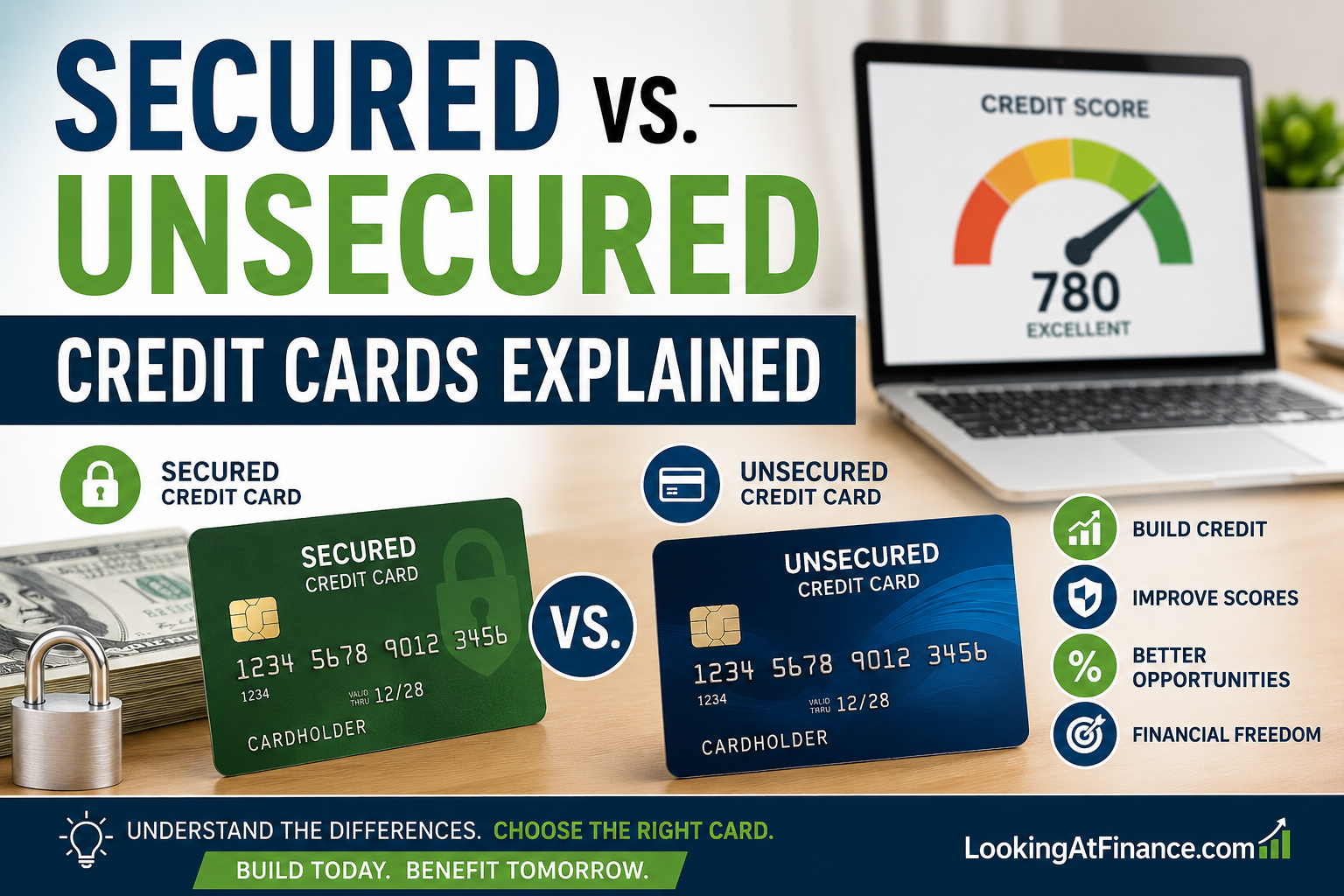
Credit cards can be confusing, especially for beginners who are trying to build credit for the first time.
If you’ve started researching credit cards, you’ve probably encountered the terms secured credit card and unsecured credit card. While these two types of cards may look similar and function similarly during everyday purchases, they are designed for different situations and borrowers.
Many people mistakenly assume that a secured credit card is simply a prepaid card or that an unsecured credit card is always the better option. Others believe they need excellent credit to qualify for any credit card at all. These misconceptions often prevent people from choosing the right credit-building tool for their financial situation.
Selecting the wrong card can slow your credit-building progress, result in unnecessary fees, or even increase the likelihood of debt problems. On the other hand, choosing the right card can help establish a positive credit history, improve your credit score, and create opportunities for better financial products in the future.
The good news is that understanding the difference between secured and unsecured credit cards is much simpler than many people think.
Both types of cards can help you build credit when used responsibly. The key difference lies in how lenders manage risk and determine eligibility. Understanding that distinction can help you make a more informed decision and avoid common beginner mistakes.
Whether you have no credit history, are rebuilding your credit after financial difficulties, or are simply trying to understand how credit cards work, this guide will walk you through everything you need to know.
By the end of this article, you’ll understand:
- How credit cards work
- Why credit scores matter
- What secured credit cards are
- How secured credit cards work
- The advantages and disadvantages of secured cards
- How secured and unsecured cards compare
- Which option may be best for your situation
Before comparing secured and unsecured credit cards, it’s important to understand the basics of how credit cards work in general.
What Is a Credit Card?
A credit card is a financial tool that allows you to borrow money from a lender to make purchases, pay bills, or cover expenses.
Unlike a debit card, which uses money already available in your bank account, a credit card allows you to spend money up to an approved limit and repay it later.
Think of a credit card as a short-term loan that remains available whenever you need it.
Each time you use the card, the amount spent is added to your balance. You are then responsible for repaying that balance according to the terms established by the card issuer.
When used responsibly, credit cards can help build credit, provide financial flexibility, and offer valuable consumer protections.
However, when used carelessly, they can also lead to debt and financial difficulties.
How Credit Cards Work
When you are approved for a credit card, the lender assigns you a credit limit.
This limit represents the maximum amount you can borrow at any given time.
For example, if your credit limit is $1,000, you can make purchases up to that amount.
Suppose you purchase:
- Groceries: $150
- Gas: $50
- Online shopping: $100
Your balance would become $300.
You would then receive a statement showing your balance and payment due date.
If you pay the full balance by the due date, you can often avoid interest charges entirely.
If you carry a balance, interest may be charged on the remaining amount.
Understanding this process is important because both secured and unsecured credit cards follow the same basic borrowing structure.
Credit Limits Explained
Your credit limit is one of the most important features of a credit card.
It determines how much borrowing power you have available.
Credit limits vary depending on factors such as:
- Credit history
- Income
- Existing debts
- Payment history
- Card type
Someone with a strong credit history may receive a credit limit of several thousand dollars.
A beginner with no credit history may receive a much lower limit.
For secured credit cards, the credit limit is often linked directly to the security deposit provided by the cardholder.
We’ll explore this concept in more detail later.
Interest Rates and Minimum Payments
Credit cards are not free money.
When balances are carried beyond the payment due date, interest charges may apply.
The interest rate is commonly referred to as the Annual Percentage Rate (APR).
Higher APRs result in greater borrowing costs.
Most statements also include a minimum payment amount.
While making only the minimum payment satisfies the lender’s requirements, it can significantly increase the total interest paid over time.
For example, carrying a balance for several years can result in paying hundreds or even thousands of dollars in interest charges.
For this reason, many financial experts recommend paying balances in full whenever possible.
Why Responsible Credit Card Use Matters
Credit cards do much more than facilitate purchases.
They also help create your credit history.
Every payment you make provides information to credit bureaus regarding how you manage borrowed money.
Consistently making payments on time demonstrates financial responsibility.
Late payments, high balances, and missed payments can have the opposite effect.
Because credit cards play such an important role in credit-building, understanding how they influence your credit score is the next logical step.
Why Credit Scores Matter
Many people do not think about their credit score until they need a loan.
Unfortunately, by the time they need financing, their credit history has already been established.
This is why understanding credit scores early can be so valuable.
A credit score is a numerical representation of your creditworthiness.
In simple terms, it helps lenders estimate how likely you are to repay borrowed money.
Higher scores generally indicate lower lending risk.
Lower scores may signal greater risk.
While credit scoring models vary, most scores are influenced by factors such as:
- Payment history
- Credit utilization
- Length of credit history
- Credit mix
- Recent credit applications
Building a strong credit score takes time, but the benefits can be substantial.
Loans and Mortgages
Credit scores often play a major role in loan approval decisions.
Whether you’re applying for:
- A personal loan
- A car loan
- A mortgage
lenders typically review your credit profile.
A stronger credit score can increase approval chances and improve loan terms.
Even a small difference in interest rates can save thousands of dollars over the life of a loan.
Insurance Rates
Many people are surprised to learn that credit information may influence insurance pricing in certain situations.
Insurance companies often use risk assessment models when determining premiums.
A stronger credit profile may contribute to lower insurance costs depending on local regulations and insurer practices depending on local regulations.
Renting an Apartment
Landlords frequently review credit reports when evaluating rental applications.
A positive credit history may help demonstrate financial reliability.
For renters competing for desirable properties, strong credit can provide an advantage.
Employment Screening in Some Cases
Certain employers conduct financial background checks as part of the hiring process.
This is more common in positions involving financial responsibility or access to sensitive financial information.
While employers do not typically see your credit score itself, they may review aspects of your credit history when permitted by law.
Credit Scores Affect More Than Borrowing
Many beginners assume credit scores only matter when applying for loans.
In reality, good credit can influence multiple aspects of financial life.
This is why building positive credit habits early is often one of the smartest financial decisions you can make.
One of the most accessible tools for building credit is the secured credit card, especially for individuals with limited or damaged credit histories.
What Is a Secured Credit Card?
A secured credit card is a credit card that requires a refundable security deposit as collateral.
The deposit reduces risk for the lender and makes approval easier for people who may not qualify for traditional credit cards.
Because secured cards require a deposit, they are commonly used by:
- Individuals with no credit history
- Young adults building credit
- Students
- People rebuilding credit after financial difficulties
- Individuals recovering from bankruptcy
Although the deposit requirement makes secured cards different from traditional credit cards, they still function much like other credit cards in everyday use.
How Security Deposits Work
When opening a secured credit card account, you provide a cash deposit to the lender.
The deposit often determines your credit limit.
For example:
- Deposit $200 → Credit limit approximately $200
- Deposit $500 → Credit limit approximately $500
- Deposit $1,000 → Credit limit approximately $1,000
The exact relationship varies by issuer, but this structure is common.
Importantly, the deposit is not a prepaid balance.
Many beginners mistakenly assume they are spending their own money.
In reality, you are still borrowing from the lender and repaying the balance each month.
The deposit simply protects the lender if payments are not made.
Why Lenders Require Deposits
People with little or no credit history present a greater level of uncertainty for lenders.
Without a track record of borrowing and repayment, lenders have limited information available to evaluate risk.
The security deposit helps reduce that risk.
As a result, lenders are often willing to approve applicants who might otherwise struggle to qualify for traditional unsecured credit cards.
This makes secured cards one of the most accessible credit-building tools available.
Typical Credit Limits
Secured credit card limits are generally lower than those offered on many unsecured cards.
Common starting limits range from:
- $200
- $300
- $500
- $1,000
However, some issuers allow larger deposits and correspondingly larger credit limits.
The limit itself is less important than how the card is used.
Responsible usage, on-time payments, and low balances are the factors that contribute most significantly to credit-building success.
Understanding what a secured credit card is provides a foundation for learning how these cards actually work and how they can help establish or rebuild credit.
How Secured Credit Cards Work
Now that you understand what a secured credit card is, let’s examine how it works in practice.
Many beginners assume that secured credit cards operate differently from traditional credit cards. In reality, the day-to-day experience is remarkably similar.
You can use a secured credit card for purchases, pay your bill each month, and build credit through responsible use. The primary difference is the security deposit required during the application process.
Understanding exactly how the process works can help eliminate confusion and ensure you use the card effectively.
Opening a Secured Credit Card Account
The process begins by applying for a secured credit card through a bank, credit union, or card issuer.
Because the lender has the protection of a security deposit, approval requirements are often less strict than those associated with unsecured credit cards.
Applicants typically provide:
- Personal information
- Proof of identity
- Income information
- Security deposit
Many people who have no credit history or damaged credit find secured cards much easier to obtain.
This accessibility is one of the reasons secured cards are frequently recommended as a starting point for credit building.
Making the Security Deposit
After approval, you must provide the required security deposit before the account becomes active.
The deposit is usually held in a separate account while your credit card remains open.
For example:
- Deposit $200 → Credit limit approximately $200
- Deposit $500 → Credit limit approximately $500
- Deposit $1,000 → Credit limit approximately $1,000
The deposit acts as collateral rather than a payment account.
You still receive monthly statements and must make payments just like any other credit card holder.
If you spend $100 using a secured card, you are expected to repay that $100 according to the card agreement.
The lender does not automatically deduct purchases from your deposit.
Using the Card Responsibly
A secured credit card should be treated exactly like an unsecured credit card.
Best practices include:
- Making payments on time
- Paying balances in full whenever possible
- Keeping balances low
- Avoiding unnecessary debt
One of the most important concepts for beginners is credit utilization.
Credit utilization measures how much of your available credit you are using.
For example:
- Credit limit: $500
- Balance: $100
Utilization rate: 20%
Many credit experts recommend keeping utilization below 30%, with lower percentages often being even better.
Low utilization combined with on-time payments can help build positive credit history over time.
Building Positive Payment History
Payment history is typically the most influential factor in many credit scoring models.
Every on-time payment helps demonstrate responsible borrowing behavior.
Imagine two secured card users:
User A
- Pays every bill on time
- Keeps balances low
- Uses the card consistently
User B
- Misses payments
- Frequently maxes out the card
- Pays late
Although both users have the same type of card, their credit outcomes will likely be very different.
The card itself does not build credit.
Responsible behavior builds credit.
This distinction is extremely important because it applies equally to both secured and unsecured credit cards.
Now that you understand how secured cards function, let’s examine the benefits they offer.
You’re already investing time in improving your finances, and that’s something to be proud of. Before you continue, download our free 7 Days To Financial Clarity™ workbook and start putting these ideas into action.
Advantages of Secured Credit Cards
Secured credit cards have helped millions of people establish or rebuild their credit histories.
While they may not offer all the features of premium credit cards, they provide several important advantages for beginners and individuals recovering from past credit challenges.
Easier Approval Requirements
One of the biggest advantages of secured credit cards is accessibility.
Traditional credit cards often require applicants to demonstrate a history of responsible borrowing.
For someone who has never used credit before, this can create a frustrating situation.
How do you build credit if you need credit to qualify?
Secured cards help solve this problem.
Because the security deposit reduces lender risk, approval requirements are generally less restrictive.
This makes secured cards an effective entry point into the credit system.
Ideal for Building Credit
Most secured credit cards report account activity to major credit bureaus.
This means responsible use can help establish a positive credit history.
Over time, positive reporting may contribute to:
- Improved credit scores
- Stronger credit profiles
- Better borrowing opportunities
For someone starting from zero, even a modest secured card can serve as an important financial stepping stone.
Helps Establish Positive Habits
Secured cards often encourage responsible financial behavior.
Because cardholders have provided their own money as collateral, many become more conscious of spending decisions.
Users frequently develop habits such as:
- Monitoring balances regularly
- Paying on time
- Avoiding excessive debt
These habits remain valuable even after transitioning to more advanced credit products.
Potential Upgrade to Unsecured Cards
Many card issuers offer graduation programs.
These programs allow responsible cardholders to transition from secured cards to unsecured cards after demonstrating positive account management.
This may include:
- Returning the security deposit
- Increasing credit limits
- Upgrading to better card products
For many consumers, a secured card is not the final destination.
It is the first step toward broader financial opportunities.
Although secured cards offer significant advantages, they are not without limitations.
Understanding these drawbacks is equally important before making a decision.
Disadvantages of Secured Credit Cards
Secured credit cards can be excellent credit-building tools, but they are not perfect.
Understanding the potential drawbacks can help you determine whether a secured card is the right fit for your situation.
Upfront Security Deposit Required
The most obvious disadvantage is the required deposit.
Unlike unsecured credit cards, secured cards require money upfront.
For some individuals, coming up with even a few hundred dollars can be challenging.
A person who wants to build credit may need to save for the deposit before opening the account.
Although the deposit is usually refundable, it still represents money that cannot be used elsewhere while the account remains open.
Lower Credit Limits
Many secured cards begin with relatively modest credit limits.
Common starting limits include:
- $200
- $300
- $500
- $1,000
While these limits are often sufficient for credit-building purposes, they provide less purchasing flexibility than many unsecured cards.
Additionally, low credit limits can make it easier to accidentally maintain high utilization ratios.
For example:
- Credit limit: $300
- Balance: $150
Utilization rate: 50%
Even moderate spending can create utilization levels that may negatively affect credit scores.
Potential Fees
Not all secured cards are created equal.
Some issuers charge:
- Annual fees
- Monthly maintenance fees
- Application fees
- Processing fees
These costs can reduce the overall value of the card.
Before applying, it is important to review the fee structure carefully.
Many reputable secured cards offer reasonable terms with minimal fees.
Limited Rewards Programs
Rewards are not typically the primary purpose of secured credit cards.
While some secured cards offer:
- Cashback rewards
- Points programs
- Travel benefits
many offer fewer perks than unsecured alternatives.
For someone focused primarily on building credit, this may not be a major concern.
However, consumers seeking substantial rewards may eventually prefer an unsecured card.
Despite these limitations, secured cards remain one of the most effective tools for establishing or rebuilding credit.
To understand how they compare, we must now examine their counterpart: the unsecured credit card.
What Is an Unsecured Credit Card?
An unsecured credit card is the type of credit card most people think of when they hear the term “credit card.”
Unlike secured cards, unsecured credit cards do not require a security deposit.
Instead, lenders approve applicants based on factors such as:
- Credit history
- Credit score
- Income
- Existing debt obligations
- Overall financial profile
Because no collateral is provided, the lender assumes more risk.
As a result, approval standards are typically higher.
How Unsecured Cards Differ From Secured Cards
The biggest difference between secured and unsecured cards is the absence of a security deposit.
With an unsecured card:
- No collateral is required.
- Credit limits are determined by lender evaluation.
- Approval relies more heavily on creditworthiness.
Once approved, however, both card types function similarly.
Cardholders can:
- Make purchases
- Receive statements
- Make monthly payments
- Build credit through responsible use
This similarity often surprises beginners.
The biggest differences occur during approval and risk management rather than everyday usage.
Knowing your balance is only the beginning. Use our free Debt Payoff Calculator to build a repayment strategy, compare payoff timelines, and take control of your debt with confidence.

Why No Deposit Is Required
Lenders issue unsecured cards based on confidence in the applicant’s ability to repay borrowed funds.
A strong credit history demonstrates responsible borrowing behavior.
As a result, the lender may feel comfortable extending credit without requiring collateral.
The better your credit profile, the more favorable your approval terms may become.
This can include:
- Higher credit limits
- Lower interest rates
- Better rewards programs
Lender Risk Assessment
Every unsecured credit card application involves risk assessment.
Lenders evaluate questions such as:
- Has the applicant managed credit responsibly?
- Have payments been made on time?
- How much existing debt does the applicant carry?
- Is income sufficient to support additional credit?
Applicants with stronger profiles generally receive better offers.
Those with limited or damaged credit histories may face denials or less favorable terms.
This is why secured cards often serve as a bridge to unsecured cards.
They allow borrowers to build the credit history necessary to qualify for better financial products in the future.
With a clear understanding of both secured and unsecured credit cards, we can now explore how unsecured cards work, their advantages, and the situations in which they may be the better choice.
How Unsecured Credit Cards Work
At their core, unsecured credit cards operate very similarly to secured credit cards.
You receive a credit limit, make purchases, receive monthly statements, and make payments according to the card agreement.
The biggest difference is that unsecured cards do not require a security deposit.
Because there is no deposit protecting the lender, approval decisions rely more heavily on your financial profile and creditworthiness.
For people with established credit histories, unsecured cards often provide greater flexibility, higher credit limits, and additional benefits.
The Credit Approval Process
When you apply for an unsecured credit card, the lender evaluates your financial background before making a decision.
Common factors reviewed include:
- Credit score
- Payment history
- Existing debt levels
- Income
- Length of credit history
- Recent credit applications
Applicants with strong credit profiles generally have access to more card options and better terms.
Someone with a long history of on-time payments may qualify easily, while a person with no credit history may face challenges obtaining approval.
This approval process is one reason secured cards exist. They provide an alternative path for individuals who have not yet established sufficient credit history.
Credit Limits
Unsecured credit cards often provide higher credit limits than secured cards.
The exact limit depends on the lender’s assessment of risk.
Examples may include:
- $500
- $2,000
- $5,000
- $10,000 or more
Higher credit limits can provide additional financial flexibility.
They can also help improve credit utilization ratios because available credit increases.
For example:
Cardholder A
Credit limit: $500
Balance: $150
Utilization: 30%
Cardholder B
Credit limit: $5,000
Balance: $150
Utilization: 3%
Even though both individuals spent the same amount, the utilization impact is very different.
Interest Charges
Unsecured credit cards often carry interest rates similar to secured cards.
If you pay your balance in full each month, interest may be avoided entirely.
However, carrying balances can become expensive.
For example, a balance carried month after month may generate significant interest charges that make repayment more difficult.
This is why many financial experts recommend using credit cards as payment tools rather than borrowing tools whenever possible.
Rewards and Benefits
One area where unsecured cards often stand out is rewards.
Many unsecured cards offer benefits such as:
- Cashback rewards
- Travel points
- Airline miles
- Purchase protection
- Extended warranties
- Fraud protection
These features can provide additional value for responsible cardholders.
However, rewards should never justify overspending.
The primary purpose of a credit card should remain responsible credit management.
Now that we understand how unsecured cards function, let’s explore their advantages.
Advantages of Unsecured Credit Cards
Unsecured credit cards are the most common type of credit card for a reason.
They offer convenience, flexibility, and access to benefits that many secured cards do not provide.
For consumers who qualify, unsecured cards often become the preferred long-term option.
No Security Deposit Required
Perhaps the most obvious advantage is the absence of a security deposit.
Applicants do not need to tie up hundreds of dollars in collateral.
This makes unsecured cards more accessible for people who have established credit and prefer to keep their cash available for other financial goals.
Without a deposit requirement, cardholders can immediately access credit without committing additional funds upfront.
Higher Credit Limits
Many unsecured cards offer significantly higher credit limits than secured cards.
Higher limits can provide:
- Greater purchasing flexibility
- Improved emergency spending capacity
- Better utilization ratios
- More financial convenience
While higher limits should not encourage excessive spending, they can make managing credit easier when used responsibly.
Rewards Programs
Rewards are one of the most attractive features of many unsecured credit cards.
Depending on the card, rewards may include:
Cashback
Earn a percentage of purchases back as cash rewards.
Travel Rewards
Earn points or miles that can be redeemed for flights, hotels, or travel expenses.
Retail Rewards
Receive discounts, points, or store-specific benefits.
Over time, these rewards can provide meaningful value for cardholders who pay balances in full.
Additional Cardholder Benefits
Many unsecured cards offer features that extend beyond rewards.
Examples include:
- Fraud protection
- Purchase protection
- Rental car coverage
- Extended warranty coverage
- Travel insurance benefits
These protections can add value and convenience that many consumers may not initially consider.
Despite these advantages, unsecured cards are not perfect.
Understanding their potential drawbacks is equally important.
Disadvantages of Unsecured Credit Cards
Although unsecured credit cards offer numerous benefits, they also present certain risks and challenges.
Many of these challenges stem from the greater amount of credit available to cardholders.
Harder Approval Requirements
Unlike secured cards, unsecured cards generally require lenders to take on greater risk.
As a result, approval standards are often stricter.
Applicants with:
- Limited credit history
- Poor credit scores
- Recent financial difficulties
may struggle to qualify.
Some applicants may receive denials even if they have steady income and responsible financial habits.
This can be frustrating for individuals who are trying to establish credit for the first time.
Higher Risk of Debt Accumulation
Higher credit limits can be beneficial.
However, they can also create temptation.
Many consumers gradually increase spending simply because more credit is available.
For example, a person with a $5,000 credit limit may feel comfortable making larger purchases than they would with a $500 secured card.
If balances are not managed carefully, debt can accumulate quickly.
Potentially Higher Interest Costs
While interest rates vary by issuer and borrower profile, carrying balances on unsecured cards can become expensive.
A common mistake involves focusing on minimum payments rather than total balances.
Although minimum payments keep the account in good standing, they often extend repayment periods and increase total interest costs.
The longer debt remains unpaid, the more expensive it becomes.
Credit Score Impact From Misuse
Credit cards can help build credit.
They can also damage credit when used irresponsibly.
Common mistakes include:
- Missing payments
- Carrying high balances
- Applying for multiple cards rapidly
- Defaulting on accounts
These behaviors can negatively affect credit scores and make future borrowing more difficult.
The card itself is not inherently good or bad.
The outcome depends largely on how it is used.
Now that we’ve examined both card types individually, it’s time to compare them directly.
| Feature | Secured Card | Unsecured Card |
| Security Deposit | Required | Not Required |
| Approval Difficulty | Easier | Harder |
| Credit Building | Yes | Yes |
| Rewards | Limited | More Common |
| Credit Limits | Lower | Higher |
| Best For | Beginners/Rebuilding | Established Credit |
Secured vs Unsecured Credit Cards: Side-by-Side Comparison
At first glance, secured and unsecured credit cards appear very similar.
Both allow purchases.
Both require monthly payments.
Both can help build credit.
However, important differences exist that may influence which card is best for your situation.
Approval Requirements
Secured Credit Cards
Approval is generally easier because the security deposit reduces lender risk.
These cards are often designed for:
- Beginners
- Students
- Individuals rebuilding credit
Unsecured Credit Cards
Approval relies more heavily on credit history and financial qualifications.
Applicants with stronger credit profiles generally have access to more options.
Winner
For accessibility and ease of approval, secured credit cards usually have the advantage.
Credit Building Potential
One of the most common questions is whether secured cards build credit as effectively as unsecured cards.
The answer is yes.
Provided both cards report to major credit bureaus, responsible usage can help build credit regardless of card type.
Key factors include:
- On-time payments
- Low credit utilization
- Account age
- Responsible account management
Winner
Tie.
Both card types can be effective credit-building tools.
Costs and Fees
Secured Credit Cards
May require:
- Security deposits
- Annual fees
- Maintenance fees
Unsecured Credit Cards
Do not require deposits but may still charge:
- Annual fees
- Interest charges
- Penalty fees
The specific card matters more than the category.
Winner
Generally, unsecured cards have an advantage because no deposit is required.
Rewards Opportunities
Rewards programs are far more common among unsecured cards.
Examples include:
- Cashback
- Travel points
- Airline miles
- Retail rewards
While some secured cards offer rewards, they are typically less generous.
Winner
Unsecured credit cards.
Credit Limits
Secured cards often begin with lower limits because limits are tied to deposits.
Unsecured cards may offer significantly higher limits based on creditworthiness.
Winner
Unsecured credit cards.
Best Use Cases
Secured Credit Cards
Best for:
- No credit history
- Limited credit history
- Credit rebuilding
- Bankruptcy recovery
Unsecured Credit Cards
Best for:
- Established credit
- Strong payment history
- Reward seekers
- Consumers seeking higher limits
The Most Important Takeaway
Many people assume unsecured cards are automatically better.
That is not necessarily true.
The best credit card is the one that matches your current financial situation.
A secured card may be the fastest path toward building the credit necessary to qualify for better unsecured cards later.
For many people, the journey starts with a secured card and eventually transitions into an unsecured card after responsible credit management.
Understanding this progression helps answer one of the most important questions beginners ask:
Which type of card is actually better for building credit?
🎯 Find Your Best Next Step
Every financial journey is different. Take our free
Financial Goal Assessment to discover which area deserves your attention first
and receive a clear direction for your next financial milestone.

Which Card Is Better for Building Credit?
One of the most common questions beginners ask is whether a secured credit card or an unsecured credit card is better for building credit.
Many people assume that unsecured cards build credit faster because they are more traditional credit products. Others believe secured cards are less effective because they require a deposit.
In reality, both secured and unsecured credit cards can help build credit when used responsibly.
The key factor is not the type of card.
The key factor is how you manage the account.
Credit Reporting and Credit Bureaus
For a credit card to help build credit, the card issuer must report account activity to the major credit bureaus.
Most reputable secured and unsecured credit cards report to the same credit bureaus.
These reports typically include:
- Payment history
- Account balance
- Credit limit
- Account age
- Account status
Because both card types can report the same information, both have the potential to contribute positively to your credit profile.
This is why many people successfully build strong credit histories using secured cards before transitioning to unsecured products.
Payment History Is the Most Important Factor
Payment history is often one of the most influential components of credit scoring models.
Every on-time payment demonstrates responsible borrowing behavior.
For example:
Cardholder A
Uses a secured credit card.
Pays every bill on time.
Keeps balances low.
Cardholder B
Uses an unsecured credit card.
Frequently pays late.
Maintains high balances.
Despite having a more desirable card type, Cardholder B may experience worse credit outcomes than Cardholder A.
This example highlights an important truth:
Responsible behavior matters far more than the specific card you use.
Credit Utilization Considerations
Credit utilization measures how much available credit you are using.
Lower utilization ratios generally indicate responsible credit management.
Consider two examples:
Example 1
Credit Limit: $300
Balance: $150
Utilization: 50%
Example 2
Credit Limit: $3,000
Balance: $150
Utilization: 5%
Even though the spending amount is identical, the utilization ratios are dramatically different.
Because secured cards often have lower limits, users may need to pay closer attention to utilization rates.
Keeping balances low can help maximize credit-building benefits.
Long-Term Credit Growth
Many successful credit-building journeys begin with a secured credit card.
After establishing a positive payment history, cardholders often qualify for unsecured cards with:
- Higher limits
- Better rewards
- More benefits
The secured card serves as the foundation upon which future credit opportunities are built.
The most important takeaway is simple:
Both secured and unsecured cards can build credit effectively.
The best choice depends on your current financial situation and credit profile.
This leads naturally to another important question: who should choose each type of card?
Who Should Choose a Secured Credit Card?
Secured credit cards are specifically designed for individuals who need help establishing or rebuilding credit.
While they are not ideal for every consumer, they can be extremely valuable in the right circumstances.
People With No Credit History
Many young adults and first-time borrowers have no credit history at all.
Without credit history, lenders have limited information available to assess risk.
A secured card provides an opportunity to begin building that history.
Responsible use can help establish the foundation needed for future financial products.
Students Without Established Credit
Students often encounter challenges when applying for traditional credit cards.
Even if they have income from part-time jobs, they may lack sufficient credit history.
A secured card can provide:
- Credit-building opportunities
- Financial education
- Experience managing credit responsibly
Learning these skills early can create long-term financial benefits.
Individuals Rebuilding Credit
Past financial difficulties do not have to define your future.
Many people experience setbacks due to:
- Job loss
- Medical emergencies
- Divorce
- Financial hardship
Secured credit cards can provide a path toward rebuilding damaged credit.
Consistent on-time payments may gradually improve credit profiles over time.
Recent Bankruptcy Recovery
Bankruptcy can make obtaining traditional credit difficult.
Because secured cards reduce lender risk, they are often more accessible to individuals rebuilding after bankruptcy.
Although recovery takes time, secured cards can play an important role in the rebuilding process.
When a Secured Card Makes Sense
A secured credit card may be the best choice if:
- You have little or no credit history.
- You have been denied for unsecured cards.
- You are rebuilding your credit.
- You want a structured way to establish positive credit habits.
For many consumers, a secured card is not a permanent solution.
It is a stepping stone toward stronger credit opportunities.
However, individuals with stronger credit profiles may benefit more from unsecured cards.
Who Should Choose an Unsecured Credit Card?
Unsecured credit cards are generally better suited for consumers who have already demonstrated responsible financial behavior.
Because no deposit is required, lenders rely heavily on an applicant’s credit profile when making approval decisions.
Quick Decision Guide
Choose a Secured Credit Card if:
✔ You have no credit history
✔ You are rebuilding credit
✔ You’ve been denied traditional cards
Choose an Unsecured Credit Card if:
✔ You have established credit
✔ You qualify without difficulty
✔ You want rewards and higher limits
People With Established Credit
Individuals who already have:
- Positive payment history
- Existing credit accounts
- Reasonable credit scores
often qualify for unsecured credit cards.
These consumers may not need the credit-building support provided by secured cards.
Instead, they may benefit from the additional flexibility unsecured cards offer.
Responsible Borrowers
Credit cards can be useful financial tools when managed properly.
Consumers who consistently:
- Pay bills on time
- Avoid excessive debt
- Monitor spending carefully
may find unsecured cards more convenient and rewarding.
Because unsecured cards often provide larger credit limits, responsible management becomes especially important.
Individuals Seeking Rewards
Many unsecured cards offer rewards programs that can provide ongoing value.
Examples include:
- Cashback
- Travel rewards
- Airline miles
- Hotel points
For cardholders who pay balances in full each month, these benefits can effectively reduce the cost of everyday spending.
Consumers Looking for Higher Credit Limits
Higher limits can improve financial flexibility and reduce utilization ratios.
For example, someone planning a major purchase may appreciate the larger available credit often associated with unsecured cards.
However, higher limits should be viewed as a tool rather than an invitation to spend more.
When an Unsecured Card Makes Sense
An unsecured credit card may be the better option if:
- You have established credit.
- You qualify without difficulty.
- You want rewards and benefits.
- You prefer not to provide a security deposit.
For many consumers, unsecured cards become the preferred long-term solution once sufficient credit history has been established.
This naturally raises another question:
How do you transition from a secured card to an unsecured card?
How to Transition From a Secured Card to an Unsecured Card
One of the biggest advantages of secured credit cards is that they often serve as a pathway to unsecured credit.
Many cardholders begin with secured cards and eventually graduate to traditional unsecured products after demonstrating responsible financial behavior.
Understanding how this process works can help you maximize the value of your secured card.
Demonstrating Responsible Usage
Lenders want evidence that you can manage credit responsibly.
Positive indicators include:
- Consistent usage
- On-time payments
- Low balances
- Responsible spending habits
These behaviors reduce perceived lending risk and improve the likelihood of future approvals.
Making On-Time Payments
Nothing contributes more to a successful transition than a strong payment history.
Every on-time payment helps build trust with lenders.
Conversely, missed payments can delay or completely derail the transition process.
Setting up automatic payments can help ensure consistency.
Maintaining Low Balances
Keeping balances low demonstrates responsible credit management.
Many experts recommend maintaining utilization below 30%.
For example:
- Credit limit: $500
- Recommended balance: Below $150
Lower utilization levels often contribute positively to credit profiles.
Graduation Programs Explained
Some secured card issuers offer graduation programs.
These programs periodically review accounts to determine whether cardholders qualify for upgrades.
Potential outcomes include:
- Security deposit returned
- Conversion to unsecured card
- Increased credit limit
- Access to additional benefits
Not all issuers offer automatic upgrades, but many provide pathways for responsible cardholders.
Real-Life Example
Emily opens a secured credit card with a $300 deposit.
For twelve months she:
- Makes every payment on time
- Keeps balances low
- Avoids unnecessary debt
After a year, the issuer reviews her account and upgrades her to an unsecured credit card.
Her security deposit is returned, and her credit limit increases to $1,500.
This progression is common among consumers who use secured cards strategically.
The transition from secured to unsecured credit demonstrates why secured cards should often be viewed as a beginning rather than an endpoint.
Regardless of which type of card you choose, avoiding common credit card mistakes remains essential for long-term success.
Common Credit Card Mistakes to Avoid
Both secured and unsecured credit cards can help improve your financial future when used responsibly.
Unfortunately, many cardholders make avoidable mistakes that slow credit-building progress or create unnecessary debt.
Understanding these common pitfalls can help you develop healthier credit habits from the beginning.
Missing Payments
Missing a payment is one of the most damaging mistakes a credit card holder can make.
Payment history is often the most important factor in determining credit scores.
Even a single missed payment can have negative consequences such as:
- Late fees
- Interest charges
- Credit score damage
- Negative credit report entries
Why It Happens
Many people simply forget payment due dates.
Others struggle with cash flow management and postpone payments when money is tight.
How to Avoid It
Consider:
- Setting up automatic payments
- Creating calendar reminders
- Scheduling weekly financial reviews
Even if you cannot pay the entire balance, making at least the minimum payment can help avoid late payment reporting.
Maxing Out Credit Limits
A common misconception is that using your full credit limit demonstrates responsible borrowing.
In reality, high credit utilization can negatively impact your credit profile.
For example:
- Credit limit: $500
- Balance: $500
Utilization: 100%
This signals increased borrowing risk to lenders.
Why It Happens
Many beginners mistakenly view their credit limit as spending power rather than borrowing capacity.
Unexpected expenses can also lead to high balances.
How to Avoid It
Aim to keep balances below 30% of your available credit.
Lower utilization ratios often contribute to healthier credit profiles.
Applying for Too Many Cards
When people become interested in credit-building, they sometimes apply for multiple cards within a short period.
Each application may generate a hard inquiry on your credit report.
Several inquiries within a short timeframe can raise concerns among lenders.
Why It Happens
Many consumers believe more credit cards automatically lead to faster credit-building.
Others apply repeatedly after being denied.
How to Avoid It
Apply strategically.
Focus on obtaining the right card rather than the greatest number of cards.
Quality is usually more important than quantity.
Ignoring Monthly Statements
Many cardholders review only their balance and payment amount.
However, statements contain valuable information.
Examples include:
- Fees
- Interest charges
- Fraudulent transactions
- Spending patterns
Ignoring statements can allow problems to go unnoticed.
How to Avoid It
Review every statement carefully.
A few minutes each month can help identify issues before they become significant financial problems.
Carrying High-Interest Balances
Credit cards can be useful tools.
However, carrying balances month after month can become expensive.
Interest charges may accumulate quickly, making repayment more difficult.
Why It Happens
Some consumers focus only on minimum payments.
Others underestimate the long-term cost of interest.
How to Avoid It
Whenever possible:
- Pay balances in full
- Avoid unnecessary borrowing
- Treat credit cards as payment tools rather than sources of long-term debt
Avoiding these mistakes can significantly improve your chances of building strong credit while minimizing financial stress.
The next section illustrates how different people use secured and unsecured credit cards in real-life situations.
Real-Life Examples
Understanding concepts is helpful.
Seeing how those concepts apply in real-world situations often makes them easier to understand.
The following examples demonstrate how different individuals may use secured and unsecured credit cards to achieve their financial goals.
Example 1: Building Credit From Scratch
Alex recently graduated from high school and has never used credit before.
When he applies for a traditional unsecured credit card, his application is denied because he has no established credit history.
Instead, Alex opens a secured credit card with a $300 security deposit.
For the next twelve months he:
- Uses the card for small purchases
- Pays every bill on time
- Keeps balances below 20% of the limit
By the end of the year, Alex has established positive credit history and becomes eligible for unsecured credit card offers.
Lesson
A secured credit card can provide an effective starting point for individuals with no credit history.
Example 2: Recovering After Credit Problems
Maria experienced financial difficulties several years ago after losing her job.
Missed payments damaged her credit score, making it difficult to qualify for traditional credit products.
To rebuild her credit, she opens a secured credit card.
Over the next eighteen months she:
- Makes all payments on time
- Maintains low balances
- Avoids applying for unnecessary credit
Gradually, her credit profile improves.
Eventually, she qualifies for an unsecured card with better terms.
Lesson
Secured cards can provide a practical pathway toward rebuilding damaged credit.
Example 3: Upgrading to an Unsecured Card
James has used a secured credit card responsibly for one year.
His card issuer regularly reviews customer accounts for graduation opportunities.
Because James has:
- Never missed a payment
- Maintained low utilization
- Demonstrated responsible borrowing
the issuer upgrades him to an unsecured card.
His security deposit is returned, and his credit limit increases significantly.
Lesson
Many secured cards are designed to help users transition into traditional unsecured credit products.
These examples highlight an important principle:
The card itself is only part of the equation.
Consistent responsible behavior is what drives long-term credit success.
Realistic Expectations: Your First Year of Credit Building
Many beginners expect dramatic credit score improvements within a few weeks.
Unfortunately, credit-building is rarely that fast.
Like many financial goals, it requires patience and consistency.
Understanding what typically happens during the first year can help set realistic expectations.
Months 1–3: Establishing Credit Activity
During the first few months, lenders and credit bureaus begin collecting information about your account.
Your primary focus should be:
- Making payments on time
- Keeping balances low
- Using the card consistently
At this stage, dramatic changes are uncommon.
The goal is establishing a positive foundation.
Months 4–6: Building Positive History
By this point, your account has generated several months of payment data.
Responsible behavior becomes increasingly visible within your credit profile.
Many people begin noticing:
- Initial score improvements
- Better approval odds
- Increased financial confidence
Consistency remains critical.
A single missed payment can undermine months of progress.
Months 7–12: Demonstrating Reliability
After several months of positive activity, lenders have more evidence of responsible credit management.
Depending on your situation, you may begin receiving:
- Pre-approved offers
- Higher credit limits
- Upgrade opportunities
- Additional credit products
For secured card holders, this period often includes graduation reviews.
What Progress Typically Looks Like
Many people imagine credit-building as a straight line.
In reality, progress often occurs gradually.
Successful credit-building usually involves:
- Consistent payments
- Low utilization
- Patience
- Responsible financial habits
The most important thing is maintaining long-term consistency rather than focusing on short-term fluctuations.
Credit is a marathon, not a sprint.
Benefits of Building Credit Responsibly
Building credit requires effort, but the rewards can be significant.
A strong credit profile can create financial opportunities that may not otherwise be available.
Easier Loan Approval
Lenders generally prefer borrowers with established credit histories.
Strong credit may improve approval chances for:
- Auto loans
- Personal loans
- Mortgages
- Business financing
This can make achieving major financial goals easier.
Better Interest Rates
Credit scores often influence borrowing costs.
Even a modest improvement in credit quality may result in lower interest rates.
Over time, this can save substantial amounts of money.
For example, a lower mortgage interest rate may reduce total borrowing costs by thousands of dollars over the life of the loan.
Greater Financial Flexibility
Strong credit often provides additional options during emergencies or major life events.
Access to responsible borrowing can help:
- Manage unexpected expenses
- Handle temporary cash flow challenges
- Finance important purchases
This flexibility can provide valuable peace of mind.
Increased Financial Confidence
Many people feel intimidated by credit.
Learning how credit works and managing it successfully can improve financial confidence significantly.
Confidence often leads to:
- Better financial decisions
- Stronger money habits
- Greater long-term financial stability
Long-Term Opportunities
Good credit supports many important life goals.
Whether you hope to:
- Buy a home
- Start a business
- Purchase a vehicle
- Build wealth
strong credit can make those goals more accessible.
This is why learning to use credit responsibly today can have lasting benefits for years to come.
Understanding the differences between secured and unsecured credit cards is an important first step toward making informed financial decisions and building a stronger financial future.
Final Thoughts
Choosing between a secured credit card and an unsecured credit card does not have to be complicated.
Both types of cards serve important purposes within the credit system, and both can help you build a strong financial foundation when used responsibly.
The right choice depends largely on your current credit situation.
If you have little or no credit history, a secured credit card may provide the easiest path toward establishing positive credit habits and building a credit profile. Although the security deposit requirement may seem inconvenient, it often opens the door to opportunities that may otherwise be unavailable.
If you already have established credit and qualify for traditional credit products, an unsecured credit card may offer greater flexibility, higher credit limits, and valuable rewards programs.
Throughout this guide, you’ve learned:
- How credit cards work
- Why credit scores matter
- The differences between secured and unsecured credit cards
- The advantages and disadvantages of each option
- How to build credit responsibly
- Common mistakes to avoid
- What realistic credit-building progress looks like
Most importantly, you’ve learned that building credit is not about finding the perfect credit card.
It is about developing responsible financial habits.
A secured credit card used responsibly will often produce better results than an unsecured card used carelessly.
Whether you choose a secured or unsecured card, focus on the behaviors that matter most:
- Pay on time.
- Keep balances low.
- Monitor your spending.
- Review your statements.
- Avoid unnecessary debt.
These habits can help you build strong credit, improve financial opportunities, and create a solid foundation for future goals such as homeownership, business ownership, investing, and long-term wealth building.
Remember that credit-building is a journey.
Progress may feel slow at times, but consistency often produces remarkable results over the long term.
The card you choose today may be the first step toward a stronger financial future tomorrow.
Frequently Asked Questions
Is a secured credit card better than a debit card?
Not necessarily. A secured credit card and a debit card serve different purposes. A debit card allows you to spend money already available in your bank account, while a secured credit card allows you to borrow money from a lender and repay it later. One major advantage of a secured credit card is its ability to help build credit when the issuer reports account activity to credit bureaus. Debit cards generally do not contribute to your credit history. If your goal is building credit, a secured credit card may provide greater long-term benefits.
Do secured credit cards build credit?
Yes, secured credit cards can build credit when used responsibly. Most reputable secured card issuers report account activity to major credit bureaus. Making payments on time, maintaining low balances, and keeping the account in good standing can help establish positive credit history. Over time, these actions may contribute to improved credit scores and better borrowing opportunities.
Can I get my security deposit back?
In most cases, yes. The security deposit is typically refundable as long as the account remains in good standing and any outstanding balances are paid. Some issuers return the deposit when the account is closed, while others may return it if you qualify for an upgrade to an unsecured credit card. The specific policies vary by issuer, so it is important to review the card’s terms and conditions.
How much should I deposit on a secured card?
The ideal deposit depends on your budget and financial goals. Many secured cards require deposits ranging from $200 to $500, although larger deposits are often allowed. A larger deposit may provide a higher credit limit, which can make it easier to maintain low credit utilization. However, never deposit more money than you can comfortably afford to set aside for an extended period.
Can I be denied for a secured credit card?
Yes. Although approval requirements are generally easier than those for unsecured cards, approval is not guaranteed. Card issuers may still evaluate factors such as identity verification, income, banking history, or previous relationships with the institution. Some applicants may be denied based on specific underwriting criteria established by the lender.
How long should I keep a secured credit card?
The answer depends on your credit-building progress and the card issuer’s policies. Many people keep secured cards for six to twenty-four months before qualifying for unsecured products. Some issuers automatically review accounts for graduation opportunities. Even after qualifying for an unsecured card, maintaining older accounts may provide credit-history benefits, so evaluate your situation carefully before closing any account.
Does closing a secured credit card hurt my credit?
It can affect your credit profile in certain situations. Closing a card may reduce your available credit, which can increase your credit utilization ratio. Additionally, older accounts often contribute positively to your overall credit history. Before closing a secured card, consider whether upgrading it to an unsecured card may be a better option. Every credit profile is different, so evaluate the potential impact carefully.
Can I upgrade from secured to unsecured?
Yes, many card issuers offer upgrade or graduation programs. These programs reward responsible cardholders who consistently make on-time payments and maintain low balances. If approved, your security deposit is often returned, and your account may transition into an unsecured credit card with additional benefits and higher credit limits.
What credit score is needed for an unsecured credit card?
There is no universal credit score requirement because every lender uses different approval standards. Some unsecured cards are designed for individuals with fair credit, while premium rewards cards often require good or excellent credit. Factors such as income, debt levels, and payment history may also influence approval decisions. Building a positive credit history increases your chances of qualifying for better card options.
Are secured credit cards worth it?
For many people, absolutely. Secured credit cards provide one of the most accessible ways to build or rebuild credit. While the security deposit requirement may seem inconvenient, the opportunity to establish positive credit history can be extremely valuable. When used responsibly, a secured card can serve as a stepping stone toward unsecured credit cards, improved credit scores, and greater financial opportunities.
Is a secured credit card better than a debit card?
Many beginners confuse secured credit cards and debit cards. We’ll cover the differences in detail in our upcoming guide: Secured Credit Cards vs Debit Cards: What’s the Difference?
🚀 Ready To Keep Going?
You have invested time learning today. Now take the next step by downloading our free 7 Days To Financial Clarity™ workbook and begin building a stronger financial future.
