
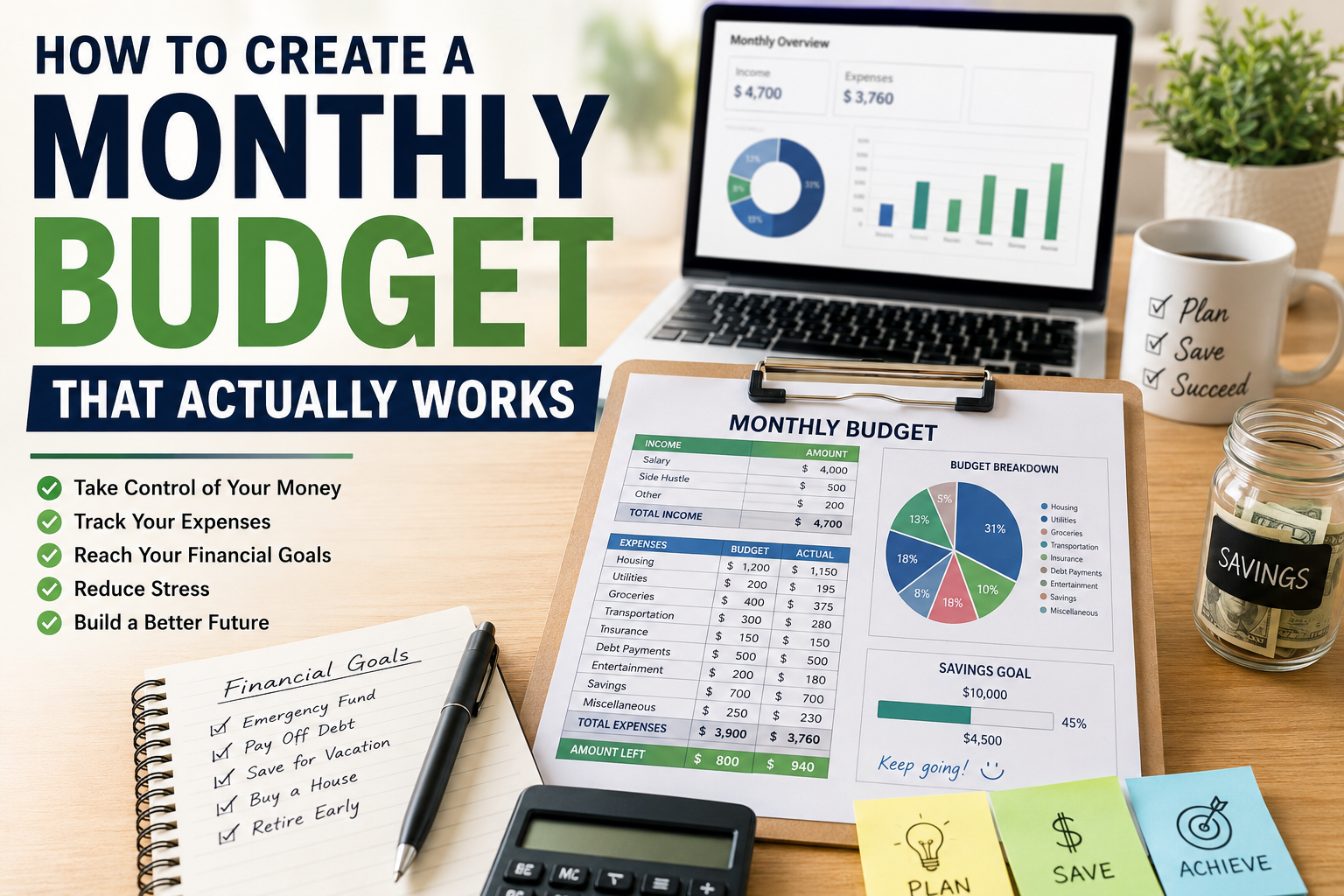
Creating a budget sounds simple.
Spend less than you earn.
Save money for the future.
Avoid unnecessary debt.
Yet despite understanding these basic principles, millions of people struggle to stick with a budget for more than a few weeks.
They start with enthusiasm, download a budgeting app, create a spreadsheet, or write down spending limits on paper. For a short period, everything seems to be going well. Then real life happens.
An unexpected car repair appears. A birthday invitation requires spending money. Grocery prices increase. A family emergency disrupts financial plans. Suddenly, the carefully designed budget no longer reflects reality.
This experience is extremely common.
The problem is not that budgeting doesn’t work. The problem is that many people create budgets that are unrealistic, overly restrictive, or disconnected from their actual spending habits.
Some people try to eliminate every non-essential expense. Others underestimate how much they spend on groceries, transportation, or entertainment. Many forget to account for irregular expenses such as vehicle maintenance, annual subscriptions, holiday shopping, or school-related costs. When these expenses inevitably occur, the budget falls apart.
A budget that actually works should not feel like a punishment.
Instead, it should serve as a practical financial roadmap that helps you balance today’s needs with tomorrow’s goals. A good budget gives you permission to spend money on things that matter while helping you avoid wasteful spending that prevents financial progress.
Whether your goal is to build an emergency fund, pay off debt, save for a home, invest for retirement, or simply gain better control over your finances, learning how to create a realistic monthly budget is one of the most valuable money skills you can develop.
The good news is that budgeting does not require complicated formulas, advanced financial knowledge, or expensive software. Anyone can learn to budget effectively with the right approach.
In this guide, you’ll learn how to create a monthly budget that fits your lifestyle, supports your financial goals, and remains sustainable long after the initial motivation wears off.
What Is a Monthly Budget?
A monthly budget is a spending plan that tells your money where to go before you spend it.
Rather than reaching the end of the month and wondering where your paycheck disappeared, a budget allows you to make intentional decisions about how your income will be used.
It creates a framework that helps you balance essential expenses, personal spending, savings, and financial goals.
Think of a budget as a roadmap for your finances.
When driving to a new destination, most people use a GPS because it provides direction and helps avoid costly mistakes. A budget serves a similar purpose for your money. It helps you navigate financial decisions and stay on course toward your goals.
Budgeting vs. Tracking Spending
Many beginners confuse budgeting with expense tracking.
While the two are related, they are not the same thing.
Expense tracking involves recording where your money has already gone. It is a review of past spending.
Budgeting involves deciding where your money will go before you spend it. It is a plan for future spending.
For example, reviewing your bank statement and discovering that you spent $300 on dining out last month is expense tracking.
Deciding that you will limit dining-out expenses to $150 next month is budgeting.
Both activities are important because they work together. Tracking provides information, while budgeting provides direction.
You're already investing time in improving your finances, and that's something to be proud of. Before you continue, download our free 7 Days To Financial Clarity™ workbook and start putting these ideas into action.

Why Every Dollar Needs a Purpose
One of the biggest reasons people struggle financially is that they spend money without a clear plan.
Small purchases often seem harmless individually.
A coffee here.
A streaming subscription there.
A few online purchases during a sale.
However, when combined over weeks and months, these seemingly minor expenses can consume a significant portion of your income.
A budget helps eliminate this problem by assigning every dollar a purpose.
Your income might be allocated toward:
- Housing expenses
- Transportation
- Groceries
- Savings
- Debt repayment
- Entertainment
- Emergency fund contributions
When every dollar has a job, it becomes much easier to avoid wasteful spending and stay focused on your financial priorities.
Common Budgeting Myths
Many people avoid budgeting because they believe common misconceptions.
One popular myth is that budgets are only necessary for people who struggle financially. In reality, people at every income level benefit from budgeting because managing money effectively is not determined solely by how much you earn.
Another myth is that budgeting eliminates all fun spending. A realistic budget should include room for entertainment, hobbies, vacations, and personal enjoyment. The goal is not to eliminate spending but to spend intentionally.
Some people also believe budgeting is too complicated. While advanced budgeting systems exist, most successful budgets are surprisingly simple. The most effective budget is not the most detailed one. It is the one you consistently follow.
Understanding what a budget truly is helps create the foundation for long-term financial success. However, before building a budget, it is important to understand why so many budgeting attempts fail.
Why Most Budgets Fail
Many people assume budgeting failures occur because they lack discipline.
While discipline plays a role, it is rarely the primary reason budgets fail.
Understanding money is one thing. Seeing your own numbers is where real financial progress begins. Spend one minute using our free Budget Calculator and discover where your money can work harder for you.

Most budgeting problems can be traced back to poor planning, unrealistic expectations, or a misunderstanding of how money habits develop over time.
Understanding these common mistakes can help you avoid them before they derail your financial progress.
Unrealistic Spending Limits
One of the most common budgeting mistakes is creating spending limits based on wishful thinking rather than reality.
For example, imagine someone currently spends $600 per month on groceries. Motivated to save money, they suddenly create a budget that allows only $250 for food.
Although the goal sounds admirable, the budget is disconnected from reality.
After several weeks, they exceed the budget, become frustrated, and conclude that budgeting does not work.
A more effective approach would be gradually reducing spending over time while making realistic adjustments that can be maintained long term.
Successful budgets are built around actual behavior and gradually improved rather than completely transformed overnight.
Forgetting Irregular Expenses
Many expenses do not occur every month.
Examples include:
- Vehicle repairs
- School expenses
- Property taxes
- Holiday shopping
- Birthday gifts
- Annual insurance premiums
- Membership renewals
Because these expenses are less frequent, people often forget to include them in their budget.
Then when the expense arrives, it feels like an unexpected emergency even though it was completely predictable.
One practical solution is creating sinking funds. A sinking fund allows you to save small amounts monthly for expenses you know will eventually occur.
For example, if holiday spending typically costs $600 per year, saving $50 each month makes the expense much easier to manage.
Emotional Spending
Money decisions are often emotional rather than logical.
People frequently spend money when they feel:
- Stressed
- Bored
- Frustrated
- Lonely
- Excited
Retail therapy may provide temporary satisfaction, but it can quickly undermine budgeting efforts.
Consider someone who has a difficult day at work and decides to reward themselves with an expensive online shopping session. The purchase may provide short-term comfort, but it can also create long-term financial stress.
Every financial journey is different. Take our free Financial Goal Assessment to discover which area deserves your attention first and receive a clear direction for your next financial milestone.

Recognizing emotional spending triggers is one of the most powerful budgeting skills you can develop.
Lifestyle Inflation
Lifestyle inflation occurs when spending increases as income increases.
A promotion, raise, or new job often leads to:
- More expensive dining habits
- Larger car payments
- Upgraded subscriptions
- Increased discretionary spending
While improving your lifestyle is not necessarily bad, allowing every income increase to be absorbed by higher spending can prevent wealth building.
Many high-income earners still struggle financially because their spending rises as quickly as their earnings.
A successful budget helps ensure that income growth also contributes to savings, investments, and long-term financial goals.
Lack of Consistent Tracking
Creating a budget is only the beginning.
Without monitoring your spending throughout the month, it becomes difficult to know whether you’re following the plan.
Imagine a pilot taking off and never checking navigation instruments again. Even a small deviation can eventually lead far off course.
Budgeting works the same way.
Regular reviews help identify problems before they become major setbacks.
The encouraging news is that every budgeting mistake discussed above can be corrected. Once you understand where budgets typically fail, you can begin building a system designed for long-term success rather than short-term motivation.
Step 1: Calculate Your Monthly Income
Every successful budget begins with one critical number: your monthly income.
This may seem obvious, but many people create budgets without having a clear understanding of how much money they actually have available to spend. As a result, they unknowingly create budgets that are either too restrictive or too generous.
Your income serves as the foundation of your entire financial plan. Every spending decision, savings goal, and debt repayment strategy depends on accurately knowing how much money enters your household each month.
Gross Income vs. Net Income
One of the first budgeting mistakes beginners make is using gross income instead of net income.
Gross income is the amount you earn before taxes, insurance premiums, retirement contributions, and other deductions are removed.
Net income, often called take-home pay, is the amount that actually reaches your bank account.
For budgeting purposes, your net income is usually the most important figure because it represents the money you actually have available to spend.
For example, if your salary is $4,500 per month but taxes and deductions reduce your take-home pay to $3,600, your budget should be based on $3,600 rather than $4,500.
Using gross income can create unrealistic spending plans that lead to overspending and financial stress.
Identifying All Income Sources
Many people focus only on their primary paycheck and forget additional sources of income.
Common income sources include:
- Salary or hourly wages
- Freelance work
- Side hustles
- Rental income
- Government benefits
- Child support
- Investment income
- Pension payments
Including all regular income sources provides a more accurate picture of your financial situation.
However, avoid including income that is inconsistent or uncertain unless it is reasonably predictable.
For example, if you occasionally sell items online but have no guarantee of future sales, it may be better to treat that money as extra income rather than building it into your core budget.
Budgeting With Variable Income
Not everyone receives the same paycheck every month.
Freelancers, self-employed professionals, commission-based employees, gig workers, and seasonal workers often experience fluctuating income.
This can make budgeting feel more challenging, but it is still possible to create a stable financial plan.
One common strategy is to calculate your average monthly income over the past six to twelve months.
For example:
Month 1: $2,800
Month 2: $3,500
Month 3: $3,000
Month 4: $3,700
Average monthly income: $3,250
Using a conservative average helps reduce the risk of overspending during lower-income months.
Another helpful approach is budgeting based on your lowest typical monthly income. Any income earned above that amount can be directed toward savings, debt repayment, or future financial goals.
Once you understand your income, the next step is identifying exactly where your money is currently going.
Step 2: Track Your Current Spending
Many people believe they know how they spend money.
In reality, spending habits often differ significantly from what people imagine.
Tracking your current spending provides the information needed to build a realistic budget. Without this information, budgeting becomes guesswork.
Think of spending tracking as gathering evidence before making financial decisions.
How to Review Your Spending Habits
The easiest way to begin is by reviewing recent financial records.
Look at:
- Bank statements
- Credit card statements
- Digital wallet transactions
- Payment app histories
- Receipts
Ideally, review at least one month of spending.
Three months provides an even clearer picture because it captures more spending patterns and irregular expenses.
As you review transactions, group purchases into categories such as:
- Housing
- Transportation
- Groceries
- Dining out
- Entertainment
- Shopping
- Savings
- Debt payments
Many people are surprised by what they discover during this process.
Identifying Spending Leaks
A spending leak is a recurring expense that gradually drains money without providing significant value.
Individually, these purchases may seem small.
Collectively, they can have a substantial impact on your finances.
Common spending leaks include:
- Multiple streaming subscriptions
- Frequent takeout meals
- Daily coffee purchases
- In-app purchases
- Unused memberships
- Impulse online shopping
Consider someone who spends:
- $5 daily on coffee
- $15 weekly on convenience-store snacks
- $50 monthly on unused subscriptions
Over a year, those expenses can easily exceed $2,000.
The goal is not necessarily to eliminate every small purchase. Instead, the goal is understanding where your money is going so you can make intentional choices.
Real-Life Example of Hidden Expenses
John believes he spends approximately $100 each month on dining out.
After reviewing his bank statements, he discovers the actual amount is closer to $280.
The difference comes from small purchases he rarely notices:
- Fast food during lunch breaks
- Weekend coffee runs
- Food delivery fees
- Restaurant tips
Because these purchases occur throughout the month, they often go unnoticed.
Once John becomes aware of the true amount, he can make informed decisions about whether that spending aligns with his goals.
Tracking spending is not about judgment.
It is about awareness.
You cannot improve what you do not measure.
After understanding your spending patterns, the next step is organizing expenses into meaningful categories.
Step 3: Categorize Your Expenses
Once you know where your money is going, you need a system for organizing it.
Expense categories help transform a long list of transactions into useful information that supports better financial decisions.
Without categories, budgeting can feel overwhelming.
With categories, it becomes much easier to identify spending patterns and opportunities for improvement.
Fixed Expenses
Fixed expenses remain relatively consistent from month to month.
These are often your most predictable costs.
Examples include:
- Rent or mortgage payments
- Insurance premiums
- Loan payments
- Internet service
- Mobile phone plans
- Subscription services
Because these expenses rarely change significantly, they are usually the easiest part of a budget to plan.
However, fixed expenses often consume a large portion of income, making them important to monitor over time.
Variable Expenses
Variable expenses fluctuate from month to month.
Examples include:
- Groceries
- Fuel
- Dining out
- Entertainment
- Clothing
- Personal care items
These categories offer the greatest flexibility because spending can often be adjusted when necessary.
For example, reducing restaurant spending may be easier than reducing rent.
Many successful budgeting improvements come from managing variable expenses more intentionally.
Irregular Expenses
Irregular expenses occur periodically rather than monthly.
Because they are less frequent, they are often overlooked.
Examples include:
- Vehicle maintenance
- Holiday gifts
- School expenses
- Medical bills
- Annual memberships
- Home repairs
Ignoring these expenses can create major budget disruptions.
Including them in your financial plan helps prevent surprises.
Why Categorization Matters
Imagine trying to improve your physical health without knowing whether you eat vegetables, exercise regularly, or get enough sleep.
The same principle applies to money management.
Categories help you identify strengths and weaknesses in your spending habits.
For example, you may discover:
- Housing costs are reasonable.
- Dining-out expenses are excessive.
- Entertainment spending is lower than expected.
- Savings contributions need improvement.
This information allows you to make targeted adjustments rather than guessing where changes are needed.
Once your expenses are organized, the next step is deciding what you want your money to accomplish.
Step 4: Set Clear Financial Goals
A budget without goals is simply a spending plan.
Financial goals provide direction, motivation, and purpose.
They help answer an important question:
Why am I budgeting in the first place?
People who connect their budget to meaningful goals are often more successful because they can clearly see the benefits of their efforts.
Short-Term Financial Goals
Short-term goals are typically achieved within one year.
Examples include:
- Building a starter emergency fund
- Paying off a small credit card balance
- Saving for a vacation
- Purchasing a new appliance
- Covering holiday expenses
Short-term goals provide quick wins that help build confidence and momentum.
For beginners, these early successes can make budgeting feel rewarding rather than restrictive.
Medium-Term Financial Goals
Medium-term goals often require one to five years to achieve.
Examples include:
- Saving for a vehicle
- Paying off significant debt
- Building a larger emergency fund
- Saving for education expenses
- Starting a business
These goals typically require consistent contributions over an extended period.
A budget helps ensure progress continues month after month.
Long-Term Financial Goals
Long-term goals often take many years to achieve.
Examples include:
- Purchasing a home
- Retirement planning
- Financial independence
- Investment portfolio growth
- Wealth building
Because these goals are further away, it can be easy to postpone them.
However, even small contributions made consistently can produce significant results over time.
Using SMART Financial Goals
One useful framework is the SMART goal system.
A goal should be:
- Specific
- Measurable
- Achievable
- Relevant
- Time-bound
Instead of saying:
“I want to save more money.”
A SMART goal would be:
“I will save $3,000 for an emergency fund within the next 12 months by contributing $250 each month.”
The second goal provides clear direction and makes progress easier to track.
When your financial goals are clearly defined, budgeting becomes more meaningful because every dollar has a purpose beyond simply paying bills.
With your income calculated, spending tracked, expenses categorized, and goals established, you are now ready to choose a budgeting method that fits your lifestyle and financial needs.
Step 5: Choose a Budgeting Method
Once you understand your income, spending habits, expenses, and financial goals, the next step is choosing a budgeting method.
Many beginners assume there is only one correct way to budget. In reality, several effective budgeting systems exist, and the best choice depends on your personality, financial situation, and money management style.
Some people prefer detailed tracking and precise control over every dollar. Others prefer a simpler approach that requires less maintenance. The goal is not to find the perfect budgeting system. The goal is to find one that you can consistently follow.
A budgeting method should make managing money easier, not more stressful.
The following budgeting systems are among the most popular and effective options for beginners.
The 50/30/20 Budget Rule
The 50/30/20 budget rule is one of the simplest and most widely recommended budgeting methods.
It divides your after-tax income into three categories:
- 50% for needs
- 30% for wants
- 20% for savings and debt repayment
Understanding Needs
Needs are essential expenses that support your basic lifestyle.
Examples include:
- Housing
- Utilities
- Groceries
- Transportation
- Insurance
- Minimum debt payments
These are expenses that would be difficult or impossible to eliminate.
For someone earning $4,000 per month after taxes, the needs category would equal approximately $2,000.
Understanding Wants
Wants are expenses that improve your lifestyle but are not strictly necessary for survival.
Examples include:
- Dining out
- Streaming services
- Vacations
- Hobbies
- Entertainment
- Premium subscriptions
For the same $4,000 income, the wants category would equal approximately $1,200.
Many people mistakenly believe budgeting means eliminating wants completely. However, including reasonable lifestyle spending often makes a budget easier to maintain long term.
Understanding Savings and Debt Repayment
The final 20% focuses on improving your financial future.
Examples include:
- Emergency fund contributions
- Retirement investing
- Extra debt payments
- Investment accounts
- Savings goals
For someone earning $4,000 monthly, this category would equal approximately $800.
Advantages of the 50/30/20 Rule
This method is popular because it is:
- Easy to understand
- Simple to implement
- Flexible
- Beginner friendly
It provides structure without requiring detailed tracking of every transaction.
Disadvantages of the 50/30/20 Rule
The rule may not work perfectly for everyone.
People living in high-cost areas often spend more than 50% of their income on necessities. Others may need to allocate more than 20% toward debt repayment.
The percentages should be viewed as guidelines rather than strict rules.
Zero-Based Budgeting
Zero-based budgeting is one of the most powerful budgeting systems available.
Unlike the 50/30/20 rule, which uses broad categories, zero-based budgeting assigns every dollar a specific purpose.
The goal is to ensure that:
Income – Expenses = Zero
This does not mean spending every dollar.
It means every dollar receives an assignment.
How Zero-Based Budgeting Works
Imagine you earn $3,500 monthly.
You might allocate:
- Rent: $1,000
- Utilities: $200
- Transportation: $300
- Groceries: $450
- Savings: $400
- Debt payments: $300
- Entertainment: $150
- Miscellaneous: $700
Every dollar has a job.
Nothing remains unaccounted for.
Why It Works So Well
Zero-based budgeting increases awareness and intentionality.
Instead of wondering where your money went, you know exactly where it was supposed to go.
Many people discover spending habits they never noticed because every expense must fit into a category.
Common Beginner Mistake
A common mistake is making the budget too rigid.
Life rarely follows a perfect plan.
Building flexibility into categories can help prevent frustration when unexpected expenses arise.
Envelope Budgeting
Envelope budgeting is one of the oldest budgeting methods.
Although it originated before digital banking, the concept remains effective today.
How the Envelope System Works
You create spending categories and allocate money to each category.
Traditionally, cash was placed into physical envelopes.
Examples:
- Groceries
- Entertainment
- Dining out
- Fuel
Once the money in an envelope is gone, spending stops until the next budgeting period.
Why It Helps
The envelope system creates clear spending boundaries.
People often spend more carefully when they physically see money leaving an envelope.
Even digital versions of envelope budgeting can create stronger spending awareness.
Best for Overspenders
This method is especially useful for individuals who struggle with impulse purchases or frequently exceed spending limits.
The visual nature of the system creates accountability.
Pay-Yourself-First Budgeting
Many people save whatever money remains at the end of the month.
Unfortunately, there is often very little left.
Pay-yourself-first budgeting reverses this process.
How It Works
The first financial priority becomes saving.
Before spending on discretionary categories, money is automatically allocated toward:
- Emergency savings
- Retirement accounts
- Investments
- Financial goals
For example:
If you earn $3,500 monthly, you might immediately transfer $350 into savings before paying any other bills.
Why This Method Is Effective
Savings become automatic rather than optional.
Because the money is moved before spending begins, there is less temptation to use it elsewhere.
Many successful savers use this method because it prioritizes future financial security.
Common Beginner Mistake
Some people save aggressively while neglecting essential expenses.
A balanced approach is important.
Saving is valuable, but basic obligations must still be covered comfortably.
Which Budgeting Method Is Best for Beginners?
There is no universal answer.
The best budgeting method is the one you can consistently follow.
The 50/30/20 rule works well for people who want simplicity.
Zero-based budgeting works well for people who want detailed control.
Envelope budgeting helps people who struggle with overspending.
Pay-yourself-first budgeting is ideal for people focused on savings goals.
Many successful budgeters combine elements from multiple systems.
For example, someone might use the 50/30/20 framework while also paying themselves first and maintaining sinking funds for irregular expenses.
The important thing is choosing a system that aligns with your lifestyle rather than forcing yourself into a method that feels unsustainable.
Now that you’ve selected a budgeting approach, it’s time to build your actual monthly budget.
Step 6: Build Your Monthly Budget
A budgeting method provides the framework.
Your monthly budget provides the details.
This is where you take everything you’ve learned so far and turn it into a practical spending plan.
Assigning Every Dollar a Job
Regardless of which budgeting method you choose, every dollar should have a purpose.
This does not mean every dollar must be spent.
Some dollars may be assigned to:
- Savings
- Investing
- Debt repayment
- Emergency funds
The key principle is intentionality.
Money that is not assigned often disappears through unplanned spending.
Creating Spending Limits
Once expenses are categorized, establish realistic spending limits.
Avoid the temptation to create overly aggressive budgets.
For example:
If you currently spend $600 monthly on groceries, immediately reducing that amount to $250 is unlikely to succeed.
A more realistic adjustment might be reducing spending gradually to $500 and continuing to improve over time.
Sustainable progress usually outperforms extreme restrictions.
Including Savings Categories
Many budgets focus exclusively on spending.
This is a mistake.
Savings should be treated like a recurring expense.
Important savings categories may include:
Emergency Fund
Protects against unexpected expenses.
Retirement Savings
Supports long-term financial security.
Major Purchases
Helps fund future goals without relying on debt.
Sinking Funds
Prepare for predictable future expenses.
Including these categories in your monthly budget helps ensure financial progress continues consistently.
Building Flexibility Into Your Budget
One reason budgets fail is because they leave no room for unexpected events.
Real life is unpredictable.
Your budget should acknowledge that reality.
A miscellaneous category can act as a financial buffer for:
- Small emergencies
- Last-minute purchases
- Unexpected opportunities
- Minor repairs
Even setting aside $50 to $100 monthly can significantly reduce financial stress.
Real-Life Example
Imagine Sarah earns $3,500 monthly.
Her budget might look like this:
- Housing: $1,000
- Utilities: $200
- Transportation: $300
- Groceries: $450
- Insurance: $150
- Savings: $400
- Debt repayment: $250
- Entertainment: $150
- Dining out: $200
- Miscellaneous: $400
Every dollar is accounted for.
The budget is realistic.
It includes savings.
It allows for enjoyment.
Most importantly, it reflects how Sarah actually lives rather than how she wishes she lived.
A successful budget is not about perfection.
It is about creating a realistic financial plan that you can consistently follow month after month.
The next challenge is preparing for expenses that do not occur every month, which is where many otherwise successful budgets begin to fail.
==============================================
Step 7: Plan for Irregular Expenses
One of the biggest reasons budgets fail is not because people overspend every month.
It is because they forget about expenses that do not occur every month.
These costs often arrive unexpectedly, creating financial stress and disrupting otherwise successful budgets.
The truth is that many so-called “unexpected expenses” are actually predictable.
You may not know the exact date or amount, but you know they will eventually happen.
Examples include:
- Vehicle maintenance
- Holiday shopping
- School expenses
- Property taxes
- Annual insurance premiums
- Home repairs
- Medical costs
- Birthday gifts
A successful budget accounts for these expenses before they occur.
What Are Sinking Funds?
A sinking fund is money set aside regularly for a future expense.
Instead of scrambling to find money when a bill arrives, you save gradually over time.
Think of a sinking fund as a planned savings category with a specific purpose.
Example
Suppose your car insurance costs $600 annually.
Rather than finding $600 all at once, you could save:
$600 ÷ 12 = $50 per month
By the time the bill arrives, the money is already available.
This approach reduces stress and prevents reliance on credit cards or loans.
Annual Bills and Seasonal Expenses
Many people focus only on monthly bills because they occur regularly.
However, annual and seasonal expenses often cause the greatest financial disruption.
Examples include:
Holiday Spending
Many families spend hundreds or even thousands of dollars during the holiday season.
Without preparation, this spending often leads to debt.
Back-to-School Expenses
School supplies, uniforms, and activity fees can quickly become expensive.
Planning throughout the year makes these costs easier to manage.
Annual Memberships
Gym memberships, professional certifications, software subscriptions, and association fees should all be included in long-term budgeting plans.
Preparing for Unexpected Costs
Some expenses cannot be predicted precisely.
Examples include:
- Emergency vehicle repairs
- Medical emergencies
- Appliance breakdowns
- Home maintenance issues
This is where emergency funds become important.
While sinking funds prepare for expected expenses, emergency funds provide protection against truly unexpected events.
A budget that ignores irregular expenses is incomplete.
Planning ahead helps transform financial surprises into manageable events.
Once these expenses are accounted for, the next step is selecting tools that make budgeting easier to maintain.
Step 8: Use Budgeting Tools and Systems
A budget only works if you consistently use it.
Fortunately, modern technology offers numerous tools that simplify budgeting and financial management.
The best budgeting tool is not necessarily the most advanced.
It is the one you will actually use.
Budgeting Apps
Budgeting apps have become increasingly popular because they automate many aspects of financial tracking.
Benefits include:
- Automatic transaction tracking
- Spending categorization
- Budget alerts
- Financial reports
- Goal tracking
Popular budgeting apps include:
YNAB (You Need A Budget)
YNAB focuses heavily on intentional spending and zero-based budgeting principles.
It encourages users to assign every dollar a specific job.
EveryDollar
EveryDollar offers a simple budgeting experience that works well for beginners.
Its straightforward interface makes it easy to create and monitor budgets.
Monarch Money
Monarch provides budgeting, investment tracking, and financial planning features within one platform.
PocketGuard
PocketGuard helps users identify how much money remains available after accounting for bills and savings goals.
Spreadsheets
Many people prefer spreadsheets because they offer complete customization.
Programs such as:
- Microsoft Excel
- Google Sheets
allow users to build personalized budgeting systems.
Advantages include:
- Full control
- No subscription costs
- Flexible design
- Detailed reporting
However, spreadsheets require more manual effort than budgeting apps.
Pen-and-Paper Budgeting
Despite advances in technology, some people still prefer traditional budgeting methods.
Writing expenses by hand can increase awareness because it requires active participation.
Pen-and-paper budgeting may be especially helpful for individuals who feel overwhelmed by technology.
Choosing the Right System
There is no universally perfect budgeting tool.
Consider:
- Your comfort with technology
- Your budgeting style
- Your need for automation
- Your willingness to track expenses manually
A simple system used consistently is usually more effective than a sophisticated system that is abandoned after two weeks.
Once you’ve chosen a budgeting system, the next challenge is staying engaged throughout the month.
Step 9: Track Spending Throughout the Month
Creating a budget at the beginning of the month is important.
Monitoring it throughout the month is equally important.
Many people create budgets and then ignore them until the next month.
This approach often leads to overspending because problems go unnoticed until it is too late to make adjustments.
Tracking spending keeps your budget active and relevant.
Weekly Budget Check-Ins
A weekly review can dramatically improve budgeting success.
Rather than waiting until the end of the month, spend a few minutes reviewing:
- Current spending
- Category balances
- Upcoming expenses
- Savings progress
These reviews help identify potential issues before they become major problems.
Example
Suppose your dining-out budget is $150 monthly.
After two weeks, you discover you have already spent $120.
This information allows you to reduce spending during the remainder of the month rather than exceeding the budget entirely.
Adjusting Categories
Budgets should be flexible.
If one category exceeds expectations, adjustments may be necessary.
For example:
- Lower entertainment spending
- Reduce discretionary purchases
- Delay non-essential expenses
Flexibility prevents minor budgeting mistakes from becoming major setbacks.
Many beginners incorrectly believe budgets are fixed.
In reality, successful budgets adapt to changing circumstances.
Staying Accountable
Accountability increases consistency.
Ways to improve accountability include:
- Budgeting with a spouse
- Using budgeting apps
- Maintaining spending journals
- Scheduling weekly reviews
Consistency matters more than perfection.
Even small improvements made regularly can produce significant long-term results.
Tracking spending helps keep your budget aligned with reality.
The final maintenance step involves reviewing and improving your budget every month.
Step 10: Review and Adjust Monthly
A budget is not something you create once and then forget.
Financial situations evolve constantly.
Income changes.
Expenses change.
Goals change.
As a result, your budget should evolve as well.
Monthly reviews help ensure your budget remains relevant and effective.
Why Budgets Must Evolve
Imagine trying to wear the same size clothing throughout your entire life.
As circumstances change, adjustments become necessary.
Budgets work the same way.
Life events such as:
- New jobs
- Salary increases
- Marriage
- Children
- Relocation
- Debt payoff
- Retirement planning
can significantly affect financial priorities.
Regular reviews allow your budget to adapt accordingly.
Learning From Budget Mistakes
Every budget contains imperfections.
That is normal.
The purpose of reviewing your budget is not to criticize yourself.
The purpose is to learn.
Questions to ask include:
- Which categories exceeded expectations?
- Which categories had money left over?
- Were savings goals achieved?
- Did unexpected expenses occur?
Each answer provides valuable information for future budgeting decisions.
Improving Month After Month
Budgeting is a skill.
Like any skill, improvement comes through practice.
Your first budget will not be perfect.
Your second budget will likely be better.
Over time, you will develop a clearer understanding of:
- Spending habits
- Financial priorities
- Savings opportunities
- Common challenges
These insights help create increasingly accurate and effective budgets.
Real-Life Example
Maria creates her first budget and discovers she consistently exceeds her grocery budget by $75 each month.
Rather than viewing this as failure, she adjusts the category to reflect reality and identifies other areas where spending can be reduced.
Three months later, her budget is significantly more accurate and easier to follow.
The goal of budgeting is not perfection.
The goal is progress.
Each monthly review helps move you closer to financial control and long-term financial success.
Now that you understand how to build and maintain a budget, it is important to address situations that require special budgeting strategies, such as managing irregular income and budgeting with a partner.
Budgeting With Irregular Income
Many budgeting guides assume you receive the same paycheck every month.
For millions of people, that simply is not true.
Freelancers, self-employed individuals, commission-based employees, seasonal workers, and gig economy workers often experience income that fluctuates from month to month. One month may bring strong earnings, while the next month may be significantly lower.
This uncertainty can make budgeting feel difficult, but it does not make budgeting impossible.
In fact, people with irregular income often benefit even more from budgeting because financial planning provides stability during unpredictable periods.
Use Your Lowest Typical Income
One of the safest budgeting strategies is to build your budget around your lowest typical monthly income.
For example, suppose your monthly earnings over the past six months were:
- $3,200
- $4,100
- $3,600
- $2,900
- $4,500
- $3,800
Rather than budgeting based on your highest month, you might use $2,900 as your baseline.
This conservative approach helps ensure essential expenses remain covered even during slower periods.
Any income earned above that amount can be directed toward:
- Savings
- Emergency funds
- Debt repayment
- Future financial goals
Build a Larger Emergency Fund
Emergency funds are important for everyone.
For people with variable income, they are even more critical.
A traditional emergency fund often covers three to six months of expenses.
Individuals with unpredictable income may benefit from saving six to twelve months of essential expenses if possible.
This additional cushion provides protection during periods of reduced earnings.
Separate Personal and Business Finances
For freelancers and self-employed individuals, mixing personal and business expenses can create confusion.
Maintaining separate accounts helps:
- Track income accurately
- Monitor business expenses
- Simplify tax preparation
- Improve budgeting accuracy
Clear separation creates a more organized financial system.
Real-Life Example
James works as a freelance graphic designer.
Some months he earns $5,000.
Other months he earns only $2,800.
Instead of budgeting based on his best months, James creates a budget using his lowest average income level.
When higher-income months occur, he saves the extra money.
This strategy allows him to maintain financial stability throughout the year despite income fluctuations.
While irregular income presents unique challenges, budgeting becomes even more important because it creates structure during uncertainty.
Another budgeting challenge many people face involves managing finances with a spouse or partner.
Budgeting as a Couple
Money is one of the most common sources of stress within relationships.
Even couples who communicate well can encounter disagreements when it comes to spending, saving, and financial priorities.
A shared budget helps reduce confusion and encourages teamwork.
The goal is not to control each other’s spending.
The goal is to create a financial plan that supports shared goals and reduces conflict.
Establish Shared Financial Goals
Before discussing numbers, discuss priorities.
Questions to consider include:
- Do we want to buy a home?
- Are we saving for children?
- How important is travel?
- What retirement lifestyle do we want?
When couples focus on shared goals, budgeting often feels less restrictive and more purposeful.
Instead of arguing about individual purchases, both partners can focus on achieving common objectives.
Combining Finances vs. Separate Finances
There is no single correct approach.
Some couples combine all finances.
Others maintain separate accounts.
Many use a hybrid approach.
Combined Finances
Advantages include:
- Simplicity
- Shared responsibility
- Easier goal tracking
Potential challenges include:
- Different spending habits
- Reduced financial independence
Separate Finances
Advantages include:
- Greater flexibility
- Individual autonomy
Potential challenges include:
- More coordination
- Potential misunderstandings
The best approach depends on the couple’s preferences and circumstances.
Schedule Regular Money Discussions
Many financial disagreements occur because conversations happen only when problems arise.
Regular financial check-ins help prevent misunderstandings.
Monthly discussions can cover:
- Budget performance
- Upcoming expenses
- Savings progress
- Financial goals
Open communication strengthens both financial management and relationships.
Real-Life Example
Sarah and Michael frequently argued about spending.
Sarah prioritized saving.
Michael enjoyed dining out and entertainment.
After creating a shared budget and agreeing on spending categories, both felt more comfortable because expectations became clear.
Their budget provided structure without eliminating personal choice.
Budgeting as a couple is less about numbers and more about communication, transparency, and shared goals.
Regardless of whether you budget alone or with a partner, avoiding common mistakes can significantly improve your chances of success.
Common Budgeting Mistakes to Avoid
Even well-designed budgets can fail if certain mistakes repeatedly occur.
Understanding these common pitfalls can save time, frustration, and money.
Ignoring Small Purchases
Many people focus on large expenses while overlooking smaller purchases.
Examples include:
- Coffee purchases
- Snacks
- App subscriptions
- Convenience-store purchases
Individually, these expenses may seem insignificant.
Collectively, they can consume hundreds or even thousands of dollars annually.
How to Avoid It
Track spending carefully and review recurring purchases regularly.
Small adjustments can create surprisingly large savings over time.
Forgetting Annual Expenses
Many budgets account for monthly bills but ignore annual costs.
Examples include:
- Insurance renewals
- Holiday shopping
- Property taxes
- Membership fees
When these expenses arrive unexpectedly, people often rely on debt.
How to Avoid It
Create sinking funds and save gradually throughout the year.
Planning ahead transforms large expenses into manageable monthly contributions.
Not Having an Emergency Fund
Unexpected expenses happen to everyone.
Without emergency savings, even minor setbacks can create financial stress.
Examples include:
- Medical expenses
- Vehicle repairs
- Appliance replacements
How to Avoid It
Start small.
Even saving a few hundred dollars can provide valuable financial protection while building toward a larger emergency fund.
Quitting After One Bad Month
Many beginners assume a budget has failed if they exceed spending limits.
This mindset often leads people to abandon budgeting entirely.
How to Avoid It
Treat mistakes as learning opportunities.
Review what happened, make adjustments, and continue moving forward.
Progress matters far more than perfection.
Budgeting for a Perfect Month
Life is unpredictable.
Many people create budgets based on ideal circumstances rather than realistic conditions.
Unexpected events are inevitable.
How to Avoid It
Build flexibility into your budget through emergency funds, miscellaneous categories, and realistic expectations.
A flexible budget is usually more successful than a rigid one.
Understanding these mistakes can help you avoid many of the frustrations that cause people to abandon budgeting altogether.
However, even successful budgets require patience and realistic expectations.
Realistic Expectations: Your First 90 Days of Budgeting
One of the biggest budgeting mistakes is expecting immediate perfection.
Budgeting is a skill.
Like learning to drive, cook, or exercise consistently, improvement takes time.
Understanding what typically happens during the first few months can help you stay motivated.
Month 1: Awareness
The first month often reveals surprising spending habits.
Many people discover:
- They spend more than expected on dining out.
- Subscription costs add up quickly.
- Small purchases occur more frequently than realized.
This month is primarily about learning.
The goal is awareness rather than perfection.
Month 2: Adjustment
During the second month, most people begin refining their budget.
They adjust spending categories based on real-world experience.
For example:
- Increasing grocery budgets
- Reducing entertainment budgets
- Adding sinking funds
The budget starts becoming more realistic and personalized.
Month 3: Improvement
By the third month, spending patterns become easier to predict.
Financial decisions become more intentional.
Many people notice:
- Reduced financial stress
- Better spending habits
- Increased savings
- Improved confidence
The budget begins functioning as a practical financial tool rather than an experiment.
What Success Really Looks Like
Many people imagine budgeting success means never overspending.
In reality, success looks different.
Successful budgeting means:
- Understanding where your money goes.
- Making intentional financial decisions.
- Progressing toward goals.
- Recovering quickly from mistakes.
The most successful budgeters are not perfect.
They are consistent.
Over time, consistent budgeting creates stronger financial habits, greater confidence, and improved financial security.
Now that you’ve learned how budgeting works in real-world situations, let’s look at several detailed examples showing how different people can successfully apply these principles.
Real-Life Budget Examples
Learning budgeting concepts is important, but seeing how those concepts work in real life can make them easier to understand and apply.
The following examples demonstrate how different people might structure their budgets based on their income, responsibilities, and financial goals.
Remember that there is no perfect budget.
The goal is to create a spending plan that reflects your circumstances while supporting your financial priorities.
Single Professional Budget Example
Jessica is a 28-year-old marketing professional who earns $4,000 per month after taxes.
Her primary goals are building an emergency fund and saving for a future home purchase.
Monthly Income
$4,000
Monthly Expenses
- Rent: $1,200
- Utilities: $200
- Groceries: $400
- Transportation: $250
- Insurance: $150
- Dining Out: $200
- Entertainment: $150
- Emergency Fund: $500
- Home Down Payment Savings: $500
- Miscellaneous: $450
Why This Budget Works
Jessica prioritizes savings while still allowing room for entertainment and personal spending.
She understands that budgeting should support her goals without making her feel deprived.
Because she has assigned every dollar a purpose, she knows exactly how her money contributes to both current needs and future objectives.
Family Budget Example
David and Lisa have two children and a combined monthly income of $6,500 after taxes.
Their priorities include household stability, children’s expenses, and retirement planning.
Monthly Income
$6,500
Monthly Expenses
- Mortgage: $1,800
- Utilities: $350
- Groceries: $900
- Transportation: $600
- Insurance: $450
- Child Activities: $300
- Dining Out: $250
- Entertainment: $200
- Emergency Fund: $500
- Retirement Savings: $700
- Miscellaneous: $450
Why This Budget Works
Family budgets often involve more categories because multiple people are involved.
David and Lisa ensure essential expenses are covered while continuing to save for future goals.
Their budget also includes flexibility for unexpected family-related costs.
Freelancer Budget Example
Mark is a freelance web designer whose income varies from month to month.
His average monthly income is approximately $3,500.
Because his earnings fluctuate, he budgets conservatively.
Monthly Income
$3,500
Monthly Expenses
- Housing: $1,000
- Utilities: $200
- Transportation: $250
- Groceries: $400
- Business Expenses: $250
- Insurance: $150
- Emergency Fund: $500
- Tax Savings: $350
- Entertainment: $150
- Miscellaneous: $250
Why This Budget Works
Mark understands that variable income creates additional uncertainty.
By maintaining larger savings categories and budgeting conservatively, he reduces financial stress during slower business months.
These examples demonstrate an important budgeting principle:
A successful budget reflects individual circumstances rather than following a one-size-fits-all formula.
Benefits of Having a Monthly Budget
Many people initially view budgeting as a restriction.
In reality, budgeting is one of the most effective tools for increasing financial freedom.
A well-designed budget helps you gain control over your money instead of wondering where it went.
Reduced Financial Stress
Financial uncertainty is a major source of stress for many households.
When people do not know whether they can cover upcoming expenses, anxiety often increases.
A budget creates clarity.
Knowing that bills, savings goals, and future expenses have been planned for can provide significant peace of mind.
Faster Savings Growth
Without a budget, saving often becomes an afterthought.
Money is spent first, and whatever remains is saved.
Unfortunately, little is often left over.
A budget reverses this process by making savings a planned priority.
Over time, consistent saving can lead to:
- Emergency funds
- Vacation funds
- Home down payments
- Investment growth
Better Spending Habits
Budgeting increases awareness.
When people understand where their money is going, they often make more intentional spending decisions.
This does not mean eliminating enjoyment.
It means spending money on things that truly matter while reducing wasteful spending.
Improved Debt Management
Many people use budgeting to accelerate debt repayment.
A budget helps identify opportunities to direct extra money toward:
- Credit cards
- Personal loans
- Auto loans
- Student loans
Faster debt repayment can reduce interest costs and improve overall financial health.
Greater Financial Confidence
Money can feel overwhelming when there is no plan.
A budget creates structure and direction.
As people gain experience managing their finances, confidence naturally increases.
Financial confidence often leads to better decision-making and stronger long-term habits.
Ultimately, budgeting is not just about managing money.
It is about creating opportunities and reducing financial uncertainty.
Final Thoughts
Creating a monthly budget that actually works is not about restricting every dollar you spend.
It is about creating a realistic plan that helps you align your spending with your goals and priorities.
Many people avoid budgeting because they believe it will make life less enjoyable. In reality, a well-designed budget can provide greater freedom because it allows you to spend intentionally rather than impulsively.
Throughout this guide, you learned how to:
- Calculate your income accurately.
- Track your spending habits.
- Categorize expenses effectively.
- Set meaningful financial goals.
- Choose an appropriate budgeting method.
- Plan for irregular expenses.
- Adjust your budget over time.
- Avoid common budgeting mistakes.
You also learned that budgeting is not a one-time event.
It is an ongoing process.
Your first budget will probably not be perfect.
That is completely normal.
The most successful budgeters are not those who never make mistakes. They are the people who consistently review, adjust, and improve their financial plans over time.
If you feel overwhelmed, start small.
Track your spending.
Create a few categories.
Set one financial goal.
Make one improvement at a time.
Small changes repeated consistently can produce remarkable results over the long term.
A budget is more than a spreadsheet, an app, or a list of numbers.
It is a tool that helps you take control of your financial future.
The sooner you begin using that tool intentionally, the sooner you can start making progress toward the financial life you want to build.
Frequently Asked Questions
How much should I save each month?
A common recommendation is to save at least 20% of your income. However, the ideal amount depends on your financial goals, expenses, and current obligations. If saving 20% feels unrealistic, start with a smaller amount and increase contributions over time. Consistency is often more important than the initial percentage.
What is the easiest budgeting method for beginners?
The 50/30/20 budget rule is often considered the easiest method because it provides simple guidelines without requiring detailed transaction tracking. Many beginners find it less overwhelming than more detailed budgeting systems while still providing enough structure to improve money management.
Should I budget if I have a low income?
Yes. Budgeting is beneficial at every income level. In fact, people with limited income often gain significant value from budgeting because it helps prioritize essential expenses, reduce wasteful spending, and maximize available resources. Budgeting is about managing money effectively, not simply having more money.
How often should I review my budget?
Most people benefit from reviewing their budget at least once per week and conducting a more detailed review at the end of each month. Frequent reviews help identify problems early and allow adjustments before spending habits move too far off track.
Can budgeting help me get out of debt?
Absolutely. Budgeting helps identify money that can be redirected toward debt repayment. It also reduces unnecessary spending that may contribute to additional debt. Many people successfully pay off credit cards, personal loans, and other debts through consistent budgeting.
What is zero-based budgeting?
Zero-based budgeting is a method that assigns every dollar of income a specific purpose. The goal is for income minus expenses to equal zero, meaning every dollar has a job. This approach encourages intentional spending and often increases financial awareness.
Can I budget with irregular income?
Yes. Many freelancers, contractors, and commission-based workers successfully use budgets. The key is creating a budget based on average or lower-end income levels while using higher-income months to build savings and financial stability.
Should I budget if I use credit cards?
Yes. Credit cards should be included in your budgeting process just like cash or debit card spending. A budget helps ensure credit card purchases remain affordable and can be paid off without accumulating unnecessary debt.
How much should I keep in an emergency fund?
A common recommendation is to save three to six months of essential living expenses. Individuals with irregular income may benefit from larger emergency funds. Building an emergency fund gradually is often more realistic than attempting to save the full amount immediately.
Is budgeting worth it if I earn a good salary?
Yes. High income does not automatically lead to financial success. Many high-income earners struggle financially because spending rises along with earnings. Budgeting helps ensure income growth contributes to savings, investments, and long-term financial goals rather than unnecessary lifestyle inflation.
You have invested time learning today. Now take the next step by downloading our free 7 Days To Financial Clarity™ workbook and begin building a stronger financial future.
