
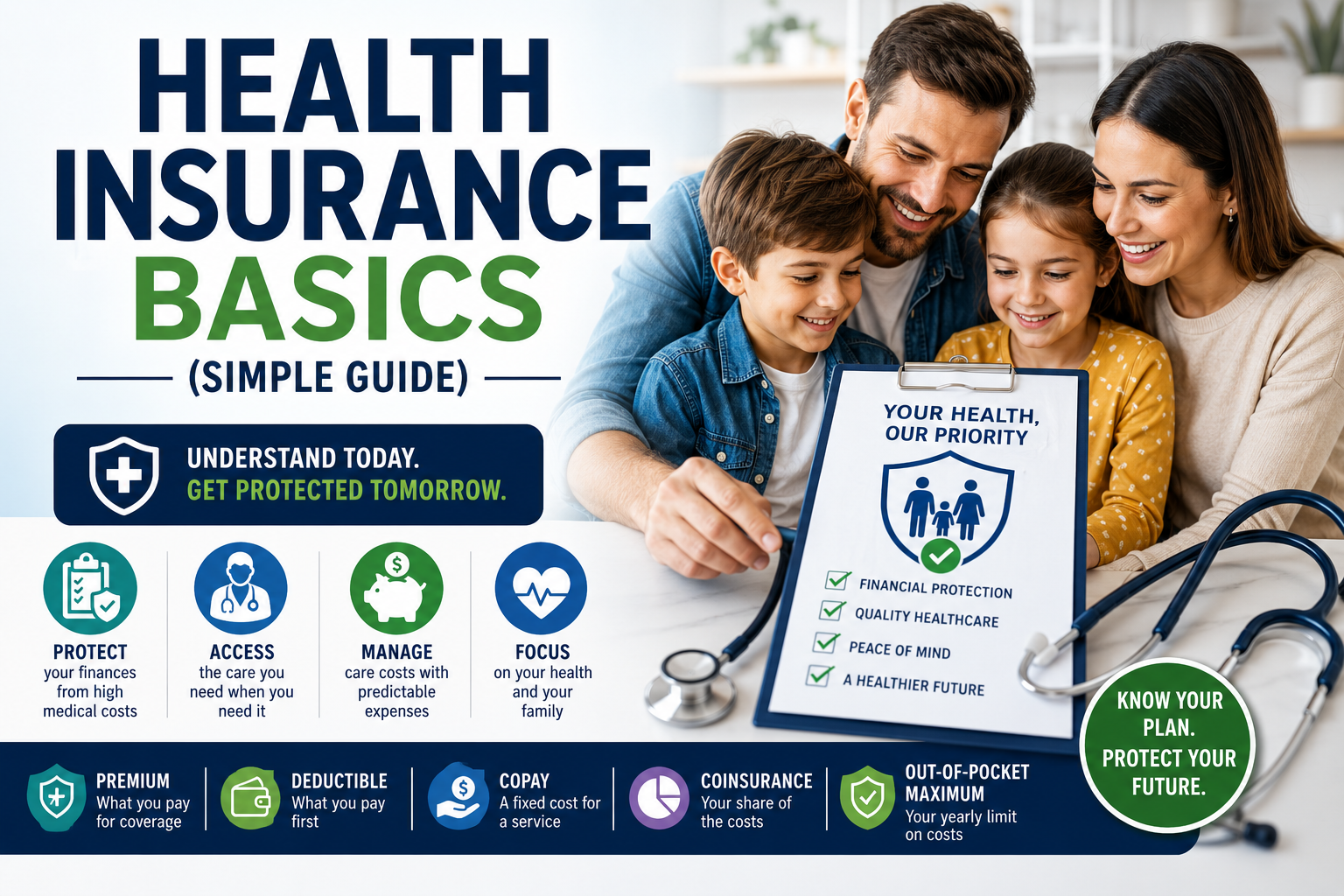
Health insurance is one of the most important financial tools available today, yet it is also one of the most misunderstood.
Many people purchase health insurance because they know they should have it, but they don’t fully understand how it works. Others avoid it altogether because the terminology seems confusing, the costs seem high, or they assume they won’t need it.
The problem is that healthcare can be extremely expensive.
A routine doctor’s visit may cost a relatively small amount, but emergency room visits, surgeries, hospital stays, and ongoing medical treatments can quickly result in bills totaling thousands or even tens of thousands of dollars.
Without health insurance, these expenses typically become your responsibility.
This is why health insurance exists.
At its core, health insurance helps protect individuals and families from potentially overwhelming medical costs. Instead of paying the full cost of healthcare services yourself, you share those costs with an insurance company according to the terms of your policy.
However, many beginners struggle to understand concepts such as:
- Premiums
- Deductibles
- Copayments
- Coinsurance
- Provider networks
These terms can make health insurance feel far more complicated than it really is.
The good news is that once you understand a few basic concepts, health insurance becomes much easier to navigate.
You don’t need to become an insurance expert.
You simply need to understand how the system works, what you’re paying for, and how to choose coverage that fits your needs.
Throughout this article, you’ll learn:
- What health insurance is
- How health insurance works
- Common health insurance terms
- The different types of plans available
- What health insurance typically covers
- Common mistakes to avoid
- How to choose the right plan
By the end, you’ll have a much clearer understanding of health insurance and be better prepared to make informed healthcare and financial decisions.
Let’s begin with the most basic question.
What exactly is health insurance?
What Is Health Insurance?
Health insurance is a financial agreement between you and an insurance company.
In exchange for regular payments, known as premiums, the insurance company agrees to help pay for certain healthcare expenses covered under your policy.
Rather than facing the full cost of medical care alone, health insurance helps spread financial risk across many people who contribute to the insurance system.
This protection can be valuable because healthcare costs are often unpredictable.
Nobody plans for an accident, unexpected illness, or medical emergency.
Health insurance helps reduce the financial burden when those situations occur.
A Simple Definition
Health insurance is a type of coverage that helps pay for medical expenses.
Depending on your policy, health insurance may help cover costs related to:
- Doctor visits
- Hospital stays
- Emergency care
- Prescription medications
- Preventive services
- Laboratory tests
- Specialist appointments
The amount covered varies based on the specific plan.
In most cases, both you and the insurance company share healthcare costs.
This shared responsibility is one of the core principles behind health insurance.
Why Health Insurance Exists
Healthcare is expensive.
Even relatively simple medical services can cost hundreds or thousands of dollars.
For example:
A broken arm may require:
- Emergency room treatment
- X-rays
- Follow-up appointments
- Physical therapy
Each service generates costs.
Without insurance, those expenses would generally be paid entirely by the patient.
Health insurance exists to help protect people from these potentially overwhelming financial burdens.
It allows individuals to access healthcare while reducing the risk of major financial hardship.
How Health Insurance Works
Although health insurance policies can vary, the basic concept is fairly straightforward.
Step 1: You Purchase Coverage
You enroll in a health insurance plan and agree to pay premiums.
These payments help fund the insurance system.
Step 2: You Receive Medical Care
When you need healthcare services, you visit a doctor, clinic, hospital, or other healthcare provider.
Step 3: Costs Are Shared
Depending on your policy:
- The insurance company pays part of the cost.
- You pay part of the cost.
Exactly how those costs are divided depends on the details of your plan.
We’ll explore this process in greater detail later in the article.
The Basic Relationship Between You, the Insurer, and Healthcare Providers
Many beginners find it helpful to think of health insurance as involving three parties.
You
The policyholder who receives healthcare services and pays premiums.
The Insurance Company
The organization that helps cover eligible healthcare expenses according to the policy.
Healthcare Providers
Doctors, hospitals, specialists, clinics, and other professionals who provide medical care.
When everything works together properly, healthcare services become more affordable and accessible than they might otherwise be.
Understanding this relationship provides a strong foundation for learning how health insurance functions in real-world situations.
Now let’s explore why health insurance is considered so important.
Why Health Insurance Is Important
Some people view health insurance as just another monthly bill.
In reality, it serves a much larger purpose.
Health insurance helps protect both your health and your finances.
A medical emergency can occur at any time, regardless of age, income, or lifestyle.
Having coverage in place before that happens can make a significant difference.
Rising Healthcare Costs
One reason health insurance is so important is the increasing cost of healthcare services.
Medical technology has advanced dramatically over the years, improving treatment options and patient outcomes.
However, these advancements often come with higher costs.
Expenses can accumulate quickly through:
- Hospital stays
- Surgeries
- Emergency treatment
- Diagnostic testing
- Prescription medications
Even a relatively short hospital visit can result in substantial medical bills.
Without insurance, many families would struggle to absorb these unexpected costs.
You’re already investing time in improving your finances, and that’s something to be proud of. Before you continue, download our free 7 Days To Financial Clarity™ workbook and start putting these ideas into action.

Protection Against Unexpected Medical Bills
Nobody can predict when they will need medical care.
A healthy person can experience:
- An accident
- A sudden illness
- An unexpected diagnosis
at any time.
Health insurance acts as a financial safety net.
Instead of paying the full cost of treatment yourself, the insurance company helps cover eligible expenses.
This protection can prevent medical situations from becoming financial crises.
Access to Healthcare Services
Health insurance often improves access to healthcare.
People with coverage are generally more likely to:
- Visit doctors regularly
- Receive preventive care
- Seek treatment earlier
- Manage chronic conditions effectively
Without insurance, some individuals delay care because they are concerned about costs.
Unfortunately, delaying treatment can sometimes lead to more serious health problems later.
Financial Peace of Mind
One of the most overlooked benefits of health insurance is peace of mind.
Knowing that you have financial protection can reduce stress when health concerns arise.
You may still have healthcare expenses.
However, you’re generally less likely to face the full financial burden of major medical events.
For many families, this security is one of the most valuable aspects of having health insurance.
Real-Life Example
Imagine two individuals.
Sarah Has Health Insurance
Sarah experiences severe abdominal pain and requires emergency surgery.
Her total medical expenses reach $35,000.
Because she has health insurance, a significant portion of the costs are covered according to her policy.
Although she still pays some expenses, the financial impact is manageable.
Michael Has No Health Insurance
Michael experiences the same medical emergency.
Without insurance, he becomes responsible for the full cost of treatment.
The resulting medical bills create substantial financial pressure and may take years to repay.
The Lesson
Neither Sarah nor Michael expected a medical emergency.
The difference was preparation.
Health insurance helped protect Sarah from a financial situation that could have become overwhelming.
This example illustrates why many people consider health insurance one of the most important forms of financial protection available.
Before choosing a health insurance plan, it’s important to understand exactly how the system works when you receive medical care. That’s what we’ll explore next.
How Health Insurance Works
Many people purchase health insurance without fully understanding what happens when they actually use it.
They know they pay a monthly premium, but they’re often surprised when they still receive medical bills after visiting a doctor or hospital.
This confusion is completely understandable.
Health insurance is not designed to pay every healthcare expense in every situation.
Instead, it helps share healthcare costs between you and the insurance company according to the rules of your policy.
Once you understand this cost-sharing arrangement, health insurance becomes much easier to navigate.
Paying Monthly Premiums
The first step in having health insurance is paying your premium.
A premium is the amount you pay to maintain your coverage.
Think of it as a membership fee that keeps your health insurance active.
Premiums are typically paid:
- Monthly
- Quarterly
- Annually
depending on the insurance plan.
Even if you don’t visit a doctor during a particular month, your premium must still be paid to maintain coverage.
Why Premiums Exist
Insurance companies collect premiums from many policyholders.
These funds help pay for medical claims submitted by people who need healthcare services.
This system spreads financial risk across a large group of individuals.
For example:
Imagine 10,000 people have health insurance.
Most will only require routine healthcare in a given year.
A smaller number may experience serious illnesses or medical emergencies.
Premiums collected from all policyholders help cover these healthcare expenses.
This risk-sharing model is one of the foundations of health insurance.
Real-Life Example
Suppose your monthly premium is:
$300
Whether you visit a doctor that month or not, you continue paying the premium to keep your coverage active.
Many beginners mistakenly assume premiums pay for all healthcare costs.
In reality, premiums are only one part of the overall cost-sharing process.
Receiving Medical Care
When you need healthcare services, you visit a healthcare provider.
Examples include:
- Primary care doctors
- Specialists
- Urgent care centers
- Hospitals
- Emergency rooms
- Laboratories
The provider delivers the healthcare service and submits billing information according to your insurance plan.
At this stage, your insurance coverage begins affecting how costs are divided.
Depending on your policy, some services may be covered immediately, while others may require you to pay part of the cost first.
The exact details depend on factors such as:
- Your deductible
- Copayments
- Coinsurance
- Provider network status
We’ll examine these terms in greater detail later.
For now, it’s important to understand that receiving care initiates the cost-sharing process.
Insurance Pays Part of the Cost
One of the biggest misconceptions about health insurance is that the insurer pays every medical bill.
This is rarely the case.
Instead, the insurance company generally pays a portion of eligible expenses after the rules of your policy have been applied.
The amount paid by the insurer depends on:
- The healthcare service received
- Your plan’s coverage terms
- Whether you’ve met your deductible
- Whether the provider is in-network
In many cases, the insurance company negotiates lower rates with healthcare providers.
This means insured patients often benefit from reduced costs even before insurance contributions are applied.
Why This Matters
Negotiated rates can significantly reduce healthcare expenses.
For example:
A hospital may charge:
$1,000
for a service.
However, the negotiated insurance rate may reduce that cost to:
$700
before additional insurance benefits are applied.
This is one reason health insurance can provide value even when you’re still responsible for some healthcare costs.
You Pay Part of the Cost
Although insurance helps cover expenses, policyholders are usually responsible for a portion of healthcare costs.
This cost-sharing arrangement helps keep insurance systems financially sustainable.
Common expenses paid by policyholders include:
- Premiums
- Deductibles
- Copayments
- Coinsurance
The exact amount varies depending on the plan.
Generally speaking:
Plans with lower monthly premiums often require higher cost-sharing when healthcare services are used.
Plans with higher premiums may reduce some out-of-pocket costs.
Understanding this trade-off is essential when comparing plans.
Why Cost Sharing Exists
Cost sharing serves several purposes.
It helps:
- Reduce unnecessary healthcare utilization
- Control insurance costs
- Encourage responsible use of healthcare services
While nobody enjoys paying medical expenses, cost sharing helps make insurance systems more sustainable over time.
Step-by-Step Example of a Doctor Visit
Now let’s walk through a simplified example to see how health insurance works in practice.
This example is designed for educational purposes and may not reflect every policy.
However, it demonstrates the basic flow of healthcare costs.
Step 1: Schedule an Appointment
Emily develops a persistent cough and schedules an appointment with her primary care physician.
Because she has health insurance, she chooses an in-network doctor covered by her plan.
This helps reduce her costs.
Step 2: Visit the Doctor
During the appointment, the physician:
- Conducts an examination
- Reviews symptoms
- Provides treatment recommendations
The total cost of the visit is:
$200
Step 3: Insurance Processes the Claim
The doctor’s office submits the claim to Emily’s insurance company.
The insurer reviews:
- The service provided
- Network status
- Coverage rules
- Cost-sharing requirements
Step 4: Cost Sharing Is Applied
Depending on Emily’s plan, several outcomes are possible.
Scenario A: Fixed Copay
Emily pays:
$30
copay.
Insurance pays the remaining covered amount.
Scenario B: Deductible Applies
If Emily has not yet met her deductible, she may be responsible for a larger portion of the visit cost.
Scenario C: Coinsurance Applies
If the deductible has already been met, Emily may pay a percentage of the cost while insurance pays the remainder.
The exact result depends on her policy.
Step 5: Emily Receives Care at a Lower Cost
Instead of paying the entire $200 herself, Emily shares costs with the insurance company according to her plan.
This illustrates the primary purpose of health insurance:
Reducing the financial burden associated with healthcare services.
A Simple Way to Think About Health Insurance
Many beginners find health insurance intimidating because of the terminology.
A simple way to think about it is this:
Premium
What you pay to maintain coverage.
Healthcare Provider
The doctor, hospital, or healthcare professional who provides care.
Insurance Company
The organization that helps cover eligible medical expenses.
Cost Sharing
The portion of expenses divided between you and the insurer.
At its core, health insurance is simply a system that helps spread healthcare costs over time rather than forcing individuals to pay the full cost of medical care on their own.
The next step is learning the most important health insurance terms you’ll encounter. Understanding concepts such as deductibles, copays, coinsurance, and out-of-pocket maximums will make choosing and using health insurance much easier.
Common Health Insurance Terms Explained
One of the biggest reasons people find health insurance confusing is the language used to describe it.
Terms such as deductible, copay, coinsurance, and out-of-pocket maximum often appear in policy documents, advertisements, and enrollment forms.
For someone purchasing health insurance for the first time, these terms can feel overwhelming.
The good news is that once you understand a few key definitions, most health insurance plans become much easier to compare and evaluate.
Let’s break down the most important terms you’ll encounter.
Premium
The premium is one of the simplest health insurance terms to understand.
It is the amount you pay to maintain your health insurance coverage.
Think of it as the cost of keeping your insurance active.
What It Means
A premium is paid regardless of whether you use healthcare services.
Just like a car insurance payment keeps your vehicle insured, a health insurance premium keeps your medical coverage in force.
Premiums may be paid:
- Monthly
- Quarterly
- Annually
Most people pay premiums monthly.
Important Point
Paying your premium does not mean all healthcare services become free.
Many beginners mistakenly believe that once they pay their premium, the insurance company covers everything.
In reality, premiums are only one part of the cost-sharing system.
Real-Life Example
Imagine you have a health insurance plan with a monthly premium of:
$350
Every month, you pay:
$350
to maintain your coverage.
Even if you don’t visit a doctor that month, the premium remains due.
In return, you have access to the benefits and protections provided by your plan.
Deductible
The deductible is one of the most important health insurance concepts to understand.
It often has the biggest impact on how much you pay when receiving medical care.
What It Means
A deductible is the amount you must pay for covered healthcare services before your insurance company begins sharing costs for many services.
Think of it as your contribution before insurance starts helping with certain expenses.
Simple Definition
You pay first.
Then insurance begins helping.
However, some preventive services may still be covered before the deductible is met.
Policy details vary, which is why reviewing plan documents is important.
Real-Life Example
Suppose your health insurance plan has a:
$2,000 deductible
If you receive medical services costing:
$1,500
you may be responsible for paying the entire amount because you haven’t yet reached your deductible.
If later in the year you incur another:
$1,000
in covered expenses:
- The remaining $500 completes your deductible.
- Insurance may then begin sharing costs according to your plan.
This is why understanding deductibles is so important when evaluating health insurance options.
Common Beginner Mistake
Many people focus only on monthly premiums and ignore deductibles.
A plan with a low premium may have a very high deductible.
This can result in higher out-of-pocket costs when healthcare services are needed.
Copayment (Copay)
A copayment, often called a copay, is a fixed amount you pay for certain healthcare services.
What It Means
Instead of paying the full cost of a service, you pay a predetermined amount.
The insurance company pays the remaining covered portion.
Copays commonly apply to:
- Doctor visits
- Specialist appointments
- Prescription medications
- Urgent care visits
The amount varies depending on the service and plan.
Real-Life Example
Suppose your plan includes:
$25 primary care copay
You visit your doctor for a routine appointment.
The total cost of the visit may be:
$180
However, your copay is:
$25
You pay:
$25
and the insurance company covers the remaining eligible amount according to your plan.
Why Copays Matter
Copays provide predictability.
Rather than wondering how much a routine appointment will cost, you know the amount in advance.
This makes budgeting for healthcare easier.
Coinsurance
Coinsurance is another form of cost sharing.
Unlike a copay, which is a fixed amount, coinsurance is a percentage of the healthcare cost.
What It Means
After your deductible has been met, you and the insurance company may share costs based on percentages.
For example:
- Insurance pays 80%
- You pay 20%
This percentage you pay is your coinsurance.
Real-Life Example
Imagine you’ve already met your deductible.
You receive a covered medical procedure costing:
$1,000
Your plan includes:
20% coinsurance
Insurance pays:
$800
You pay:
$200
The exact percentages vary depending on the plan.
Common arrangements include:
- 80/20
- 90/10
- 70/30
The higher the insurer’s percentage, the lower your coinsurance responsibility.
Common Beginner Mistake
Many people confuse copays and coinsurance.
Remember:
- Copay = fixed dollar amount
- Coinsurance = percentage of the cost
Understanding this distinction helps prevent surprises when reviewing medical bills.
Out-of-Pocket Maximum
The out-of-pocket maximum is one of the most valuable protections provided by health insurance.
Unfortunately, many people overlook it when comparing plans.
What It Means
The out-of-pocket maximum is the most you will generally pay for covered healthcare services during a policy year.
Once you reach this limit, the insurance company typically pays 100% of covered eligible expenses for the remainder of the year.
This protection helps prevent catastrophic medical costs.
Why It Matters
Without an out-of-pocket maximum, serious illnesses or major medical events could create enormous financial burdens.
The out-of-pocket maximum places a cap on your financial exposure.
This can provide significant peace of mind.
Real-Life Example
Suppose your plan includes:
- $3,000 deductible
- 20% coinsurance
- $8,000 out-of-pocket maximum
During the year, you experience a major illness requiring extensive treatment.
After your total eligible healthcare spending reaches:
$8,000
the insurance company generally covers 100% of additional covered expenses for the remainder of the policy year.
This protection can save policyholders thousands of dollars during major medical events.
Life is full of unexpected expenses, but being prepared can make all the difference. Use our free Emergency Fund Calculator to discover how much you should save and create a financial cushion that gives you greater peace of mind when life throws you a surprise.

Understanding the Cost-Sharing Process
Now that you understand the key terms, let’s see how they work together.
Many people learn the definitions individually but still struggle to understand how healthcare costs actually flow through a health insurance plan.
The cost-sharing process ties everything together.
How Premiums Work
Premiums keep your coverage active.
Think of premiums as the price of membership in the health insurance system.
Without paying premiums, you generally lose access to coverage.
Premiums do not count toward your deductible.
This surprises many first-time insurance buyers.
How Deductibles Work
The deductible is typically the first layer of healthcare costs you must satisfy before insurance begins sharing certain expenses.
The higher the deductible:
- The lower premiums often are.
- The more healthcare costs you may pay initially.
This is why choosing a plan requires balancing affordability and risk.
How Copays Work
Copays simplify many routine healthcare transactions.
Instead of paying a percentage of the bill, you pay a fixed amount.
Examples:
- $25 doctor visit
- $40 specialist visit
- $15 generic prescription
This predictability makes healthcare expenses easier to manage.
How Coinsurance Works
Once the deductible is satisfied, coinsurance determines how remaining costs are shared.
For example:
Insurance:
80%
Patient:
20%
The exact percentages vary by plan.
Coinsurance becomes particularly important for expensive healthcare services such as:
- Hospital stays
- Surgeries
- Advanced imaging
- Specialty treatments
Complete Cost-Sharing Example
Let’s put everything together.
Imagine Jennifer has the following health insurance plan:
Monthly Premium
$400
Annual Deductible
$2,000
Coinsurance
20%
Out-of-Pocket Maximum
$7,500
Step 1: Jennifer Pays Premiums
Throughout the year, Jennifer pays her monthly premiums to keep coverage active.
These payments maintain her eligibility for benefits.
Step 2: Jennifer Needs Surgery
Jennifer requires a covered surgical procedure.
The negotiated cost is:
$10,000
Step 3: Deductible Applies
Jennifer has not yet paid any healthcare expenses this year.
She must first satisfy her:
$2,000 deductible
Jennifer pays:
$2,000
Remaining eligible cost:
$8,000
Step 4: Coinsurance Applies
Jennifer’s plan requires:
20% coinsurance
Insurance pays:
80%
For the remaining $8,000:
Insurance pays:
$6,400
Jennifer pays:
$1,600
Step 5: Total Cost to Jennifer
Jennifer’s total healthcare responsibility becomes:
Deductible:
$2,000
Coinsurance:
$1,600
Total:
$3,600
Instead of paying the full:
$10,000
medical bill.
Key Takeaway
Health insurance is ultimately a cost-sharing system.
You contribute through:
- Premiums
- Deductibles
- Copays
- Coinsurance
The insurance company helps cover eligible healthcare expenses according to the terms of your policy.
Understanding these terms is essential because they influence:
- Monthly costs
- Healthcare affordability
- Financial risk
- Plan selection
Now that you understand the language of health insurance, the next step is learning about the different types of health insurance plans and how they compare. This knowledge will help you choose coverage that best fits your healthcare needs and budget.
Types of Health Insurance Plans
Once you understand how health insurance works, the next step is learning about the different types of plans available.
Many people focus entirely on premiums and overlook plan structure.
However, two plans with similar premiums can provide very different healthcare experiences.
Some plans offer greater flexibility when choosing doctors.
Others prioritize lower costs.
Some require referrals before seeing specialists.
Others allow more freedom.
Understanding these differences can help you select coverage that aligns with your healthcare needs, budget, and personal preferences.
The four most common plan types are:
- HMO (Health Maintenance Organization)
- PPO (Preferred Provider Organization)
- EPO (Exclusive Provider Organization)
- POS (Point of Service)
Let’s examine each one.
HMO Plans
HMO plans are often among the most affordable health insurance options.
They are designed to control healthcare costs by using a network of participating providers.
How They Work
With an HMO plan, you generally choose a primary care physician (PCP).
Your primary care physician acts as your main healthcare provider and coordinates much of your care.
If you need specialized treatment, your PCP typically provides a referral.
Healthcare services are generally covered only when received from in-network providers, except in emergency situations.
Example
Suppose you develop persistent knee pain.
Under many HMO plans:
- You visit your primary care doctor.
- The doctor evaluates the issue.
- A referral is issued to an orthopedic specialist.
- The specialist provides further treatment.
This coordinated approach helps manage healthcare costs.
Pros
Lower Premiums
HMO plans often have lower monthly costs than other plan types.
Lower Out-of-Pocket Costs
Many HMOs offer affordable copays and predictable healthcare expenses.
Coordinated Care
Your primary doctor helps manage referrals and treatment plans.
This can improve continuity of care.
Cons
Limited Provider Choice
You generally must use in-network providers.
Referral Requirements
Specialist visits often require approval from your primary care physician.
Less Flexibility
Individuals who prefer complete freedom in choosing providers may find HMOs restrictive.
Who They Are Best For
HMO plans are often a good fit for:
- Individuals seeking lower costs
- Families with predictable healthcare needs
- People comfortable using a primary care physician as a healthcare coordinator
For many healthy individuals, HMOs offer an effective balance between affordability and coverage.
PPO Plans
PPO plans provide greater flexibility when choosing healthcare providers.
Because of this flexibility, they are often more expensive than HMO plans.
How They Work
PPO plans allow policyholders to visit both:
- In-network providers
- Out-of-network providers
Although out-of-network care generally costs more, coverage may still be available.
In most cases, referrals are not required before seeing specialists.
Example
Suppose you want to see a dermatologist.
With many PPO plans, you can schedule an appointment directly without first obtaining a referral from a primary care physician.
This flexibility is one reason PPO plans remain popular.
Pros
Greater Provider Freedom
You have more choices when selecting doctors and specialists.
No Referral Requirement
Specialist appointments are often easier to access.
Out-of-Network Coverage
Coverage may still be available when using providers outside the network.
Cons
Higher Premiums
Greater flexibility usually comes with higher monthly costs.
Higher Out-of-Pocket Expenses
Costs may increase when using out-of-network providers.
More Complexity
Comparing provider costs can require additional research.
Who They Are Best For
PPO plans are often attractive for:
- Individuals with ongoing medical needs
- People who frequently visit specialists
- Those wanting maximum provider flexibility
For consumers who value choice, the additional cost may be worthwhile.
EPO Plans
EPO plans combine features of both HMO and PPO plans.
They offer more flexibility than many HMOs but generally less flexibility than PPOs.
How They Work
EPO plans typically require policyholders to use providers within the plan’s network.
However, unlike many HMOs, referrals are often unnecessary.
This creates a middle ground between affordability and flexibility.
Example
If you need to see a specialist:
- No referral may be required.
- The specialist generally must be within the network.
This simplifies access while maintaining cost controls.
Pros
No Referral Requirements
Specialist access is often easier than under many HMO plans.
Lower Premiums Than PPOs
Costs are often more affordable than comparable PPO plans.
Simplified Care Access
The process is generally straightforward.
Cons
Limited Out-of-Network Coverage
Non-emergency out-of-network care is often not covered.
Provider Restrictions
Network participation remains important.
Less Flexibility Than PPOs
Individuals seeking broad provider freedom may prefer PPO plans.
POS Plans
POS plans attempt to blend elements of HMO and PPO structures.
Although less common than HMOs and PPOs, they remain available in some markets.
How They Work
Like an HMO, POS plans often require:
- A primary care physician
- Referrals for specialist care
However, similar to PPO plans, some out-of-network coverage may be available.
Example
You may choose:
- Lower-cost in-network care
- Higher-cost out-of-network care
depending on your preferences and healthcare needs.
Pros
Coordinated Care
Primary care physicians help manage treatment.
Some Out-of-Network Flexibility
Coverage may extend beyond the provider network.
Balanced Structure
POS plans offer a compromise between cost control and flexibility.
Cons
Referral Requirements
Specialist access may involve additional steps.
Increased Complexity
Understanding network and referral rules can be challenging.
Potentially Higher Costs
Out-of-network services often result in greater expenses.
Comparing Health Insurance Plan Types
The following table provides a simplified comparison.
| Feature | HMO | PPO | EPO | POS |
| Primary Care Doctor Required | Usually | No | Usually No | Usually |
| Specialist Referral Required | Usually | No | Usually No | Usually |
| Out-of-Network Coverage | Rarely | Often | Rarely | Sometimes |
| Premium Costs | Lower | Higher | Moderate | Moderate |
| Provider Flexibility | Lower | Higher | Moderate | Moderate |
No plan type is universally better.
The best choice depends on your healthcare needs, preferred providers, and budget.
What Health Insurance Typically Covers
Although coverage varies by plan, most health insurance policies cover a range of common healthcare services.
Understanding what is generally included helps set realistic expectations.
Doctor Visits
Most plans provide coverage for routine physician appointments.
Examples include:
- Annual checkups
- Illness evaluations
- Follow-up visits
These visits often play an important role in maintaining overall health.
Preventive Care
Preventive care focuses on identifying health issues before they become serious.
Examples include:
- Wellness exams
- Vaccinations
- Screenings
- Blood pressure checks
Preventive services can improve long-term health outcomes and may help reduce future healthcare costs.
Emergency Services
Medical emergencies are one of the primary reasons people purchase health insurance.
Coverage often includes:
- Emergency room treatment
- Ambulance services
- Emergency procedures
Policy details may vary, but emergency care is generally an important component of coverage.
Hospitalization
Hospital stays can become extremely expensive.
Many plans help cover costs associated with:
- Inpatient care
- Surgery
- Medical monitoring
- Hospital-based treatments
This protection can significantly reduce financial risk.
Prescription Medications
Many health insurance plans provide prescription drug coverage.
However, coverage may vary based on:
- Medication type
- Drug formularies
- Generic versus brand-name status
Reviewing prescription benefits is especially important for individuals taking ongoing medications.
Laboratory Testing
Doctors frequently rely on laboratory testing to diagnose and monitor health conditions.
Examples include:
- Blood tests
- Urine tests
- Diagnostic screenings
These services are commonly covered according to plan rules.
Mental Health Services
Many modern health insurance plans include coverage for mental health treatment.
Examples include:
- Counseling
- Therapy
- Psychiatric care
- Substance use treatment
Mental health services have become an increasingly important component of comprehensive healthcare coverage.
What Health Insurance May Not Cover
Many people assume health insurance covers every healthcare expense.
Unfortunately, this is not always the case.
Understanding coverage limitations can help avoid unexpected bills.
Cosmetic Procedures
Procedures performed primarily for appearance rather than medical necessity are often excluded.
Examples may include:
- Cosmetic surgery
- Certain elective treatments
Coverage rules vary, so policy details should always be reviewed carefully.
Experimental Treatments
Some treatments may be considered experimental or investigational.
These services may not qualify for coverage depending on plan guidelines.
Certain Alternative Therapies
Coverage for alternative healthcare services varies significantly.
Examples may include:
- Acupuncture
- Chiropractic care
- Alternative medicine programs
Some plans offer limited benefits while others may exclude these services entirely.
Non-Covered Services
Every policy contains exclusions.
These exclusions identify services that are not covered under the plan.
Reviewing policy documents can help prevent costly surprises later.
Why Reading Policy Documents Matters
Many healthcare frustrations occur because consumers assume services are covered without verifying their policy details.
Before receiving non-routine medical care, it can be helpful to confirm:
- Coverage eligibility
- Network status
- Referral requirements
- Cost-sharing responsibilities
Taking a few minutes to review these details may save substantial money and frustration.
Now that you understand the major plan types and common coverage categories, the next step is learning how provider networks work and why choosing the wrong doctor can dramatically affect healthcare costs.
In-Network vs Out-of-Network Providers
One of the most important concepts in health insurance is understanding provider networks.
Many people focus on premiums, deductibles, and copays when choosing a health insurance plan but overlook provider networks.
Unfortunately, this mistake can become expensive.
Using the wrong provider may result in significantly higher healthcare costs or, in some cases, little or no insurance coverage at all.
Understanding the difference between in-network and out-of-network providers can help you avoid unexpected medical bills and make better healthcare decisions.
What In-Network Means
In-network providers are doctors, hospitals, clinics, and healthcare professionals that have agreed to work with your insurance company.
These providers have negotiated pricing agreements with the insurer.
As a result, policyholders generally benefit from:
- Lower healthcare costs
- Reduced out-of-pocket expenses
- Simplified billing
- Greater insurance coverage
When you visit an in-network provider, your insurance company typically pays according to the terms of your plan and negotiated rates.
This usually results in lower costs for the patient.
Real-Life Example
Suppose you need a medical procedure costing:
$2,000
Because your doctor is in-network, the insurer’s negotiated rate reduces the bill to:
$1,400
After applying your plan benefits, your actual responsibility may be significantly lower.
This demonstrates one of the major advantages of staying within your provider network.
What Out-of-Network Means
Out-of-network providers do not have negotiated agreements with your insurance company.
As a result:
- Costs are often higher.
- Coverage may be reduced.
- Billing can be more complicated.
Depending on your plan type, out-of-network services may:
- Receive limited coverage
- Receive reduced coverage
- Receive no coverage at all
This is particularly important for HMO and EPO plans, which often provide little or no non-emergency out-of-network coverage.
Real-Life Example
Suppose the same procedure costs:
$2,000
at an out-of-network facility.
Without negotiated rates, you may be responsible for a much larger portion of the bill.
In some situations, the insurer may cover little or none of the expense.
Cost Differences
Many people are surprised by how dramatically costs can vary between network and non-network providers.
Potential differences include:
- Higher deductibles
- Higher coinsurance percentages
- Larger medical bills
- Additional provider charges
These differences can quickly add up.
This is why verifying provider network participation before receiving care is often a smart practice.
Common Mistakes Beginners Make
Several common mistakes lead to unexpected healthcare costs.
Assuming All Doctors Accept Your Insurance
Even doctors practicing within the same city may participate in different insurance networks.
Forgetting to Verify Specialists
Your primary care physician may be in-network while a referred specialist is not.
Ignoring Hospital Networks
A doctor may be in-network while the hospital used for treatment is not.
Not Checking Before Treatment
Many coverage disputes can be avoided through a quick verification before services are received.
Understanding provider networks is one of the easiest ways to reduce healthcare costs without changing insurance plans.
Now let’s explore how to choose the right health insurance plan in the first place.
Choosing the Right Health Insurance Plan
Selecting a health insurance plan can feel overwhelming.
Many people are presented with multiple options and struggle to determine which one provides the best value.
The good news is that choosing a plan becomes much easier when you focus on a few key factors.
The best health insurance plan is not necessarily the cheapest or the most expensive.
It is the plan that best aligns with your healthcare needs, financial situation, and risk tolerance.
Assessing Your Healthcare Needs
Start by evaluating how frequently you typically use healthcare services.
Ask yourself:
- How often do I visit doctors?
- Do I regularly take prescription medications?
- Do I have ongoing medical conditions?
- Do I expect significant healthcare needs this year?
Someone who rarely visits healthcare providers may have different priorities than someone managing a chronic condition.
Example
A healthy 25-year-old who visits a doctor once per year may prioritize lower monthly premiums.
A person managing diabetes may place greater value on comprehensive coverage and prescription benefits.
Understanding your healthcare needs helps narrow your options.
Comparing Premiums and Deductibles
One of the most important trade-offs in health insurance involves premiums and deductibles.
Lower Premium Plans
Often include:
- Lower monthly costs
- Higher deductibles
- Greater cost-sharing when care is needed
Higher Premium Plans
Often include:
- Higher monthly costs
- Lower deductibles
- Lower healthcare expenses when services are used
Neither approach is automatically better.
The right choice depends on how frequently you expect to use healthcare services.
Practical Example
Imagine two plans:
Plan A
Monthly Premium:
$250
Deductible:
$4,500
Plan B
Monthly Premium:
$500
Deductible:
$1,000
Someone expecting frequent medical care may benefit more from Plan B.
Someone expecting minimal healthcare usage may prefer Plan A.
Reviewing Provider Networks
A plan’s network may be just as important as its cost.
Before enrolling, verify whether your preferred:
- Doctors
- Specialists
- Hospitals
- Healthcare facilities
participate in the network.
Switching doctors unexpectedly can be frustrating and expensive.
Many consumers discover network limitations only after enrollment.
A little research beforehand can prevent future problems.
Evaluating Prescription Coverage
Prescription medications can represent a significant healthcare expense.
If you regularly take medication, review:
- Drug formularies
- Coverage tiers
- Copayment requirements
- Preferred pharmacies
Two plans with similar premiums may provide very different prescription benefits.
For some individuals, prescription coverage can become a major deciding factor.
Looking Beyond Monthly Costs
A common mistake is focusing solely on the premium.
Instead, consider the bigger picture.
Evaluate:
- Premiums
- Deductibles
- Copays
- Coinsurance
- Out-of-pocket maximums
The lowest monthly premium may not always result in the lowest overall healthcare costs.
Common Health Insurance Mistakes
Even people who have health insurance sometimes make costly mistakes.
Understanding these common errors can help you avoid unnecessary expenses and frustration.
Choosing Based Only on Premiums
The premium is important, but it is only one component of a health insurance plan.
A very low premium may come with:
- High deductibles
- High coinsurance
- Limited provider networks
The cheapest plan isn’t always the most cost-effective choice.
Ignoring Deductibles
Many people discover their deductible only after receiving medical care.
A high deductible may significantly increase out-of-pocket expenses.
Always review deductible amounts before selecting a plan.
Not Understanding Networks
As discussed earlier, provider networks can dramatically affect healthcare costs.
Failing to verify network participation remains one of the most common insurance mistakes.
Skipping Preventive Care
Preventive services are often covered because they help identify health issues early.
Examples include:
- Annual checkups
- Vaccinations
- Screenings
Delaying preventive care may allow small problems to become larger and more expensive later.
Failing to Review Coverage Annually
Health insurance needs evolve over time.
A plan that worked well last year may not be the best option today.
Changes in:
- Health conditions
- Family size
- Prescription needs
- Provider preferences
may justify reevaluating your coverage.
Annual reviews can help ensure your plan remains appropriate.
Real-Life Examples
Health insurance decisions become easier when viewed through real-world situations.
The following examples illustrate how different people may choose different plans based on their needs.
Example 1: Young Healthy Adult
Alex is 26 years old.
He exercises regularly, rarely visits doctors, and takes no prescription medications.
Choosing a Lower Premium Plan
Because Alex expects minimal healthcare usage, he selects a plan with:
- Lower premiums
- Higher deductible
This allows him to reduce monthly expenses while maintaining protection against major medical events.
Lesson
Healthy individuals may prioritize affordability while still protecting themselves from unexpected healthcare costs.
Example 2: Family With Children
Maria and David have two young children.
Their family frequently uses healthcare services for:
- Pediatric visits
- Vaccinations
- Routine illnesses
- Prescription medications
Balancing Costs and Coverage
They choose a plan with:
- Higher premiums
- Lower deductible
- Broad provider network
Although monthly costs are higher, the plan reduces healthcare expenses throughout the year.
Lesson
Families often benefit from balancing affordability with predictable access to care.
Example 3: Individual With Ongoing Medical Needs
Robert manages a chronic medical condition requiring:
- Specialist visits
- Regular laboratory testing
- Ongoing medications
Prioritizing Comprehensive Coverage
Rather than focusing solely on premiums, Robert evaluates:
- Specialist access
- Prescription benefits
- Out-of-pocket maximums
He selects a plan that better supports his long-term healthcare needs.
Lesson
For individuals with ongoing medical conditions, comprehensive coverage may provide better overall value than the lowest-cost option.
A Key Takeaway Before Moving Forward
Choosing health insurance is not about finding the perfect plan.
No plan covers every situation perfectly.
Instead, the goal is to find coverage that aligns with your healthcare needs and financial circumstances.
The better you understand:
- Networks
- Cost sharing
- Coverage options
- Personal healthcare needs
the more confident you’ll be when selecting a plan.
Next, we’ll examine a question many people ask:
Do you really need health insurance?
We’ll also explore common myths, realistic expectations, and a practical checklist that can help simplify future insurance decisions.
Every financial journey is different. Take our free
Financial Goal Assessment to discover which area deserves your attention first
and receive a clear direction for your next financial milestone.

Do You Really Need Health Insurance?
After learning how health insurance works, many people naturally ask:
Do I actually need health insurance?
The answer depends on your personal circumstances, but for most people, health insurance provides important financial protection that would be difficult to replace on their own.
The challenge is that many individuals evaluate health insurance based only on how often they visit a doctor.
In reality, health insurance is often most valuable when something unexpected happens.
A healthy person may go years without major medical expenses.
Then suddenly:
- An accident occurs
- A serious illness develops
- Emergency surgery becomes necessary
- A chronic condition is diagnosed
These situations can create substantial healthcare costs with little warning.
Health insurance helps reduce the financial impact of these events.
Risks of Being Uninsured
Without health insurance, you are generally responsible for the full cost of medical care.
This means paying for services such as:
- Doctor visits
- Emergency room treatment
- Hospital stays
- Diagnostic testing
- Prescription medications
- Specialist care
While routine healthcare expenses may seem manageable, major medical events can become financially overwhelming.
A single emergency room visit or hospital stay can cost thousands of dollars.
More complex medical situations may result in significantly higher expenses.
Financial Consequences
Medical debt remains a significant financial challenge for many families.
Unexpected healthcare costs can affect:
- Savings goals
- Emergency funds
- Retirement planning
- Debt repayment strategies
Even individuals with strong financial habits can struggle to absorb major medical expenses without insurance.
Health insurance helps transfer some of that risk to the insurance company.
Medical Access Considerations
Health insurance can also improve access to healthcare services.
People with coverage are often more likely to:
- Seek treatment promptly
- Attend preventive appointments
- Follow medical recommendations
- Manage chronic conditions effectively
Delaying treatment because of cost concerns may allow health issues to worsen over time.
This can create both medical and financial consequences.
The Bottom Line
While not every individual requires the same level of coverage, most people benefit from having some form of health insurance protection.
The goal is not necessarily to eliminate every healthcare expense.
The goal is to reduce financial risk and improve access to care when it is needed most.
Health Insurance Myths Debunked
Health insurance is surrounded by misconceptions.
Some myths cause people to overpay for coverage.
Others prevent people from obtaining coverage altogether.
Let’s address some of the most common misunderstandings.
“I’m Healthy So I Don’t Need Insurance”
This is one of the most common myths.
Good health today does not guarantee perfect health tomorrow.
Many medical events occur unexpectedly.
Examples include:
- Accidents
- Injuries
- Infections
- Emergency surgeries
Health insurance exists to protect against uncertainty.
The fact that you’re healthy is not necessarily a reason to avoid coverage.
In many cases, it’s a reason to secure protection before health circumstances change.
“The Cheapest Plan Is Always Best”
Low premiums may seem attractive.
However, plans with lower monthly costs often include:
- Higher deductibles
- Higher out-of-pocket expenses
- Narrower provider networks
The cheapest plan is not always the most cost-effective option.
The best plan balances affordability with adequate protection.
“All Plans Cover the Same Things”
Although many plans cover similar healthcare services, important differences often exist.
Coverage may vary regarding:
- Prescription drugs
- Specialist care
- Provider networks
- Cost-sharing requirements
Reviewing policy details is essential before enrolling.
“Health Insurance Covers Everything”
No health insurance policy covers every possible healthcare expense.
Most plans include:
- Exclusions
- Coverage limits
- Cost-sharing requirements
Understanding these limitations helps create realistic expectations and reduces the likelihood of unexpected bills.
Realistic Expectations
Health insurance provides valuable financial protection, but it is important to understand both its strengths and limitations.
Consumers sometimes expect health insurance to eliminate all healthcare expenses.
In reality, health insurance is designed to share costs, not remove them entirely.
What Health Insurance Can Do
Health insurance can help:
- Reduce major medical expenses
- Improve access to healthcare
- Protect against financial hardship
- Support preventive care
- Limit catastrophic healthcare costs
For many families, these benefits provide significant peace of mind.
What Health Insurance Cannot Do
Health insurance cannot:
- Eliminate every medical bill
- Guarantee every treatment is covered
- Prevent illnesses or injuries
- Replace healthy lifestyle choices
You will still have responsibilities such as:
- Paying premiums
- Managing deductibles
- Understanding coverage limitations
Being informed remains an important part of using health insurance effectively.
Understanding Your Financial Responsibility
The most successful health insurance users understand their role in the process.
This includes:
- Reviewing policy documents
- Verifying provider networks
- Understanding cost-sharing requirements
- Monitoring healthcare expenses
The better informed you are, the easier it becomes to avoid surprises and make confident healthcare decisions.
Quick Health Insurance Checklist
Choosing health insurance becomes much easier when you follow a structured approach.
Use the following checklist whenever evaluating coverage.
Before Choosing a Plan
✓ Understand your healthcare needs
✓ Estimate how often you use healthcare services
✓ Compare premiums and deductibles
✓ Review provider networks
✓ Check prescription drug coverage
✓ Compare out-of-pocket maximums
✓ Understand referral requirements
After Enrolling
✓ Review your policy documents
✓ Confirm preferred providers are in-network
✓ Understand copays and coinsurance
✓ Learn how claims are processed
✓ Store insurance information in a safe location
Every Year During Renewal
✓ Review healthcare usage from the previous year
✓ Compare available plan options
✓ Verify provider network participation
✓ Review prescription coverage changes
✓ Reassess healthcare needs
Health insurance decisions should not be treated as “set it and forget it” choices.
Regular reviews help ensure your coverage remains appropriate.
The Cost of Choosing the Wrong Insurance Policy
Choosing the wrong insurance policy can be expensive in ways that are not immediately obvious.
Some people discover too late that their policy limits are too low. Others learn that important losses are excluded from coverage. Some focus entirely on premium costs and overlook deductibles, liability limits, or claim restrictions.
Insurance is most valuable before a loss occurs. Taking the time to evaluate coverage carefully today can help prevent financial surprises tomorrow
Final Thoughts
Health insurance can seem complicated at first.
Terms such as premiums, deductibles, copays, and coinsurance often make the process feel more intimidating than it needs to be.
Fortunately, the basic concept is relatively simple.
Health insurance helps protect you from potentially overwhelming healthcare costs by sharing financial responsibility between you and an insurance company.
Throughout this article, we’ve explored:
- What health insurance is
- How it works
- Common insurance terminology
- Different plan types
- Coverage considerations
- Common mistakes to avoid
The most important takeaway is that health insurance should be evaluated as both a healthcare tool and a financial protection tool.
A good plan can help you:
- Access medical care
- Manage healthcare costs
- Reduce financial risk
- Gain peace of mind
No health insurance plan is perfect.
However, understanding how coverage works allows you to make informed decisions that support both your health and your finances.
The more you understand before choosing a plan, the more confident you’ll feel when healthcare decisions arise in the future.
Frequently Asked Questions
What is health insurance?
Health insurance is a financial arrangement that helps pay for covered healthcare expenses. In exchange for paying premiums, policyholders receive financial assistance for eligible medical services according to the terms of their plan.
How does health insurance work?
Health insurance works by sharing healthcare costs between you and the insurance company. You pay premiums to maintain coverage, and when medical care is needed, costs are divided according to your deductible, copays, coinsurance, and other plan features.
What is a deductible?
A deductible is the amount you generally pay for covered healthcare services before your insurance company begins sharing certain costs. Deductibles vary widely among plans and are an important factor when comparing coverage options.
What is the difference between a copay and coinsurance?
A copay is a fixed dollar amount paid for a healthcare service, such as $25 for a doctor’s visit. Coinsurance is a percentage of the healthcare cost, such as paying 20% of a covered medical bill after meeting your deductible.
What does health insurance usually cover?
Most plans commonly cover services such as doctor visits, preventive care, hospital stays, emergency services, prescription medications, laboratory testing, and various specialist services. Coverage details vary by policy.
What happens if I don’t have health insurance?
Without health insurance, you are generally responsible for the full cost of healthcare services. This can create significant financial challenges if unexpected medical events occur.
How do I choose the right health insurance plan?
Start by evaluating your healthcare needs, preferred providers, prescription medications, and budget. Compare premiums, deductibles, provider networks, and out-of-pocket maximums before making a decision.
Is the cheapest health insurance plan the best?
Not necessarily. Lower-cost plans often include higher deductibles, narrower provider networks, or greater cost-sharing requirements. The best plan balances affordability with appropriate coverage.
What is an out-of-pocket maximum?
The out-of-pocket maximum is generally the most you will pay for covered healthcare services during a policy year. Once this limit is reached, the insurance company typically covers eligible expenses according to the plan rules.
Can I use any doctor with my health insurance?
It depends on the plan type. PPO plans often offer greater flexibility, while HMO and EPO plans typically require the use of in-network providers except for emergencies.
🚀 Ready To Keep Going?
You have invested time learning today. Now take the next step by downloading our free 7 Days To Financial Clarity™ workbook and begin building a stronger financial future.
